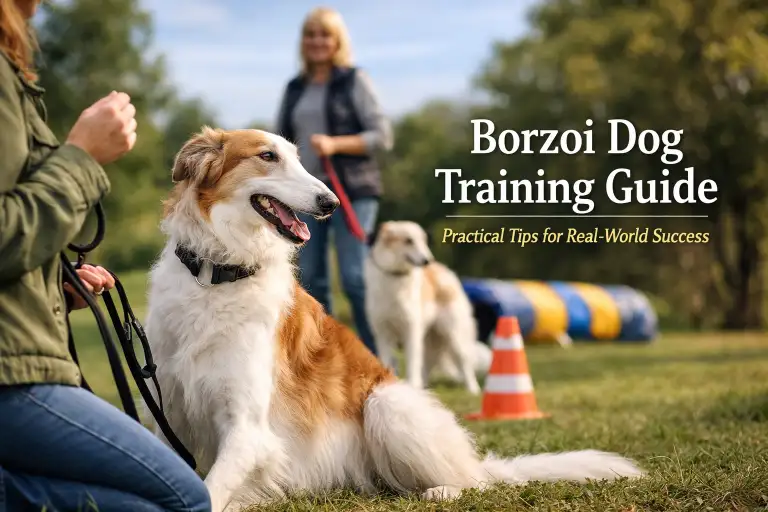
Training a Borzoi is not about turning them into a perfectly obedient dog that responds instantly to every command. It’s about building cooperation, safety, and reliability with a breed that was designed to think independently, move fast, and make decisions without human direction.
Recommended Dog Care Products
Based on your dog’s age, these products may help with comfort, health, grooming, and daily care.

Purina Pro Plan Veterinary Supplements
Daily probiotics for dogs to support digestive and gut health.
View on Amazon ↗
Earth Rated Poop Bags for Dogs
Leak-proof, extra thick waste bag refill rolls with lavender scent.
View on Amazon ↗
Greenies Pill Pockets for Dogs
Large dog treats for capsule medication, peanut butter flavor.
View on Amazon ↗
HONEY CARE All-Absorb Dog Wrap
Small male dog wraps, 50 count, useful for daily care support.
View on Amazon ↗
Seresto Flea & Tick Collar
Flea and tick treatment and prevention for dogs over 18 lbs.
View on Amazon ↗
Milk-Bone MaroSnacks
Small dog treats with real bone marrow in a 40 oz canister.
View on Amazon ↗
Vital Essentials Dog Treats
Freeze dried beef liver dog treats, grain free and single ingredient.
View on Amazon ↗
Stain & Odor Eliminator
Enzyme cleaner for pet stains, carpet messes, and strong odors.
View on Amazon ↗
Pur Luv Chicken Jerky Treats
Dog treats made with real chicken breast, high protein and chew-friendly.
View on Amazon ↗
Milk-Bone Flavor Snacks
Mini crunchy dog biscuits in a 36 oz canister for small rewards.
View on Amazon ↗As an Amazon Associate, we may earn from qualifying purchases.
Many Borzoi owners feel confused or discouraged early on. Their dog may seem calm indoors but ignore cues outside, freeze on leash, or suddenly chase movement with breathtaking speed. This often leads people to believe their Borzoi is stubborn, unmotivated, or “not trainable,” when in reality the issue is a mismatch between common dog training advice and how this breed actually learns.
This guide is designed to bridge that gap.
You’ll learn how to train a Borzoi using methods that respect their temperament, prey drive, and sensitivity while still creating practical, real-world skills like leash manners, recall foundations, impulse control, and calm handling. The focus is not on perfection, but on progress you can realistically achieve and maintain.
Whether you’re raising a Borzoi puppy, working with an adolescent who suddenly seems to forget everything, or helping an adult Borzoi adapt to a new home, this guide will give you clear expectations, science-backed strategies, and a training approach that works with the Borzoi mind instead of fighting against it.
Why Borzoi Training Is Different (And Why It Matters)
Borzoi are not difficult to train, but they are very different from many popular dog breeds. Most common training advice is written for dogs that were bred to work closely with people, repeat tasks, and wait for direction. Borzoi were bred for the opposite job.
This breed was developed to hunt by sight, not by instruction. A Borzoi sees movement, makes a decision, and acts fast. That ability is still strong today, even in family homes. Because of this, Borzoi do not respond well to pressure, force, or repeated drilling. These methods often lead to stress, shutdown, or a dog that simply walks away.
Training matters for Borzoi because of safety. They are large, fast, and powerful. A moment of chasing can turn dangerous near roads, wildlife, or other dogs. Reliable skills like leash manners, attention, and recall foundations help keep them safe, even if they are never fully off-leash reliable.
Training also matters for their emotional health. Borzoi are sensitive dogs. Harsh corrections, yelling, or pushing them into situations can cause fear or avoidance. Over time, this can lead to anxiety or a dog that refuses to engage at all. Calm, reward-based training helps Borzoi feel secure and willing to work with you.
Many owners struggle because they expect Borzoi to behave like Labradors or German Shepherds. When that does not happen, frustration builds on both sides. Understanding that Borzoi need a different approach is the first step toward successful training and a better relationship.
Recommended Dog Care Products
Based on your dog’s age, these products may help with comfort, health, grooming, and daily care.
Purina Pro Plan Veterinary Supplements
Daily probiotics for dogs to support digestive and gut health.
View on Amazon ↗
Earth Rated Poop Bags for Dogs
Leak-proof, extra thick waste bag refill rolls with lavender scent.
View on Amazon ↗
Greenies Pill Pockets for Dogs
Large dog treats for capsule medication, peanut butter flavor.
View on Amazon ↗
HONEY CARE All-Absorb Dog Wrap
Small male dog wraps, 50 count, useful for daily care support.
View on Amazon ↗
Seresto Flea & Tick Collar
Flea and tick treatment and prevention for dogs over 18 lbs.
View on Amazon ↗
Milk-Bone MaroSnacks
Small dog treats with real bone marrow in a 40 oz canister.
View on Amazon ↗
Vital Essentials Dog Treats
Freeze dried beef liver dog treats, grain free and single ingredient.
View on Amazon ↗
Stain & Odor Eliminator
Enzyme cleaner for pet stains, carpet messes, and strong odors.
View on Amazon ↗
Pur Luv Chicken Jerky Treats
Dog treats made with real chicken breast, high protein and chew-friendly.
View on Amazon ↗
Milk-Bone Flavor Snacks
Mini crunchy dog biscuits in a 36 oz canister for small rewards.
View on Amazon ↗As an Amazon Associate, we may earn from qualifying purchases.
Borzoi vs typical obedience breeds
| Trait | Borzoi | Typical obedience breeds |
|---|---|---|
| Work style | Independent decision-making | Handler-focused teamwork |
| Motivation | Movement, choice, selective food | Food, praise, repetition |
| Repetition tolerance | Low | Higher |
| Response to pressure | Often shuts down or avoids | May push through more easily |
| Recall risk outdoors | High due to prey drive | Usually more trainable over time |
Understanding Borzoi Behavior and Motivation
To train a Borzoi well, you must first understand how they think. Many training problems happen because owners expect Borzoi to behave like dogs that were bred to follow humans closely. Borzoi were bred to work on their own.
A Borzoi does not ignore you to be rude. Most of the time, they are choosing what feels safest or most interesting in that moment. Moving objects, open space, and new smells can pull their attention away very fast. Once their focus is gone, it is hard to get it back without calm planning.
Borzoi also learn differently. They do not enjoy repeating the same action many times. Too much repetition can make them bored or cause them to stop trying. Short training sessions with clear rewards work much better than long lessons.
Food can be a good reward, but it is not always enough. Many Borzoi are more motivated by movement, space, and choice. Letting them walk away, sniff, or rest can be just as rewarding as treats. This is why forcing commands often fails with this breed.
Borzoi are also sensitive to stress. Loud voices, fast movements, or strong corrections can cause them to shut down. A shut-down Borzoi may freeze, lie down, or refuse to move. This is not stubborn behavior. It is a sign that the dog feels overwhelmed.
Age also plays a role. Puppies are curious but easily distracted. Adolescents may test limits and chase more. Adult Borzoi may seem calm but still react strongly to sudden movement. Training should always match the dog’s age and comfort level.
Common Borzoi behaviors and what they often mean
| What you see | What it often means | Helpful next step |
|---|---|---|
| “Ignoring” a cue outside | Environment is too exciting | Move to a quieter spot and reward attention |
| Freezing on leash | Stress, uncertainty, or overwhelm | Pause, give space, lower difficulty |
| Walking away mid-session | Boredom or pressure | Shorten sessions, reward faster, add breaks |
| Sudden chasing | Prey drive triggered by movement | Use management, distance, and controlled practice |
| Lying down during training | Stress or shutdown | End session calmly and try easier steps later |
Step-by-Step Borzoi Training Method (Daily Life Skills)
This training method is made for real life, not perfect obedience. The goal is to build safety, calm behavior, and cooperation step by step.
Keep training short and simple. Most Borzoi learn best with sessions that last 5 to 10 minutes, one to three times a day. Stop before your dog gets bored or walks away. Ending early helps your Borzoi stay willing to train next time.
Recommended Dog Care Products
Based on your dog’s age, these products may help with comfort, health, grooming, and daily care.
Purina Pro Plan Veterinary Supplements
Daily probiotics for dogs to support digestive and gut health.
View on Amazon ↗
Earth Rated Poop Bags for Dogs
Leak-proof, extra thick waste bag refill rolls with lavender scent.
View on Amazon ↗
Greenies Pill Pockets for Dogs
Large dog treats for capsule medication, peanut butter flavor.
View on Amazon ↗
HONEY CARE All-Absorb Dog Wrap
Small male dog wraps, 50 count, useful for daily care support.
View on Amazon ↗
Seresto Flea & Tick Collar
Flea and tick treatment and prevention for dogs over 18 lbs.
View on Amazon ↗
Milk-Bone MaroSnacks
Small dog treats with real bone marrow in a 40 oz canister.
View on Amazon ↗
Vital Essentials Dog Treats
Freeze dried beef liver dog treats, grain free and single ingredient.
View on Amazon ↗
Stain & Odor Eliminator
Enzyme cleaner for pet stains, carpet messes, and strong odors.
View on Amazon ↗
Pur Luv Chicken Jerky Treats
Dog treats made with real chicken breast, high protein and chew-friendly.
View on Amazon ↗
Milk-Bone Flavor Snacks
Mini crunchy dog biscuits in a 36 oz canister for small rewards.
View on Amazon ↗As an Amazon Associate, we may earn from qualifying purchases.
Start with attention before commands. If your Borzoi is not looking at you or aware of you, asking for a command will not work. Reward eye contact, checking in, or calmly standing near you. This builds the habit of noticing you in different places.
Use real-life rewards, not just treats. Food is helpful, but Borzoi also value space, movement, and choice. Letting them sniff, walk forward, or rest can be powerful rewards. This makes training feel fair and natural to them.
Focus on these daily life skills first:
- Responding to their name
- Walking calmly on a leash without pulling or freezing
- Checking in with you during walks
- Learning to pause before chasing movement
- Accepting gentle handling for grooming and vet care
Keep training environments easy at first. Practice indoors or in quiet areas before moving to busy places. If your Borzoi fails, the situation is usually too hard, not the dog being stubborn.
Progress happens slowly with this breed. In the first few weeks, expect small changes, like better attention at home. After a few months, you may see calmer walks and safer choices. Reliable skills take time, and that is normal for Borzoi.
Daily Borzoi training plan
| Timeframe | Session length | What to practice | Where |
|---|---|---|---|
| Morning | 5–10 minutes | Name + attention + 1 easy skill | Indoors or quiet yard |
| Midday | 5 minutes | Leash skills (tiny steps) | Quiet street or driveway |
| Evening | 5–10 minutes | Check-ins + calm handling | Indoors |
| Walk time | Micro-moments | Reward loose leash + eye contact | On regular walks |
Common Borzoi Training Problems and When to Get Help
Many Borzoi owners worry that something is “wrong” when training feels hard. Most problems are normal for this breed and can be improved with the right approach.
One common issue is ignoring commands. This usually happens when the environment is too exciting or the command was taught with too much pressure. Go back to easier places and reward attention before asking for any skill.
Another problem is pulling or stopping on the leash. Borzoi may pull toward movement or freeze when they feel unsure. Keep walks calm, avoid tight leash pressure, and reward loose walking often. Do not drag or force them to move.
Recall problems are very common. Borzoi are driven by motion, and chasing is deeply natural for them. Many Borzoi are never fully safe off leash in open areas. Using long lines, fenced spaces, and strong management is not a failure. It is responsible ownership.
Recommended Dog Care Products
Based on your dog’s age, these products may help with comfort, health, grooming, and daily care.
Purina Pro Plan Veterinary Supplements
Daily probiotics for dogs to support digestive and gut health.
View on Amazon ↗
Earth Rated Poop Bags for Dogs
Leak-proof, extra thick waste bag refill rolls with lavender scent.
View on Amazon ↗
Greenies Pill Pockets for Dogs
Large dog treats for capsule medication, peanut butter flavor.
View on Amazon ↗
HONEY CARE All-Absorb Dog Wrap
Small male dog wraps, 50 count, useful for daily care support.
View on Amazon ↗
Seresto Flea & Tick Collar
Flea and tick treatment and prevention for dogs over 18 lbs.
View on Amazon ↗
Milk-Bone MaroSnacks
Small dog treats with real bone marrow in a 40 oz canister.
View on Amazon ↗
Vital Essentials Dog Treats
Freeze dried beef liver dog treats, grain free and single ingredient.
View on Amazon ↗
Stain & Odor Eliminator
Enzyme cleaner for pet stains, carpet messes, and strong odors.
View on Amazon ↗
Pur Luv Chicken Jerky Treats
Dog treats made with real chicken breast, high protein and chew-friendly.
View on Amazon ↗
Milk-Bone Flavor Snacks
Mini crunchy dog biscuits in a 36 oz canister for small rewards.
View on Amazon ↗As an Amazon Associate, we may earn from qualifying purchases.
Some Borzoi shut down during training. They may lie down, avoid eye contact, or refuse to move. This means the dog is stressed. Stop the session, give space, and lower your expectations next time.
Owner mistakes also cause trouble. Training for too long, repeating commands, using harsh corrections, or comparing Borzoi to other breeds often leads to frustration.
Get professional help if you see:
- Strong fear or panic
- Aggression during handling
- Ongoing anxiety that does not improve
- Complete refusal to engage with training
Look for trainers who understand sighthounds and use calm, reward-based methods. In some cases, a veterinarian may also need to check for pain or anxiety issues.
Quick troubleshooting (problem → cause → what to do)
| Problem | Likely cause | What to do next | When to get help |
|---|---|---|---|
| Dog “ignores” cues | Too much distraction | Train in easier places, reward check-ins | If it worsens with fear signs |
| Pulling | Movement triggers + excitement | Reward loose leash, add distance | If pulling becomes frantic or unsafe |
| Freezing | Stress or uncertainty | Pause, give space, lower difficulty | If freezing is frequent or extreme |
| Chasing | Prey drive | Long line + fenced areas + management | If chasing causes injuries or panic |
| Shutdown | Overwhelm or pressure | Stop, simplify, make sessions shorter | If shutdown is ongoing or severe |
For readers who want to learn more about the Borzoi breed’s background, temperament, and original purpose, you can explore the official breed overview from the American Kennel Club, which provides helpful context on why Borzoi behave the way they do and how that affects training.

Ata Ur Rehman is the founder of Pet Age in Human Years Calculator, an educational platform that provides age conversion charts and lifespan guides for dogs, cats, birds, and other companion animals. His work focuses on helping pet owners understand how animal ages translate into human years using commonly accepted age conversion formulas and published lifespan averages.
The website compiles breed and species lifespan data from kennel clubs, breed organizations, and general animal lifespan studies to present simple and easy-to-understand guides for pet owners worldwide.
This website was created to centralize animal age conversion charts into one easy reference platform for pet owners.