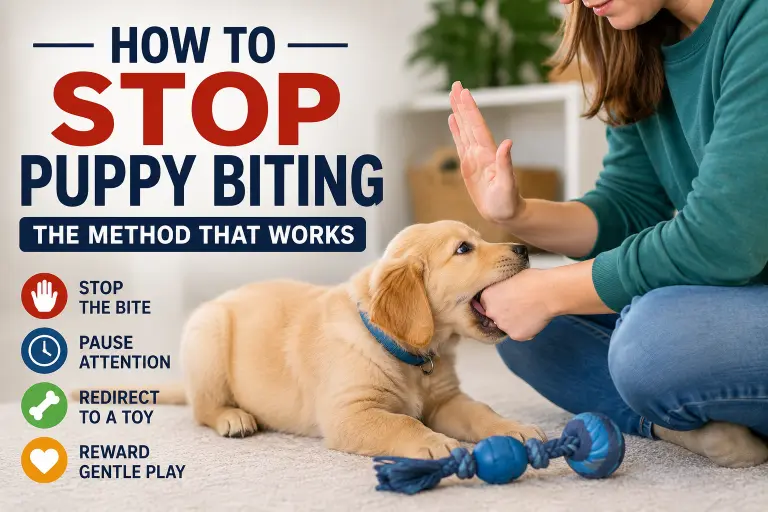
Puppy biting can quickly turn playtime into a frustrating experience. One minute your puppy is happily interacting with you, and the next they’re grabbing your hands, ankles, sleeves, or anything else they can reach.
Recommended Dog Care Products
Based on your dog’s age, these products may help with comfort, health, grooming, and daily care.

Purina Pro Plan Veterinary Supplements
Daily probiotics for dogs to support digestive and gut health.
View on Amazon ↗
Earth Rated Poop Bags for Dogs
Leak-proof, extra thick waste bag refill rolls with lavender scent.
View on Amazon ↗
Greenies Pill Pockets for Dogs
Large dog treats for capsule medication, peanut butter flavor.
View on Amazon ↗
HONEY CARE All-Absorb Dog Wrap
Small male dog wraps, 50 count, useful for daily care support.
View on Amazon ↗
Seresto Flea & Tick Collar
Flea and tick treatment and prevention for dogs over 18 lbs.
View on Amazon ↗
Milk-Bone MaroSnacks
Small dog treats with real bone marrow in a 40 oz canister.
View on Amazon ↗
Vital Essentials Dog Treats
Freeze dried beef liver dog treats, grain free and single ingredient.
View on Amazon ↗
Stain & Odor Eliminator
Enzyme cleaner for pet stains, carpet messes, and strong odors.
View on Amazon ↗
Pur Luv Chicken Jerky Treats
Dog treats made with real chicken breast, high protein and chew-friendly.
View on Amazon ↗
Milk-Bone Flavor Snacks
Mini crunchy dog biscuits in a 36 oz canister for small rewards.
View on Amazon ↗As an Amazon Associate, we may earn from qualifying purchases.
The good news is that most puppy biting is normal, and there is a proven way to reduce it. The goal is not simply to stop the behavior immediately. It’s to teach your puppy how hard is too hard and what they should do instead. This process is called bite inhibition, and it forms the foundation of effective puppy bite training.
In this guide, you’ll learn exactly what to do when your puppy bites, how to respond consistently, and how to help them develop gentler habits over time.
The Fast Answer: How to Stop Puppy Biting
If you’re looking for the method that works, here’s the short version:
- Stop interacting immediately when your puppy bites too hard.
- Remove your attention for a few seconds.
- Redirect them to an appropriate chew toy.
- Reward calm play and gentle mouth behavior.
- Repeat the same response every time.
This approach teaches two important lessons. First, biting people makes the fun stop. Second, chewing toys and playing gently keeps the fun going.
Many owners accidentally make puppy nipping worse by continuing to play, pushing the puppy away, or turning the situation into a game. Even negative attention can feel rewarding to an excited puppy.
The key is consistency. A puppy that receives the same response from every family member learns much faster than a puppy who receives mixed signals.
Don’t expect puppy biting to disappear overnight. Most puppies need time to develop self-control, especially during teething. What you should look for first is a gradual reduction in bite pressure and frequency.
Why Puppies Bite and Nip in the First Place
Understanding why puppies bite helps you respond correctly.
Puppies explore the world with their mouths in the same way young children use their hands. Biting, mouthing, and nipping are natural behaviors, especially during the first few months of life.
Recommended Dog Care Products
Based on your dog’s age, these products may help with comfort, health, grooming, and daily care.
Purina Pro Plan Veterinary Supplements
Daily probiotics for dogs to support digestive and gut health.
View on Amazon ↗
Earth Rated Poop Bags for Dogs
Leak-proof, extra thick waste bag refill rolls with lavender scent.
View on Amazon ↗
Greenies Pill Pockets for Dogs
Large dog treats for capsule medication, peanut butter flavor.
View on Amazon ↗
HONEY CARE All-Absorb Dog Wrap
Small male dog wraps, 50 count, useful for daily care support.
View on Amazon ↗
Seresto Flea & Tick Collar
Flea and tick treatment and prevention for dogs over 18 lbs.
View on Amazon ↗
Milk-Bone MaroSnacks
Small dog treats with real bone marrow in a 40 oz canister.
View on Amazon ↗
Vital Essentials Dog Treats
Freeze dried beef liver dog treats, grain free and single ingredient.
View on Amazon ↗
Stain & Odor Eliminator
Enzyme cleaner for pet stains, carpet messes, and strong odors.
View on Amazon ↗
Pur Luv Chicken Jerky Treats
Dog treats made with real chicken breast, high protein and chew-friendly.
View on Amazon ↗
Milk-Bone Flavor Snacks
Mini crunchy dog biscuits in a 36 oz canister for small rewards.
View on Amazon ↗As an Amazon Associate, we may earn from qualifying purchases.
Common reasons puppies bite include:
- Play and excitement
- Teething discomfort
- Seeking attention
- Overstimulation
- Fatigue from being awake too long
Many owners assume their puppy is being aggressive when they bite. In most cases, that’s not what’s happening. A playful puppy that repeatedly grabs hands or clothing is usually displaying normal puppy behavior, not aggression.
This distinction matters because the solution is teaching better behavior, not punishing the puppy.
Harsh corrections can create fear, confusion, or even defensive behavior. Bite inhibition training works because it teaches the puppy a practical skill: how to control the force of their mouth during interactions.
The Step-by-Step Puppy Bite Training Method
Step 1: End Interaction Immediately After a Hard Bite
The moment your puppy bites harder than you are willing to tolerate, stop interacting.
Stand up, pull your hands away calmly, and end the game. Avoid dramatic reactions or physical punishment. The goal is simply to remove the reward your puppy was enjoying.
For many puppies, the reward is your attention. When attention disappears immediately after a bite, they begin making the connection between biting and losing access to play.
Keep the pause brief. Usually 10 to 20 seconds is enough.
Step 2: Redirect to an Appropriate Chew Toy
After the short pause, offer an acceptable alternative.
A chew toy gives your puppy a way to satisfy their natural urge to bite and chew without using your hands or clothing.
Recommended Dog Care Products
Based on your dog’s age, these products may help with comfort, health, grooming, and daily care.
Purina Pro Plan Veterinary Supplements
Daily probiotics for dogs to support digestive and gut health.
View on Amazon ↗
Earth Rated Poop Bags for Dogs
Leak-proof, extra thick waste bag refill rolls with lavender scent.
View on Amazon ↗
Greenies Pill Pockets for Dogs
Large dog treats for capsule medication, peanut butter flavor.
View on Amazon ↗
HONEY CARE All-Absorb Dog Wrap
Small male dog wraps, 50 count, useful for daily care support.
View on Amazon ↗
Seresto Flea & Tick Collar
Flea and tick treatment and prevention for dogs over 18 lbs.
View on Amazon ↗
Milk-Bone MaroSnacks
Small dog treats with real bone marrow in a 40 oz canister.
View on Amazon ↗
Vital Essentials Dog Treats
Freeze dried beef liver dog treats, grain free and single ingredient.
View on Amazon ↗
Stain & Odor Eliminator
Enzyme cleaner for pet stains, carpet messes, and strong odors.
View on Amazon ↗
Pur Luv Chicken Jerky Treats
Dog treats made with real chicken breast, high protein and chew-friendly.
View on Amazon ↗
Milk-Bone Flavor Snacks
Mini crunchy dog biscuits in a 36 oz canister for small rewards.
View on Amazon ↗As an Amazon Associate, we may earn from qualifying purchases.
When redirecting:
- Keep chew toys within easy reach.
- Offer the toy as soon as interaction resumes.
- Encourage engagement with the toy rather than your hands.
If your puppy chooses the toy, continue playing. This helps them learn what behavior earns attention and interaction.
Step 3: Reward Calm Play and Gentle Mouth Behavior
Many owners focus entirely on correcting bites and forget to reinforce good behavior.
When your puppy plays without biting or uses a gentle mouth, reward that choice. Rewards can include:
- Praise
- Continued play
- Petting
- Occasional treats
This creates a clear message: gentle behavior leads to positive outcomes.
Over time, your puppy learns that calm interactions are more rewarding than rough ones.
Step 4: Repeat the Same Response Every Time
Consistency is what makes puppy bite training work.
If biting sometimes ends play and sometimes leads to more excitement, your puppy receives conflicting information. That slows learning and often makes the behavior harder to change.
Everyone in the household should follow the same process:
- Bite happens.
- Interaction stops.
- Short pause.
- Redirect to a toy.
- Reward gentle behavior.
The more predictable your response, the faster your puppy understands the rules.
Recommended Dog Care Products
Based on your dog’s age, these products may help with comfort, health, grooming, and daily care.
Purina Pro Plan Veterinary Supplements
Daily probiotics for dogs to support digestive and gut health.
View on Amazon ↗
Earth Rated Poop Bags for Dogs
Leak-proof, extra thick waste bag refill rolls with lavender scent.
View on Amazon ↗
Greenies Pill Pockets for Dogs
Large dog treats for capsule medication, peanut butter flavor.
View on Amazon ↗
HONEY CARE All-Absorb Dog Wrap
Small male dog wraps, 50 count, useful for daily care support.
View on Amazon ↗
Seresto Flea & Tick Collar
Flea and tick treatment and prevention for dogs over 18 lbs.
View on Amazon ↗
Milk-Bone MaroSnacks
Small dog treats with real bone marrow in a 40 oz canister.
View on Amazon ↗
Vital Essentials Dog Treats
Freeze dried beef liver dog treats, grain free and single ingredient.
View on Amazon ↗
Stain & Odor Eliminator
Enzyme cleaner for pet stains, carpet messes, and strong odors.
View on Amazon ↗
Pur Luv Chicken Jerky Treats
Dog treats made with real chicken breast, high protein and chew-friendly.
View on Amazon ↗
Milk-Bone Flavor Snacks
Mini crunchy dog biscuits in a 36 oz canister for small rewards.
View on Amazon ↗As an Amazon Associate, we may earn from qualifying purchases.
Some puppies improve within a few days. Others take several weeks. The timeline matters less than maintaining the same response every time the behavior occurs.
How to Use Bite Inhibition Training Effectively
Many owners try to stop all mouthing immediately. In practice, teaching bite inhibition usually works better than trying to eliminate every mouth contact from day one.
Bite inhibition means your puppy learns to control the pressure of their bite. A puppy that understands bite inhibition may still mouth occasionally during play, but they learn not to clamp down hard enough to hurt.
Think of it as a two-stage process:
- Teach your puppy that hard bites are unacceptable.
- Gradually encourage gentler and gentler mouth behavior until biting becomes rare.
This matters because puppies don’t naturally know how much pressure is too much. They learn through feedback from littermates, other dogs, and people.
When your puppy bites hard and play stops immediately, they learn that level of pressure is unacceptable. As they improve, you can become more selective and stop play for softer bites as well.
Focus on Bite Pressure Before Bite Frequency
One mistake many owners make is focusing only on how often their puppy bites.
A better approach is to watch whether the bites are becoming softer.
For example:
- Week one: hard, painful bites.
- Week two: less pressure but still frequent.
- Week three: gentle mouthing with occasional slips.
- Week four and beyond: significantly reduced biting overall.
A puppy that is learning to bite more softly is making progress, even if the behavior has not completely disappeared yet.
Avoid Mixed Messages
Bite inhibition training breaks down when family members respond differently.
If one person ends play after a bite but another continues wrestling or encouraging rough play, the puppy receives conflicting information.
Agree on a simple household rule:
Hard bites always make play stop.
This consistency helps puppies learn much faster.
Stay Calm During Training
Puppies often become more excited when people:
- Wave their hands around
- Shout
- Push them away repeatedly
- Chase them
- Turn biting into a game
A calm response is usually more effective.
The goal is not to punish your puppy. The goal is to clearly show them which behavior ends interaction and which behavior keeps it going.
Common Situations That Trigger Puppy Biting
Even puppies that are improving can have periods where biting suddenly gets worse.
Understanding common triggers helps you manage these situations without abandoning your training plan.
During Play Sessions
Play is one of the most common times for puppy nipping.
As excitement increases, many puppies become less controlled and start grabbing hands, sleeves, shoelaces, or pant legs.
When this happens:
- Pause the game immediately after hard bites.
- Give your puppy a chance to calm down.
- Resume play only when they’re engaging appropriately.
Short, structured play sessions often work better than long sessions that allow excitement to build too high.
When Puppies Become Overtired
An overtired puppy can behave a lot like an overtired child.
Many owners notice that biting becomes dramatically worse in the evening or after long periods of activity.
Signs your puppy may need rest include:
- Increased nipping
- Zoomies
- Difficulty settling down
- Ignoring cues they normally follow
In these situations, the solution may not be more training. Your puppy may simply need a nap or quiet time in a safe area.
During Teething Periods
Teething can make puppy biting more intense.
As adult teeth develop, puppies often experience discomfort that increases their desire to chew.
During this stage:
- Provide appropriate chew toys.
- Rotate toys to maintain interest.
- Continue using the same bite inhibition process.
Teething explains why biting may temporarily increase, but it doesn’t mean training should stop. Consistency during this period helps prevent bad habits from becoming established.
When to Expect Results and When to Get Extra Help
One of the most common questions owners ask is, “How long will this take?”
The answer depends on your puppy’s age, breed tendencies, energy level, and how consistently the training method is applied.
Most owners notice early improvement within a few weeks. The first signs of progress are usually:
- Softer bites
- Faster recovery after redirection
- More interest in chew toys
- Less frequent nipping during play
Complete improvement takes longer.
Young puppies are still developing impulse control, and teething can temporarily slow progress. It’s normal to see good days and bad days during the process.
Signs the Training Is Working
Look for these positive changes:
- Bite pressure decreases.
- Your puppy redirects more easily.
- Play sessions stay calmer for longer periods.
- Biting occurs less often than before.
Small improvements matter. Consistent progress is more important than immediate perfection.
When Professional Help May Be Needed
Most puppy biting is normal and improves with training.
However, consider speaking with a qualified trainer or behavior professional if:
- Biting becomes increasingly intense over time.
- Your puppy appears fearful or defensive when handling is attempted.
- The behavior is causing injuries.
- You are not seeing any improvement despite consistent training.
- You suspect the behavior involves aggression rather than normal puppy mouthing.
Getting help early can prevent a manageable problem from becoming more difficult later.
For most puppies, though, the combination of bite inhibition training, consistent responses, appropriate chew outlets, and patience is enough to significantly reduce biting and create safer, more enjoyable interactions with people.
Conclusion
If you’re wondering how to stop puppy biting, the most effective approach is not punishment—it’s teaching your puppy what behavior is acceptable.
The method is simple:
- End play immediately after hard bites.
- Remove attention briefly.
- Redirect to an appropriate chew toy.
- Reward gentle behavior.
- Stay consistent every time.
Most puppies bite because they’re playing, teething, exploring, or becoming overstimulated. That’s why the goal isn’t just stopping the behavior in the moment. It’s helping your puppy develop bite inhibition and better self-control over time.
Progress usually happens gradually. First, bites become softer. Then they become less frequent. Eventually, your puppy learns that gentle play gets attention while biting does not.
If everyone in the household follows the same rules and responds consistently, you’ll give your puppy the best chance to outgrow the habit and develop good manners that last into adulthood.
Frequently Asked Questions
How long does it take to stop puppy biting?
Most puppies begin showing improvement within a few weeks of consistent training. The exact timeline depends on age, teething stage, energy level, and how consistently everyone responds to biting. Complete improvement often takes several months as puppies mature and develop better impulse control.
Should I yell when my puppy bites me?
No. Yelling can confuse some puppies or even make highly excitable puppies more energetic. A calm, immediate response—ending interaction and briefly removing attention—is usually more effective than shouting or harsh corrections.
Is puppy nipping normal?
Yes. Puppy nipping is a normal part of development. Puppies use their mouths to explore, play, and interact with the world around them. The goal of training is not to punish normal behavior but to teach appropriate bite pressure and better habits.
What age do puppies usually stop biting?
Many puppies show significant improvement between 4 and 7 months of age as teething ends and training begins to take effect. Some high-energy puppies may take longer, especially if they haven’t received consistent bite inhibition training.
Why is my puppy biting harder instead of improving?
Temporary setbacks are common. Teething discomfort, overtiredness, overstimulation, and inconsistent responses from family members can all make biting seem worse. If the behavior is becoming progressively more intense despite consistent training, consider consulting a qualified trainer or behavior professional.