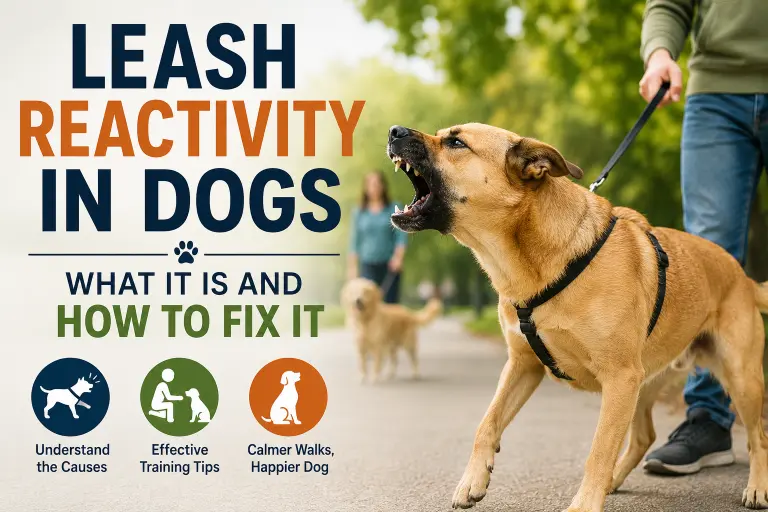
Leash Reactivity in Dogs: What It Is and How to Fix It
If your dog barks, lunges, growls, or seems impossible to control whenever another dog, person, bicycle, or vehicle appears during a walk, you’re likely dealing with leash reactivity.
Recommended Dog Care Products
Based on your dog’s age, these products may help with comfort, health, grooming, and daily care.

Purina Pro Plan Veterinary Supplements
Daily probiotics for dogs to support digestive and gut health.
View on Amazon ↗
Earth Rated Poop Bags for Dogs
Leak-proof, extra thick waste bag refill rolls with lavender scent.
View on Amazon ↗
Greenies Pill Pockets for Dogs
Large dog treats for capsule medication, peanut butter flavor.
View on Amazon ↗
HONEY CARE All-Absorb Dog Wrap
Small male dog wraps, 50 count, useful for daily care support.
View on Amazon ↗
Seresto Flea & Tick Collar
Flea and tick treatment and prevention for dogs over 18 lbs.
View on Amazon ↗
Milk-Bone MaroSnacks
Small dog treats with real bone marrow in a 40 oz canister.
View on Amazon ↗
Vital Essentials Dog Treats
Freeze dried beef liver dog treats, grain free and single ingredient.
View on Amazon ↗
Stain & Odor Eliminator
Enzyme cleaner for pet stains, carpet messes, and strong odors.
View on Amazon ↗
Pur Luv Chicken Jerky Treats
Dog treats made with real chicken breast, high protein and chew-friendly.
View on Amazon ↗
Milk-Bone Flavor Snacks
Mini crunchy dog biscuits in a 36 oz canister for small rewards.
View on Amazon ↗As an Amazon Associate, we may earn from qualifying purchases.
This behavior can be frustrating and embarrassing, especially when your dog seems perfectly friendly in other situations. Many owners worry their dog has become aggressive, but that’s not always the case.
Leash reactivity is often a response to excitement, frustration, fear, or anxiety that becomes more intense when a dog is restrained by a leash. The good news is that understanding the cause is the first step toward improving the behavior.
In this guide, you’ll learn what leash reactivity in dogs actually is, how it differs from aggression, what causes it, and the training strategies that can help your dog stay calmer on walks.
What Is Leash Reactivity in Dogs?
Leash reactivity in dogs refers to an exaggerated response to a trigger while on a leash. The trigger could be another dog, a person, a jogger, a bicycle, a car, or anything else that causes the dog to become highly aroused.
Common signs of a leash reactive dog include:
- Barking repeatedly at triggers
- Lunging forward on the leash
- Growling or snarling
- Pulling intensely toward or away from something
- Spinning, jumping, or becoming difficult to redirect
- Fixating on a trigger and ignoring the handler
One important detail is that many reactive dogs do not display the same behavior when they are not on a leash. A dog may greet other dogs politely at daycare or in a fenced area but become reactive during walks.
This happens because the leash changes how a dog experiences a situation. Being restrained can create frustration when a dog wants to approach something, or it can make a dog feel trapped when something feels threatening. In both cases, the reaction becomes stronger because the dog cannot freely move away or investigate.
For example, a dog that loves meeting other dogs may start barking and pulling whenever one appears. To an owner, this can look aggressive. In reality, the dog may simply be frustrated because the leash prevents interaction.
On the other hand, a fearful dog may lunge and bark because it wants to create distance from something that makes it uncomfortable.
Recommended Dog Care Products
Based on your dog’s age, these products may help with comfort, health, grooming, and daily care.
Purina Pro Plan Veterinary Supplements
Daily probiotics for dogs to support digestive and gut health.
View on Amazon ↗
Earth Rated Poop Bags for Dogs
Leak-proof, extra thick waste bag refill rolls with lavender scent.
View on Amazon ↗
Greenies Pill Pockets for Dogs
Large dog treats for capsule medication, peanut butter flavor.
View on Amazon ↗
HONEY CARE All-Absorb Dog Wrap
Small male dog wraps, 50 count, useful for daily care support.
View on Amazon ↗
Seresto Flea & Tick Collar
Flea and tick treatment and prevention for dogs over 18 lbs.
View on Amazon ↗
Milk-Bone MaroSnacks
Small dog treats with real bone marrow in a 40 oz canister.
View on Amazon ↗
Vital Essentials Dog Treats
Freeze dried beef liver dog treats, grain free and single ingredient.
View on Amazon ↗
Stain & Odor Eliminator
Enzyme cleaner for pet stains, carpet messes, and strong odors.
View on Amazon ↗
Pur Luv Chicken Jerky Treats
Dog treats made with real chicken breast, high protein and chew-friendly.
View on Amazon ↗
Milk-Bone Flavor Snacks
Mini crunchy dog biscuits in a 36 oz canister for small rewards.
View on Amazon ↗As an Amazon Associate, we may earn from qualifying purchases.
The behavior may look similar, but the underlying motivation can be very different. That’s why identifying the cause of leash reactivity is so important before starting training.
Is Your Dog Reactive or Aggressive?
Many owners use the terms “reactive” and “aggressive” interchangeably, but they are not the same thing.
A reactive dog has an intense emotional response to a trigger. The barking, lunging, or growling is often driven by excitement, frustration, fear, or overstimulation.
An aggressive dog is actively attempting to threaten, intimidate, or harm another person or animal.
The challenge is that reactive behavior can look aggressive from a distance. A dog lunging on leash while barking loudly may appear dangerous even if its goal is not to attack.
Some signs that point toward reactivity rather than aggression include:
- The behavior occurs mainly on leash
- The dog calms down once distance is created
- The dog is friendly in off-leash settings
- Reactions are linked to specific triggers
- The dog appears overstimulated rather than intent on causing harm
However, there is not always a clear line between the two. Some dogs are both reactive and aggressive, while others may become aggressive if their warnings are ignored or their stress levels continue to rise.
Instead of focusing solely on labels, pay attention to patterns:
- What triggers the reaction?
- How intense is the response?
- Does your dog recover quickly afterward?
- Is the behavior getting better, worse, or staying the same?
If your dog’s reactions involve attempts to bite, repeated escalation, or create safety concerns for people or other animals, professional help from a qualified trainer or behavior professional is recommended.
For most dogs, though, leash reactivity is a behavior issue that can improve significantly when the underlying cause is identified and addressed through training.
Recommended Dog Care Products
Based on your dog’s age, these products may help with comfort, health, grooming, and daily care.
Purina Pro Plan Veterinary Supplements
Daily probiotics for dogs to support digestive and gut health.
View on Amazon ↗
Earth Rated Poop Bags for Dogs
Leak-proof, extra thick waste bag refill rolls with lavender scent.
View on Amazon ↗
Greenies Pill Pockets for Dogs
Large dog treats for capsule medication, peanut butter flavor.
View on Amazon ↗
HONEY CARE All-Absorb Dog Wrap
Small male dog wraps, 50 count, useful for daily care support.
View on Amazon ↗
Seresto Flea & Tick Collar
Flea and tick treatment and prevention for dogs over 18 lbs.
View on Amazon ↗
Milk-Bone MaroSnacks
Small dog treats with real bone marrow in a 40 oz canister.
View on Amazon ↗
Vital Essentials Dog Treats
Freeze dried beef liver dog treats, grain free and single ingredient.
View on Amazon ↗
Stain & Odor Eliminator
Enzyme cleaner for pet stains, carpet messes, and strong odors.
View on Amazon ↗
Pur Luv Chicken Jerky Treats
Dog treats made with real chicken breast, high protein and chew-friendly.
View on Amazon ↗
Milk-Bone Flavor Snacks
Mini crunchy dog biscuits in a 36 oz canister for small rewards.
View on Amazon ↗As an Amazon Associate, we may earn from qualifying purchases.
What Causes Leash Reactivity?
Leash reactivity is not a single behavior with a single cause. Two dogs may show the exact same barking and lunging behavior for completely different reasons.
Understanding why your dog reacts is essential because the most effective training approach depends on the underlying cause.
Frustration and Excitement
Some dogs genuinely enjoy interacting with other dogs, people, or interesting sights during walks. The problem starts when the leash prevents them from getting what they want.
Imagine a dog that sees another dog across the street and wants to greet it. The leash restricts movement, excitement builds, and frustration follows. The dog may start pulling, whining, barking, or lunging in an attempt to reach the trigger.
Owners often assume this behavior is aggression because it looks intense. In reality, the dog may simply be overexcited.
Common signs of frustration-based reactivity include:
- Pulling toward the trigger
- Playful or excited body language before reacting
- Strong interest in greeting others
- Friendly behavior once interaction occurs
Fear or Anxiety Around Dogs or People
For many leash reactive dogs, fear is the driving force.
When a dog feels uncomfortable around a person, dog, or situation, creating distance becomes the priority. However, a leash limits movement and escape options. As a result, the dog may bark, growl, or lunge to make the trigger move away.
From the dog’s perspective, the behavior works. If the other dog continues walking past or moves away, the reactive dog may learn that barking successfully removed the threat.
Signs that fear may be contributing to leash reactivity include:
Recommended Dog Care Products
Based on your dog’s age, these products may help with comfort, health, grooming, and daily care.
Purina Pro Plan Veterinary Supplements
Daily probiotics for dogs to support digestive and gut health.
View on Amazon ↗
Earth Rated Poop Bags for Dogs
Leak-proof, extra thick waste bag refill rolls with lavender scent.
View on Amazon ↗
Greenies Pill Pockets for Dogs
Large dog treats for capsule medication, peanut butter flavor.
View on Amazon ↗
HONEY CARE All-Absorb Dog Wrap
Small male dog wraps, 50 count, useful for daily care support.
View on Amazon ↗
Seresto Flea & Tick Collar
Flea and tick treatment and prevention for dogs over 18 lbs.
View on Amazon ↗
Milk-Bone MaroSnacks
Small dog treats with real bone marrow in a 40 oz canister.
View on Amazon ↗
Vital Essentials Dog Treats
Freeze dried beef liver dog treats, grain free and single ingredient.
View on Amazon ↗
Stain & Odor Eliminator
Enzyme cleaner for pet stains, carpet messes, and strong odors.
View on Amazon ↗
Pur Luv Chicken Jerky Treats
Dog treats made with real chicken breast, high protein and chew-friendly.
View on Amazon ↗
Milk-Bone Flavor Snacks
Mini crunchy dog biscuits in a 36 oz canister for small rewards.
View on Amazon ↗As an Amazon Associate, we may earn from qualifying purchases.
- Backing away before reacting
- Tense body posture
- Tail tucked or held low
- Avoiding eye contact before suddenly barking
- Increased reactions in unfamiliar environments
Fear-based reactivity often requires patience because the goal is not simply to stop the behavior but to change the dog’s emotional response to triggers.
Lack of Social Exposure or Previous Negative Experiences
Some dogs become reactive because they have limited experience with the situations they encounter on walks.
A dog that rarely sees bicycles, crowds, or unfamiliar dogs may struggle to remain calm when suddenly exposed to them. Without positive experiences to build confidence, uncertainty can lead to reactive behavior.
Past negative experiences can also contribute. A dog that has been frightened, attacked, cornered, or repeatedly overwhelmed may begin anticipating future problems whenever similar triggers appear.
Not every reactive dog has experienced trauma, but previous experiences often influence how dogs interpret situations during walks.
The important takeaway is that leash reactivity is usually a symptom of an underlying emotional response. Effective reactive dog training focuses on addressing that response rather than simply suppressing the outward behavior.
How to Fix Leash Reactivity in Dogs
Improving leash reactivity takes consistency, but most dogs make progress when owners focus on changing the dog’s emotional response instead of trying to force obedience around triggers.
The goal is not to make your dog ignore the world. The goal is to teach your dog that seeing a trigger predicts something positive and does not require an explosive reaction.
Manage Distance From Triggers
Distance is one of the most powerful tools in reactive dog training.
Many owners unknowingly place their dogs too close to triggers, making learning impossible. Once a dog is barking, lunging, and fully aroused, it is no longer in a good position to learn new behaviors.
Instead, identify the distance where your dog notices a trigger but can still remain relatively calm.
This is often called staying “under threshold.”
For example:
- If your dog reacts at 20 feet from another dog, start training at 50 or 60 feet.
- If your dog reacts when someone passes on the same sidewalk, create more space by crossing the street.
Training becomes much more effective when your dog is capable of paying attention.
Teach Attention and Engagement Skills
Before asking your dog to handle difficult situations, teach simple skills that encourage engagement with you.
Useful foundation behaviors include:
- Looking at you when their name is called
- Making eye contact on cue
- Following a hand target
- Walking calmly beside you for short periods
- Checking in voluntarily during walks
Practice these skills in low-distraction environments first.
When they become reliable, you can gradually use them around mild triggers. The goal is not to distract your dog forever but to give them a clear alternative behavior when something exciting or concerning appears.
Use Reward-Based Counterconditioning
Counterconditioning is one of the most effective ways to reduce leash reactivity.
The process is simple:
- Your dog notices a trigger.
- You immediately provide a high-value reward.
- The trigger disappears or passes.
- The pattern repeats consistently.
Over time, the dog begins associating the trigger with positive outcomes instead of frustration or anxiety.
For example, every time another dog appears at a comfortable distance, your dog receives a favorite treat. Eventually, seeing another dog starts predicting rewards rather than stress.
Timing matters. Rewards should be delivered while the trigger is visible and before your dog escalates into barking or lunging.
Increase Difficulty Gradually
One of the biggest mistakes owners make is progressing too quickly.
A dog that remains calm at 60 feet from another dog is not necessarily ready to work at 10 feet.
Successful reactive dog training involves gradual exposure:
- Start with easy situations.
- Reduce distance slowly.
- Introduce slightly more challenging environments.
- Continue rewarding calm behavior.
If your dog begins reacting frequently again, it usually means the training setup has become too difficult. Move back to an easier level and rebuild success.
Progress is rarely perfectly linear. Some days will be better than others. Consistent practice, realistic expectations, and gradual increases in difficulty produce far better results than trying to force rapid improvement.
What to Do During a Reactive Episode on a Walk
Even with a solid training plan, reactive episodes will happen. A dog may be surprised by a trigger around a corner, encounter an off-leash dog, or simply have an off day.
What you do in these moments can help prevent the situation from escalating further.
Create Distance Immediately
Distance is usually the fastest way to reduce the intensity of a reaction.
If possible:
- Turn and walk in the opposite direction
- Cross the street
- Step behind a parked car or visual barrier
- Move into a driveway or open area
The goal is not to avoid training. The goal is to help your dog regain enough composure to think and respond.
Stay Calm and Avoid Escalating the Situation
Dogs often feed off their handler’s tension.
Yelling, leash jerks, or repeated corrections can increase stress and frustration, making the reaction stronger.
Instead:
- Keep your voice calm
- Move confidently away from the trigger
- Focus on helping your dog recover
A reactive episode is not a training failure. It’s information that the situation exceeded your dog’s current skill level.
Redirect Once Your Dog Can Think Again
After creating enough distance, try redirecting your dog’s attention with a familiar behavior.
Examples include:
- Responding to their name
- Making eye contact
- Following a hand target
- Finding treats scattered on the ground
If your dog cannot respond to simple cues, more distance is probably needed.
Avoid Common Mistakes
During a reactive episode, avoid:
- Forcing your dog closer to the trigger
- Punishing barking or lunging
- Tightening the leash excessively
- Continuing to approach when your dog is clearly overwhelmed
The immediate goal is recovery, not perfection. Once your dog calms down, you can continue the walk or end the session if needed.
How Long Does It Take to Improve Leash Reactivity?
There is no universal timeline because leash reactivity varies widely between dogs.
Some dogs show noticeable improvement within a few weeks of consistent training. Others may require several months of structured work before significant changes become obvious.
Progress depends on factors such as:
- The underlying cause of the reactivity
- How long the behavior has existed
- The intensity of reactions
- Training consistency
- Exposure to triggers
- The dog’s overall temperament
Rather than focusing on a specific deadline, look for smaller signs of progress:
- Recovering faster after seeing a trigger
- Responding to cues more reliably
- Remaining calm at shorter distances
- Checking in with you more often during walks
- Showing less barking and lunging overall
These improvements often appear before the reactive behavior disappears completely.
It’s also important to understand that improvement does not always mean a complete cure. Some dogs may always be more sensitive to certain triggers than others. However, many leash reactive dogs can learn to walk calmly and safely in situations that once caused major reactions.
Consistency matters more than speed. A steady training plan practiced over time will almost always outperform short periods of intensive training followed by long gaps.
Frequently Asked Questions
Can leash reactivity be completely cured?
Some dogs eventually stop reacting altogether, while others continue to need management around specific triggers. The goal of training is to reduce reactions, improve emotional responses, and make walks more manageable. Many dogs achieve significant improvement even if they never become completely indifferent to every trigger.
Why is my dog friendly off leash but reactive on leash?
This is common in dogs with frustration-based leash reactivity. Off leash, they can move freely and interact naturally. On leash, the restriction creates frustration, which can lead to barking, pulling, and lunging.
Should I correct or punish a dog for lunging on leash?
Punishment may suppress behavior temporarily, but it often fails to address the underlying emotion driving the reaction. In some cases, it can increase fear, anxiety, or frustration. Reward-based training is generally more effective for long-term improvement.
How often should I train a leash reactive dog?
Short, consistent sessions usually work best. Practicing several times per week, or incorporating training into regular walks, often produces better results than occasional long sessions.
When should I seek help from a professional trainer?
Consider professional guidance if:
- Your dog attempts to bite people or animals
- Reactions are becoming more intense over time
- You feel unsafe handling your dog
- Training progress has stalled despite consistent effort
A qualified trainer or behavior professional can identify underlying causes and help create a plan tailored to your dog’s specific needs.
Final Thoughts
Leash reactivity in dogs can be frustrating, but it is often more manageable than many owners initially believe.
The key is understanding that barking, lunging, and overreacting on walks are usually symptoms of an underlying emotional response rather than simple disobedience. Whether the cause is frustration, excitement, fear, or anxiety, lasting improvement comes from addressing the reason behind the behavior.
Focus on creating distance when needed, rewarding calm responses, and progressing at a pace your dog can handle. Small improvements add up over time, and consistent reactive dog training can transform stressful walks into far more enjoyable experiences for both you and your dog.

Ata Ur Rehman is the founder of Pet Age in Human Years Calculator, an educational platform that provides age conversion charts and lifespan guides for dogs, cats, birds, and other companion animals. His work focuses on helping pet owners understand how animal ages translate into human years using commonly accepted age conversion formulas and published lifespan averages.
The website compiles breed and species lifespan data from kennel clubs, breed organizations, and general animal lifespan studies to present simple and easy-to-understand guides for pet owners worldwide.
This website was created to centralize animal age conversion charts into one easy reference platform for pet owners.