Pug Age Chart: Quick Human Years Answer
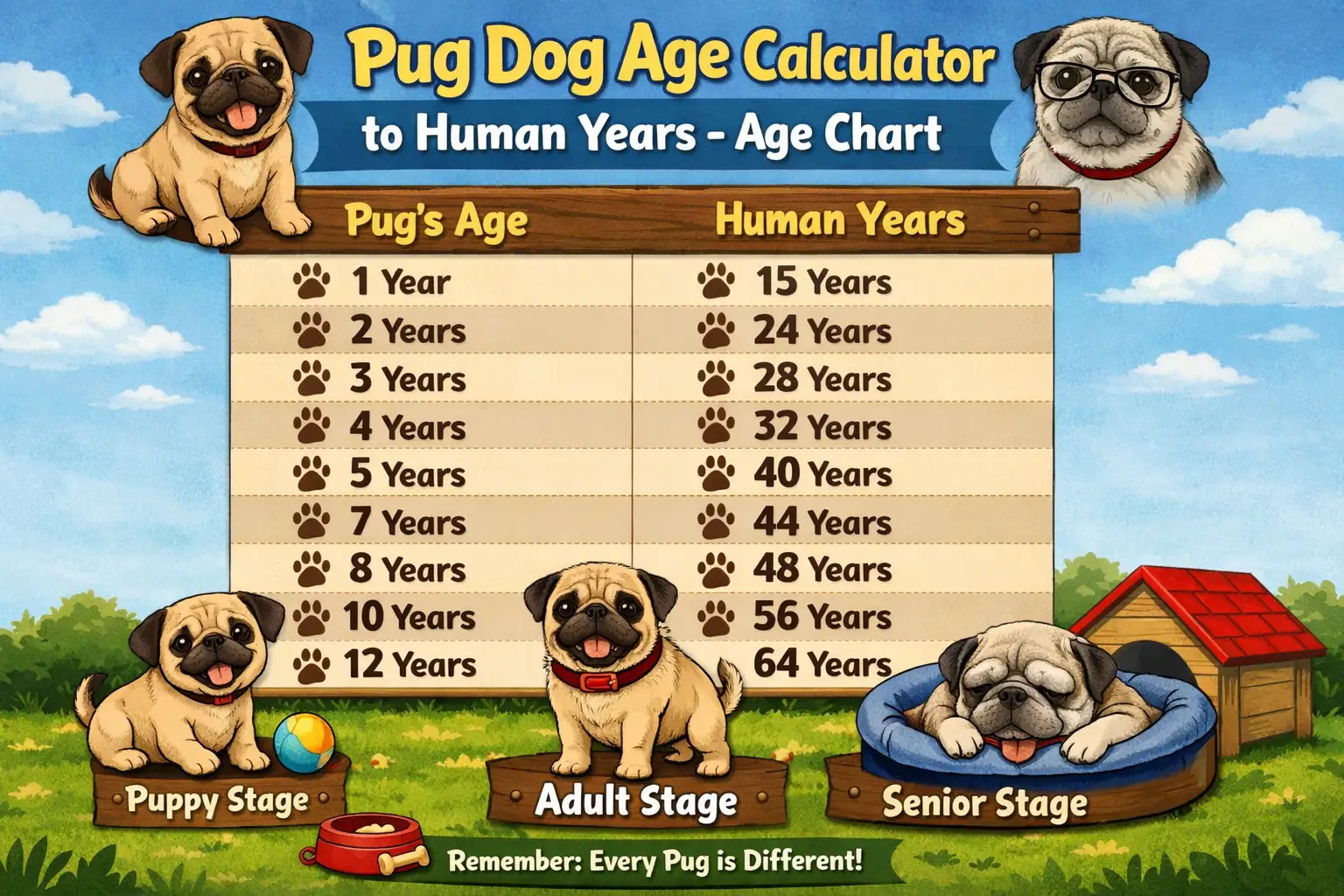
If you want a fast estimate, this Pug age chart shows the most common Pug years to human years conversions:
Recommended Dog Care Products
Based on your dog’s age, these products may help with comfort, health, grooming, and daily care.

Purina Pro Plan Veterinary Supplements
Daily probiotics for dogs to support digestive and gut health.
View on Amazon ↗
Earth Rated Poop Bags for Dogs
Leak-proof, extra thick waste bag refill rolls with lavender scent.
View on Amazon ↗
Greenies Pill Pockets for Dogs
Large dog treats for capsule medication, peanut butter flavor.
View on Amazon ↗
HONEY CARE All-Absorb Dog Wrap
Small male dog wraps, 50 count, useful for daily care support.
View on Amazon ↗
Seresto Flea & Tick Collar
Flea and tick treatment and prevention for dogs over 18 lbs.
View on Amazon ↗
Milk-Bone MaroSnacks
Small dog treats with real bone marrow in a 40 oz canister.
View on Amazon ↗
Vital Essentials Dog Treats
Freeze dried beef liver dog treats, grain free and single ingredient.
View on Amazon ↗
Stain & Odor Eliminator
Enzyme cleaner for pet stains, carpet messes, and strong odors.
View on Amazon ↗
Pur Luv Chicken Jerky Treats
Dog treats made with real chicken breast, high protein and chew-friendly.
View on Amazon ↗
Milk-Bone Flavor Snacks
Mini crunchy dog biscuits in a 36 oz canister for small rewards.
View on Amazon ↗As an Amazon Associate, we may earn from qualifying purchases.
- 1-year-old Pug ≈ 15 human years
- 2-year-old Pug ≈ 24 human years
- 5-year-old Pug ≈ 36 human years
- 10-year-old Pug ≈ 56 human years
This is more accurate than the old “1 dog year = 7 human years” rule because Pugs mature very quickly in the first two years, then age more gradually as adults.
If you’ve ever wondered how old your Pug is in human years, this chart gives you a simple age-by-age estimate. A 1-year-old Pug is about 15 human years, while a 2-year-old Pug is about 24 human years. After age two, each year adds fewer human years because Pug aging slows down.
This Pug age to human years chart is designed for quick reference. For an instant result based on your dog’s exact age, use our Pug Age Calculator.
The chart below gives a simple human-age estimate for each Pug age, from early puppy growth to the senior years.
If you’re new to the breed and want more background on Pug traits, size, temperament, and care needs, you can also read our Pug dog breed guide.
How Pug Age Is Calculated
| Pug Age Range | Aging Speed | Human Age Comparison |
|---|---|---|
| 0–1 year | Very rapid growth | From infancy to teenage years |
| 1–2 years | Fast maturation | Late teens to early adulthood |
| 3+ years | Gradual aging | Steady adult aging |
In the first year of life, a Pug matures very quickly, both physically and developmentally. By age one, many Pugs are already comparable to a human teenager. By age two, a Pug is closer to a young adult human. After that, aging becomes more gradual.
Why Pug Aging Is Different from Other Dogs
Pugs are small, brachycephalic dogs, so their aging pattern is not the same as every breed. Large dogs often age faster in their later years, while smaller breeds like Pugs usually age more gradually after early adulthood. This is why a breed-specific Pug age chart is more useful than a simple 7-year rule.
This makes the chart more useful for understanding your Pug’s life stage, not just the human-age number.
Pug Age in Months Before the First Year
Many Pug owners search by months, especially during puppyhood. The main Pug age chart starts at 1 year, but the first 12 months are still important because Pugs develop quickly during this stage.
Recommended Dog Care Products
Based on your dog’s age, these products may help with comfort, health, grooming, and daily care.
Purina Pro Plan Veterinary Supplements
Daily probiotics for dogs to support digestive and gut health.
View on Amazon ↗
Earth Rated Poop Bags for Dogs
Leak-proof, extra thick waste bag refill rolls with lavender scent.
View on Amazon ↗
Greenies Pill Pockets for Dogs
Large dog treats for capsule medication, peanut butter flavor.
View on Amazon ↗
HONEY CARE All-Absorb Dog Wrap
Small male dog wraps, 50 count, useful for daily care support.
View on Amazon ↗
Seresto Flea & Tick Collar
Flea and tick treatment and prevention for dogs over 18 lbs.
View on Amazon ↗
Milk-Bone MaroSnacks
Small dog treats with real bone marrow in a 40 oz canister.
View on Amazon ↗
Vital Essentials Dog Treats
Freeze dried beef liver dog treats, grain free and single ingredient.
View on Amazon ↗
Stain & Odor Eliminator
Enzyme cleaner for pet stains, carpet messes, and strong odors.
View on Amazon ↗
Pur Luv Chicken Jerky Treats
Dog treats made with real chicken breast, high protein and chew-friendly.
View on Amazon ↗
Milk-Bone Flavor Snacks
Mini crunchy dog biscuits in a 36 oz canister for small rewards.
View on Amazon ↗As an Amazon Associate, we may earn from qualifying purchases.
| Pug Age in Months | Development Stage | What You May Notice |
|---|---|---|
| 0–2 months | Infancy | Very small, dependent, learning basic comfort and routine |
| 2–4 months | Early puppy stage | Curious, teething begins, short attention span, early training starts |
| 4–6 months | Growing puppy stage | More confident, stronger play, learning commands and boundaries |
| 6–9 months | Pre-teen stage | More energy, testing limits, consistent training becomes important |
| 9–12 months | Teen stage | Near adult size, stronger personality, more adult-like behavior |
Tip: Once your Pug reaches 1 year old, use the main chart below for a clearer human-age estimate and life-stage label.
Pug Age to Human Years Chart
This Pug age to human years chart gives you a quick way to understand how old your Pug is in human terms. Instead of using the outdated 7-year rule, the chart reflects how Pugs age quickly early in life and then more gradually after adulthood.
Find your Pug’s age in the first column, then check the estimated human age and life stage. For a more exact result, you can also calculate your Pug’s age in human years using the dedicated calculator.
Pug Age Chart by Year
| Pug Age | Human Age Equivalent | Life Stage |
|---|---|---|
| 1 year | About 15 years | Puppy / adolescent |
| 2 years | About 24 years | Young adult |
| 3 years | About 28 years | Adult |
| 4 years | About 32 years | Adult |
| 5 years | About 36 years | Adult |
| 6 years | About 40 years | Mature adult |
| 7 years | About 44 years | Mature adult |
| 8 years | About 48 years | Mature |
| 9 years | About 52 years | Mature |
| 10 years | About 56 years | Senior |
| 11 years | About 60 years | Senior |
| 12 years | About 64 years | Senior |
| 13 years | About 68 years | Senior |
| 14 years | About 72 years | Senior |
| 15 years | About 76 years | Senior |
| 16 years | About 80 years | Senior |
This chart shows the most important aging pattern for Pugs: the first two years count heavily, and later years add more gradually. That is why a 2-year-old Pug is already close to a young adult human, while a 10-year-old Pug is usually in the senior stage.
What Each Pug Age Usually Means
- 1–2 years: fast maturity, high energy, and more adult-like behavior
- 3–7 years: stable adult years, steady routine, and balanced energy
- 8–9 years: mature stage, more rest time, and slower recovery after activity
- 10+ years: senior stage, possible stiffness, more sleep, and more important vet checkups
Remember, this Pug age chart is an estimate. Weight, diet, activity level, breathing health, and overall care can affect how quickly an individual Pug seems to age.
Note: This chart is useful for understanding your Pug’s life stage, but it should not replace veterinary advice. For sudden changes in energy, breathing, mobility, appetite, or behavior, speak with your veterinarian.
Why the 7-Year Rule Does Not Work for Pugs
The old “1 dog year = 7 human years” rule does not work well for Pugs because dogs do not age at the same speed every year. Pugs mature very quickly during the first two years, then their aging becomes more gradual as adults.
| Pug Age | 7-Year Rule | Pug Age Chart |
|---|---|---|
| 1 year | 7 human years | About 15 human years |
| 2 years | 14 human years | About 24 human years |
| 10 years | 70 human years | About 56 human years |
The biggest difference happens in the early years. A 2-year-old Pug is not like a 14-year-old human. In most age charts, a 2-year-old Pug is closer to a young adult human, around 24 human years.
This is why a Pug age chart is more helpful than a fixed multiplier. It gives a better estimate of your Pug’s real life stage instead of assuming every dog ages the same way.
Pug Age FAQs
How old is a Pug in human years?
A Pug’s age in human years depends on its life stage. In general, a 1-year-old Pug is about 15 human years, and a 2-year-old Pug is about 24 human years. After age two, Pugs age more gradually each year.
Recommended Dog Care Products
Based on your dog’s age, these products may help with comfort, health, grooming, and daily care.
Purina Pro Plan Veterinary Supplements
Daily probiotics for dogs to support digestive and gut health.
View on Amazon ↗
Earth Rated Poop Bags for Dogs
Leak-proof, extra thick waste bag refill rolls with lavender scent.
View on Amazon ↗
Greenies Pill Pockets for Dogs
Large dog treats for capsule medication, peanut butter flavor.
View on Amazon ↗
HONEY CARE All-Absorb Dog Wrap
Small male dog wraps, 50 count, useful for daily care support.
View on Amazon ↗
Seresto Flea & Tick Collar
Flea and tick treatment and prevention for dogs over 18 lbs.
View on Amazon ↗
Milk-Bone MaroSnacks
Small dog treats with real bone marrow in a 40 oz canister.
View on Amazon ↗
Vital Essentials Dog Treats
Freeze dried beef liver dog treats, grain free and single ingredient.
View on Amazon ↗
Stain & Odor Eliminator
Enzyme cleaner for pet stains, carpet messes, and strong odors.
View on Amazon ↗
Pur Luv Chicken Jerky Treats
Dog treats made with real chicken breast, high protein and chew-friendly.
View on Amazon ↗
Milk-Bone Flavor Snacks
Mini crunchy dog biscuits in a 36 oz canister for small rewards.
View on Amazon ↗As an Amazon Associate, we may earn from qualifying purchases.
How old is a 7-year-old Pug in human years?
A 7-year-old Pug is about 44 human years. At this age, many Pugs are still active, but they may start showing small signs of maturity, such as more rest time or slower recovery after activity.
How old is a 10-year-old Pug in human years?
A 10-year-old Pug is about 56 human years. This is usually considered the senior stage for a Pug, so regular vet checks, healthy weight control, and gentle activity become more important.
How old is a 12-year-old Pug in human years?
A 12-year-old Pug is about 64 human years. At this stage, many Pugs need a more comfortable routine, easier exercise, and closer attention to breathing, movement, appetite, and energy levels.
Is 13 old for a Pug?
Yes, a 13-year-old Pug is usually considered senior. In human years, this is about 68 human years. Some Pugs remain active at this age, but they usually need more rest and more careful health monitoring.
Is 15 old for a Pug?
Yes. A 15-year-old Pug is very senior and is about 76 human years based on this Pug age chart. At this age, comfort, mobility support, and regular veterinary care are especially important.
Is 14 human years old for a Pug?
No. A Pug does not become 14 in human years at age two. The old rule says 2 dog years equals 14 human years, but for Pugs, 2 years is closer to 24 human years. This is because Pugs mature quickly early in life.
What is the difference between a Pug age chart and a Pug age calculator?
A Pug age chart gives a quick estimate by matching your Pug’s age with an approximate human-age equivalent. A Pug Age Calculator is better when you want a faster, direct result based on your dog’s exact age.
Average Pug Lifespan
Pugs often live around 12 to 15 years, though some may live longer with proper care. Because Pugs are small dogs, they often age more gradually after adulthood compared with many larger breeds.
Understanding your Pug’s age in human years can help you prepare for each stage of life, from puppy growth to adult maintenance and senior care.
Age is only an estimate. Weight, diet, activity level, breathing health, genetics, and regular vet care can all affect how quickly an individual Pug seems to age.
Recommended Dog Care Products
Based on your dog’s age, these products may help with comfort, health, grooming, and daily care.
Purina Pro Plan Veterinary Supplements
Daily probiotics for dogs to support digestive and gut health.
View on Amazon ↗
Earth Rated Poop Bags for Dogs
Leak-proof, extra thick waste bag refill rolls with lavender scent.
View on Amazon ↗
Greenies Pill Pockets for Dogs
Large dog treats for capsule medication, peanut butter flavor.
View on Amazon ↗
HONEY CARE All-Absorb Dog Wrap
Small male dog wraps, 50 count, useful for daily care support.
View on Amazon ↗
Seresto Flea & Tick Collar
Flea and tick treatment and prevention for dogs over 18 lbs.
View on Amazon ↗
Milk-Bone MaroSnacks
Small dog treats with real bone marrow in a 40 oz canister.
View on Amazon ↗
Vital Essentials Dog Treats
Freeze dried beef liver dog treats, grain free and single ingredient.
View on Amazon ↗
Stain & Odor Eliminator
Enzyme cleaner for pet stains, carpet messes, and strong odors.
View on Amazon ↗
Pur Luv Chicken Jerky Treats
Dog treats made with real chicken breast, high protein and chew-friendly.
View on Amazon ↗
Milk-Bone Flavor Snacks
Mini crunchy dog biscuits in a 36 oz canister for small rewards.
View on Amazon ↗As an Amazon Associate, we may earn from qualifying purchases.
Pug Life Stages and What Each Age Means
Knowing your Pug’s age in human years is useful, but the life stage matters too. A young adult Pug, mature Pug, and senior Pug may all need different levels of activity, feeding control, rest, and health attention.
Pug Life Stages by Age
| Pug Age | Life Stage | What You May Notice |
|---|---|---|
| 0–1 year | Puppy | Fast growth, high energy, learning basic routines |
| 2–4 years | Young adult | Playful, active, curious, and more mature |
| 5–7 years | Adult | More settled behavior, steady routine, balanced energy |
| 8–9 years | Mature | More rest time, slower recovery, possible weight changes |
| 10+ years | Senior | Slower movement, more sleep, closer health monitoring needed |
Puppy Pugs grow quickly and need structure, gentle training, and healthy routines. Adult Pugs are usually more stable and settled, but weight control remains important. Senior Pugs may sleep more, move more slowly, and need more regular checkups.
If you want to compare your Pug’s life stage with an exact human-age estimate, use the Pug dog age calculator for a quick result.
Age-Based Care Tips for Pugs
Your Pug’s age can help you understand what kind of care matters most at each life stage. A puppy, adult, and senior Pug may need different levels of activity, rest, weight control, and health monitoring.
Recommended Checkups by Pug Age
| Pug Age | Suggested Vet Visit Frequency | Main Focus |
|---|---|---|
| Puppy | Every few months | Vaccinations, growth checks, early development |
| Adult | Once per year | Weight control, dental health, breathing health |
| Senior | 1–2 times per year | Mobility, comfort, senior screening, early detection |
Simple Pug Care Tips by Life Stage
| Life Stage | Main Focus | Simple Care Tips |
|---|---|---|
| Puppy | Growth and learning | Build routines, use gentle training, and support healthy development |
| Adult | Weight and activity | Use portion control, short walks, playtime, and regular health checks |
| Senior | Comfort and monitoring | Provide soft bedding, easier movement, calm routines, and more frequent vet visits |
Healthy weight is especially important for Pugs. Extra weight can make movement harder and may add stress to breathing. As your Pug gets older, gentle exercise, portion control, and regular checkups become more important.
Exercise should match your Pug’s age. Younger Pugs may enjoy play and short walks, while older Pugs usually do better with slower, easier activity.
Senior comfort matters. Older Pugs may benefit from soft bedding, easy access to water, less jumping, and a calm daily routine.
Key Takeaways
- 1-year-old Pug is about 15 human years
- 2-year-old Pug is about 24 human years
- After age two, Pugs age more gradually than the old 7-year rule suggests
- The Pug age chart is best for quick age comparison and life-stage understanding
- The Pug Age Calculator is the better option if you want an instant exact-age result
- Healthy weight, gentle exercise, and regular vet checks matter more as your Pug becomes senior

Ata Ur Rehman is the founder of Pet Age in Human Years Calculator, an educational platform that provides age conversion charts and lifespan guides for dogs, cats, birds, and other companion animals. His work focuses on helping pet owners understand how animal ages translate into human years using commonly accepted age conversion formulas and published lifespan averages.
The website compiles breed and species lifespan data from kennel clubs, breed organizations, and general animal lifespan studies to present simple and easy-to-understand guides for pet owners worldwide.
This website was created to centralize animal age conversion charts into one easy reference platform for pet owners.