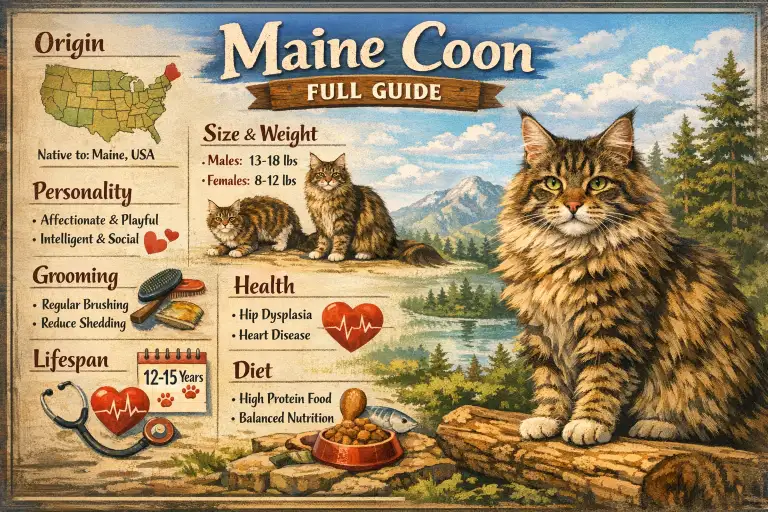
The Maine Coon is one of the largest and most popular cat breeds in the world. It is often called the “gentle giant” because it looks big and wild but behaves in a calm and friendly way. Many people choose this breed because it is social, smart, and easy to live with. Maine Coons are known for acting more like dogs than cats. They often follow their owners around and enjoy being part of daily life.
This breed comes from the United States, specifically the state of Maine. Maine Coons are a natural breed, which means they were not created by humans through planned breeding. Long ago, these cats lived on farms and ships, where they helped control mice and rats. Their strong bodies, thick fur, and large paws helped them survive cold winters.
There are many old stories about where Maine Coons came from. Some people once believed they were part raccoon because of their bushy tails, but this is not true. Another popular story says they came from Viking cats, but there is no proof. The most likely truth is that they developed naturally from long-haired cats brought to America by sailors.
Today, Maine Coons are officially recognized by major cat organizations like CFA and TICA. They are loved not only for their looks, but also for their sweet personality.
Maine Coon Size, Appearance & Physical Traits
Maine Coons are famous for their large size. They are one of the biggest domestic cat breeds. Male Maine Coons are usually larger than females. They grow slowly and may take up to 4 or even 5 years to fully mature. Because of this, many owners are surprised when their cat keeps growing after the first year.
Their bodies are long and strong, not short or round. Maine Coons have a rectangular body shape with solid muscles and big bones. Their paws are large and often have fur between the toes, which helps them walk on snow. Their long, fluffy tail helps them stay warm and is often wrapped around the body when they rest.
The coat of a Maine Coon is thick but not wool-like. It is longer on the chest, belly, and tail, and shorter on the shoulders. This coat helps protect them from cold weather and light rain. Maine Coons come in many colors and patterns, but tabby patterns are the most common.
They also have very expressive faces. Their ears are large and may have tufts on the tips, similar to a lynx. Their eyes are big and can be green, gold, or copper. These features give them a wild look, even though their personality is gentle.
Maine Coon physical traits overview:
| Feature | Details |
|---|---|
| Average weight | 12–18 lbs (males), 8–12 lbs (females) |
| Body type | Large, muscular, rectangular |
| Coat type | Semi-long, thick, water-resistant |
| Common colors | Tabby, solid, silver, smoke |
| Maturity age | 3–5 years |
| Lifespan | 12–15 years (often longer with good care) |
Maine Coon Personality, Temperament & Behavior
Maine Coons are known for their friendly and calm nature. They enjoy being around people but are not overly needy. Instead of sitting on your lap all day, they often prefer to sit nearby or follow you from room to room. This makes them great companions without feeling demanding.
These cats are very social and usually get along well with children. They are patient and not easily upset, which makes them a good choice for families. Many Maine Coons enjoy gentle play and can handle normal household noise better than more sensitive breeds.
Maine Coons are also known for being smart. They can learn routines quickly and may even learn simple tricks. Some owners teach them to walk on a leash or play fetch. Because they are curious, they enjoy puzzle toys and interactive games.
They are not loud cats, but they are talkative in a soft way. Instead of loud meowing, Maine Coons often make chirping or trilling sounds. These sounds are usually friendly and used to communicate with their owners.
Maine Coon behavior and personality summary:
| Trait | What to expect |
|---|---|
| Affection level | High but not clingy |
| Energy level | Medium |
| Vocalization | Soft chirps and trills |
| With children | Very good |
| With other cats | Usually friendly |
| With dogs | Good with proper introduction |
| Intelligence | High |
Maine Coon Care, Health & Daily Needs
Even though Maine Coons have long fur, they are not very hard to care for. Their coat does not mat as easily as some other long-haired breeds. Brushing two to three times a week is usually enough to keep their fur clean and healthy. During shedding seasons, brushing may be needed more often.
Maine Coons are playful but not hyperactive. They enjoy daily play but also like to rest. Because of their size, they need strong cat trees and enough space to stretch and climb. Mental stimulation is important, as bored Maine Coons may get into trouble simply out of curiosity.
Like all breeds, Maine Coons have some health risks. The most common concern is heart disease called hypertrophic cardiomyopathy (HCM). Some may also have hip problems or genetic muscle conditions. Choosing a responsible breeder and regular vet checkups can lower these risks.
Maine Coons can live happily indoors. Many owners prefer indoor living because it is safer. If allowed outside, it should be supervised or in a secure area.
Care and health overview:
| Area | Details |
|---|---|
| Grooming | Brush 2–3 times weekly |
| Shedding | Moderate to heavy (seasonal) |
| Exercise | Daily play needed |
| Common health issues | HCM, hip dysplasia |
| Indoor living | Highly suitable |
Is a Maine Coon Right for You? Cost, Pros & Comparisons
Maine Coons are a great choice for many people, but they are not for everyone. Because of their size, they need more space than a small cat. They also eat more food and may cost more at the vet. However, many owners feel their loving nature is worth the extra cost.
The price of a Maine Coon kitten can be high, especially from a responsible breeder. Monthly costs are also higher due to food, grooming tools, and possible health care. Pet insurance is often a good idea for this breed.
Pros and cons of owning a Maine Coon:
| Pros | Cons |
|---|---|
| Friendly and social | Large size needs space |
| Good with kids and pets | Higher food cost |
| Smart and trainable | Grooming required |
| Calm temperament | Kitten price can be high |
Maine Coons are often compared to other large cat breeds like the Norwegian Forest Cat or Siberian Cat. Maine Coons are usually more social and dog-like, while some other large breeds are more independent.
Comparison with similar breeds:
| Breed | Size | Personality | Grooming |
|---|---|---|---|
| Maine Coon | Very large | Social, gentle | Moderate |
| Norwegian Forest Cat | Large | Independent | High |
| Siberian Cat | Large | Playful | High |
If you want a big cat that is loving, social, and good with families, the Maine Coon may be perfect for you. If you want a smaller or lower-maintenance cat, another breed might be better.
For official breed standards and health information, you can visit the Cat Fanciers’ Association website:
https://cfa.org/maine-coon/

Ata Ur Rehman is the founder of Pet Age in Human Years Calculator, an educational platform that provides age conversion charts and lifespan guides for dogs, cats, birds, and other companion animals. His work focuses on helping pet owners understand how animal ages translate into human years using commonly accepted age conversion formulas and published lifespan averages.
The website compiles breed and species lifespan data from kennel clubs, breed organizations, and general animal lifespan studies to present simple and easy-to-understand guides for pet owners worldwide.
This website was created to centralize animal age conversion charts into one easy reference platform for pet owners.