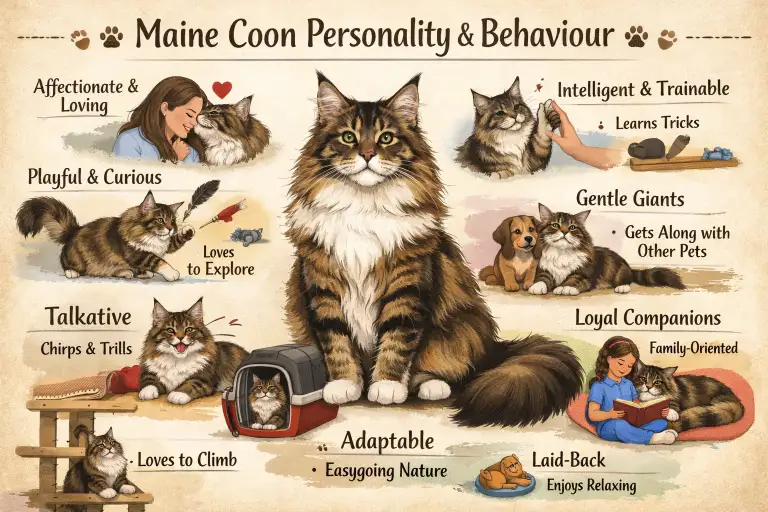
Maine Coon personality is often described as friendly, calm, and people-focused, but that is only part of the story. These cats are known for being emotionally aware and very tuned in to their home. They notice changes in routine, tone of voice, and even mood. This makes them feel “connected” to their people without being demanding.
Unlike the stereotype that all cats are distant, many Maine Coons enjoy being involved in daily life. They may sit nearby while you work, follow you from room to room, or quietly watch what you are doing. This behavior is not about control or neediness. It is their way of feeling secure and included.
It is important to understand that personality and behavior are not the same thing. Personality is the natural emotional style a cat is born with. Behavior is how that personality shows up in daily life. Two Maine Coons can live in the same house and still act very differently because personality is individual, not fixed by breed alone.
Environment also plays a big role. A Maine Coon raised in a calm, social home may seem relaxed and open. One raised in a busy or unpredictable space may be more observant and reserved. Both are normal. The breed gives a general direction, not a strict rulebook.
Core Maine Coon Personality Traits Explained
Maine Coons are often social, but they usually prefer closeness over constant touch. Many enjoy sitting near their people rather than on their lap. This is why some owners say their Maine Coon is loving but not clingy. This balance is a key part of the breed’s personality.
Another common trait is confidence. Maine Coons tend to move through their space calmly and with purpose. They are curious, but not jumpy. When something new appears, they often watch first instead of reacting fast. This thoughtful style is sometimes mistaken for laziness, but it is actually careful awareness.
Intelligence is also strong in this breed. Maine Coons like to understand how things work. They may open doors, study routines, or wait patiently for the right moment to act. This does not mean they need constant stimulation. It means they enjoy meaningful interaction and choice.
Emotionally, many Maine Coons are sensitive. They respond to gentle voices and consistent routines. Loud or forced interaction can make them pull back, while calm presence builds trust over time.
Maine Coon Personality Traits at a Glance
| Trait | How It Shows Up | Often Misunderstood As |
|---|---|---|
| Sociable | Stays near people | Needy |
| Calm confidence | Slow, steady movement | Lazy |
| Intelligent | Observes before acting | Stubborn |
| Affectionate | Chooses when to engage | Aloof |
Maine Coon Behavior With Humans and Family Life
Many Maine Coons form strong bonds with their humans, but they often spread their affection across the household. They may have a favorite person, yet still enjoy the company of others. This makes them well suited for family homes.
A common behavior is following people around the house. This does not always mean the cat wants attention. Often, it means they feel safest when they know where their people are. They like shared space, not constant handling.
When it comes to being held, Maine Coons vary a lot. Some enjoy cuddling, while others prefer sitting beside you. Their large size can also make holding uncomfortable for them, even if they are relaxed. Respecting this preference helps keep trust strong.
With children, Maine Coons are often patient, especially when kids are calm and gentle. They usually walk away instead of reacting if they feel overwhelmed. Teaching children to notice when a cat wants space is important.
Affection and Attachment Styles in Maine Coons
| Behavior | What It Means | Normal or Misread |
|---|---|---|
| Follows you | Feels secure with you | Normal |
| Sits nearby | Enjoys company | Normal |
| Avoids being held | Prefers control | Normal |
| Slow blinking | Trust and comfort | Normal |
Social, Play, and Natural Instinct Behaviors
Maine Coons often keep their playful side longer than other cats. Many act kitten-like well into adulthood. Their play style is usually gentle and thoughtful, with more focus on chasing and carrying than fast pouncing.
They also enjoy vertical space. Climbing, perching, and watching from above are natural behaviors. This does not mean they want to dominate the space. It simply helps them feel informed and relaxed.
With other cats and pets, Maine Coons are often tolerant. Their calm confidence helps reduce tension. Still, every introduction matters. Personality and past experience shape how social they will be.
Some Maine Coons show interest in water, such as watching taps or dipping paws in bowls. This is curiosity, not a need. It shows their playful and exploratory nature.
Play, Social, and Instinct Behaviors
| Behavior | Natural Purpose | What to Expect |
|---|---|---|
| Gentle play | Practice hunting skills | Longer playtime |
| Climbing | Feeling safe and aware | Loves cat trees |
| Watching first | Risk assessment | Slow reactions |
| Water curiosity | Exploration | Occasional interest |
Commonly Misunderstood Maine Coon Behaviors
Maine Coons are often labeled as quiet or talkative, but both can be true. Many do not meow loudly. Instead, they chirp or trill. These sounds are usually friendly and social, not signs of trouble.
Night activity is another area of confusion. Maine Coons may become active in the evening because they are crepuscular, meaning they are naturally more alert at dawn and dusk. This is normal behavior, not bad habits.
Their large size can also lead people to assume dominance or aggression. In reality, most Maine Coons avoid conflict. They rely on calm presence rather than force.
As they age, Maine Coons often become more settled. They may play less but observe more. This is a natural shift, not a loss of personality.
Common Myths vs Reality
| Behavior | Myth | Reality |
|---|---|---|
| Chirping | Complaining | Friendly communication |
| Night activity | Disobedience | Natural rhythm |
| Calm nature | Boring | Emotionally steady |
| Big size | Aggressive | Usually gentle |
For more general information on cat behavior and communication, you can visit the ASPCA cat behavior resource: https://www.aspca.org/pet-care/cat-care/cat-behavior

Ata Ur Rehman is the founder of Pet Age in Human Years Calculator, an educational platform that provides age conversion charts and lifespan guides for dogs, cats, birds, and other companion animals. His work focuses on helping pet owners understand how animal ages translate into human years using commonly accepted age conversion formulas and published lifespan averages.
The website compiles breed and species lifespan data from kennel clubs, breed organizations, and general animal lifespan studies to present simple and easy-to-understand guides for pet owners worldwide.
This website was created to centralize animal age conversion charts into one easy reference platform for pet owners.