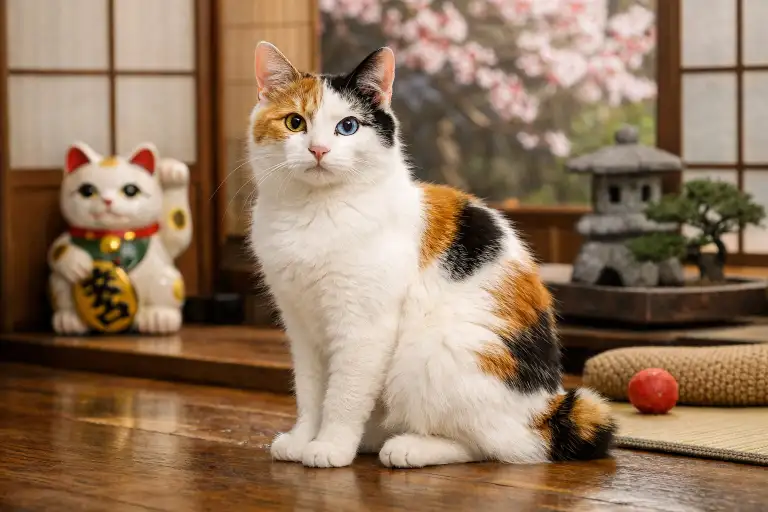
The Japanese Bobtail cat is one of the world’s oldest naturally occurring cat breeds—and one of the most misunderstood. Best known for its short, pom-pom-like tail and deep cultural ties to Japan, this breed is far more than a “lucky cat” symbol. In real homes, Japanese Bobtails are energetic, intelligent, people-focused companions with a personality that feels almost dog-like in its engagement and loyalty.
Recommended Dog Care Products
Based on your dog’s age, these products may help with comfort, health, grooming, and daily care.

Purina Pro Plan Veterinary Supplements
Daily probiotics for dogs to support digestive and gut health.
View on Amazon ↗
Earth Rated Poop Bags for Dogs
Leak-proof, extra thick waste bag refill rolls with lavender scent.
View on Amazon ↗
Greenies Pill Pockets for Dogs
Large dog treats for capsule medication, peanut butter flavor.
View on Amazon ↗
HONEY CARE All-Absorb Dog Wrap
Small male dog wraps, 50 count, useful for daily care support.
View on Amazon ↗
Seresto Flea & Tick Collar
Flea and tick treatment and prevention for dogs over 18 lbs.
View on Amazon ↗
Milk-Bone MaroSnacks
Small dog treats with real bone marrow in a 40 oz canister.
View on Amazon ↗
Vital Essentials Dog Treats
Freeze dried beef liver dog treats, grain free and single ingredient.
View on Amazon ↗
Stain & Odor Eliminator
Enzyme cleaner for pet stains, carpet messes, and strong odors.
View on Amazon ↗
Pur Luv Chicken Jerky Treats
Dog treats made with real chicken breast, high protein and chew-friendly.
View on Amazon ↗
Milk-Bone Flavor Snacks
Mini crunchy dog biscuits in a 36 oz canister for small rewards.
View on Amazon ↗As an Amazon Associate, we may earn from qualifying purchases.
Unlike many modern breeds, the Japanese Bobtail was not created through selective breeding for looks. Its defining feature—the bobbed tail—is the result of a natural genetic mutation that has existed in Japan for centuries. Historical records, paintings, and temple art depict short-tailed cats as far back as the 6th century, suggesting the breed has lived alongside humans for over a thousand years. These cats were valued not only for companionship but also for controlling rodents in silk farms and rice stores, giving them an important working role in Japanese society.
The breed’s cultural fame is closely tied to the Maneki-neko, the beckoning “good luck” cat often seen in shops and homes across Japan and beyond. While the Maneki-neko is a stylized figure rather than a literal breed standard, its short tail, upright posture, and alert expression are unmistakably inspired by the Japanese Bobtail. This association has helped the breed gain global recognition, but it has also created myths—such as the idea that Japanese Bobtails are purely ornamental or passive—which couldn’t be further from the truth.
In reality, Japanese Bobtails are active, social, and highly interactive cats. They tend to form strong bonds with their humans, enjoy being involved in daily routines, and often follow their owners from room to room. Many owners describe them as “always present but never needy,” a balance that appeals to people who want companionship without constant lap-sitting.
The breed was formally introduced to the Western cat fancy in the late 1960s and gained recognition from major associations such as the Cat Fanciers’ Association (CFA) and The International Cat Association (TICA). Despite this, Japanese Bobtails remain relatively rare outside Japan, especially compared to more commercial breeds. This rarity is partly due to limited breeding lines and partly because the breed appeals most to owners seeking personality and interaction rather than extreme physical traits.
What truly sets the Japanese Bobtail apart is how seamlessly history, culture, and real-world behavior intersect. This is a cat shaped by centuries of coexistence with humans—alert, adaptable, expressive, and deeply tuned into its environment. For people drawn to a breed with authentic roots and a lively, engaging presence, the Japanese Bobtail offers something genuinely special.
Japanese Bobtail Appearance, Size, Coat, and Tail Explained
The Japanese Bobtail has a look that is easy to recognize once you know what to look for. This breed is medium in size, with a slim but strong body built for movement and jumping. Most adult Japanese Bobtails weigh between 6 to 10 pounds, with males usually being a little heavier than females. They grow at a steady pace and reach full size around one year of age.
Their body is long and lean, not bulky. The legs are long and muscular, especially the back legs, which makes them excellent jumpers. When they move, they look light, quick, and graceful rather than heavy or slow.
The most famous feature of the Japanese Bobtail is its short tail. Unlike other bobtail breeds, no two Japanese Bobtail tails are the same. Some tails curve, some bend, and others look like a small puff or pom-pom. The tail is usually 1 to 3 inches long and is flexible, not stiff. A common myth is that the short tail causes spine problems, but this is not true for Japanese Bobtails. Their tail gene is natural and not linked to serious health issues.
Japanese Bobtails come in both shorthair and longhair varieties. The coat is soft, smooth, and lies close to the body. Even the longhair type does not have a thick undercoat, which means less matting and easier grooming. Many owners are surprised by how low-maintenance the coat feels.
Recommended Dog Care Products
Based on your dog’s age, these products may help with comfort, health, grooming, and daily care.
Purina Pro Plan Veterinary Supplements
Daily probiotics for dogs to support digestive and gut health.
View on Amazon ↗
Earth Rated Poop Bags for Dogs
Leak-proof, extra thick waste bag refill rolls with lavender scent.
View on Amazon ↗
Greenies Pill Pockets for Dogs
Large dog treats for capsule medication, peanut butter flavor.
View on Amazon ↗
HONEY CARE All-Absorb Dog Wrap
Small male dog wraps, 50 count, useful for daily care support.
View on Amazon ↗
Seresto Flea & Tick Collar
Flea and tick treatment and prevention for dogs over 18 lbs.
View on Amazon ↗
Milk-Bone MaroSnacks
Small dog treats with real bone marrow in a 40 oz canister.
View on Amazon ↗
Vital Essentials Dog Treats
Freeze dried beef liver dog treats, grain free and single ingredient.
View on Amazon ↗
Stain & Odor Eliminator
Enzyme cleaner for pet stains, carpet messes, and strong odors.
View on Amazon ↗
Pur Luv Chicken Jerky Treats
Dog treats made with real chicken breast, high protein and chew-friendly.
View on Amazon ↗
Milk-Bone Flavor Snacks
Mini crunchy dog biscuits in a 36 oz canister for small rewards.
View on Amazon ↗As an Amazon Associate, we may earn from qualifying purchases.
This breed comes in many colors and patterns, but the most well-known is the mi-ke pattern, which is a mix of white, black, and red. Solid colors, bi-colors, tabbies, and calico patterns are also common. Their eyes are large, oval-shaped, and bright, giving them an alert and curious expression. Some Japanese Bobtails even have odd-colored eyes, which adds to their unique look.
Overall, the Japanese Bobtail’s appearance matches its personality. It looks active, alert, and ready to interact, not like a cat built just for looks.
The Japanese Bobtail is known for having a friendly and lively personality. This is not a shy or quiet cat that hides all day. Most Japanese Bobtails enjoy being around people and like to know what is happening in the home. They often follow their owners from room to room and watch daily activities with interest.
This breed is affectionate but not clingy. Japanese Bobtails enjoy attention, petting, and playtime, but they usually do not demand constant cuddles. Some will sit on your lap, while others prefer to stay close beside you. They are good at respecting personal space while still being loving.
Japanese Bobtails are also very smart and curious. They learn routines quickly and can solve simple problems, like opening doors or finding hidden toys. Many owners notice that these cats enjoy interactive toys and games that make them think. Boredom can lead to trouble, so they do best in homes where they get daily play and mental activity.
When it comes to sound, this breed is known for soft and pleasant vocal sounds. Instead of loud meowing, Japanese Bobtails often make chirps, trills, and gentle talking noises. They may “talk” back when spoken to, but they are not usually noisy or annoying.
Japanese Bobtails are generally good with children when kids are calm and gentle. They enjoy play but do not like rough handling. With other cats, they are usually social and confident, especially if introduced properly. Many Japanese Bobtails also get along well with dogs that are friendly and not too aggressive.
One thing many owners love is how playful this breed stays, even as an adult. Japanese Bobtails enjoy chasing toys, jumping, and interactive games well into their senior years. Their energy feels fun and joyful, not wild or destructive.
Care, Activity, Grooming, and Health of the Japanese Bobtail
The Japanese Bobtail is an active cat that needs daily movement and play. This breed enjoys short bursts of energy rather than nonstop running. Simple games like wand toys, balls, and chasing toys across the floor are usually enough. Many Japanese Bobtails also enjoy puzzle toys that make them think. Playing for 15 to 30 minutes a day helps keep them happy and calm.
Mental activity is just as important as physical exercise. Japanese Bobtails are smart and can get bored if left alone with nothing to do. A bored cat may knock things over, scratch furniture, or wake people at night. Rotating toys and spending time playing together helps prevent these problems.
Recommended Dog Care Products
Based on your dog’s age, these products may help with comfort, health, grooming, and daily care.
Purina Pro Plan Veterinary Supplements
Daily probiotics for dogs to support digestive and gut health.
View on Amazon ↗
Earth Rated Poop Bags for Dogs
Leak-proof, extra thick waste bag refill rolls with lavender scent.
View on Amazon ↗
Greenies Pill Pockets for Dogs
Large dog treats for capsule medication, peanut butter flavor.
View on Amazon ↗
HONEY CARE All-Absorb Dog Wrap
Small male dog wraps, 50 count, useful for daily care support.
View on Amazon ↗
Seresto Flea & Tick Collar
Flea and tick treatment and prevention for dogs over 18 lbs.
View on Amazon ↗
Milk-Bone MaroSnacks
Small dog treats with real bone marrow in a 40 oz canister.
View on Amazon ↗
Vital Essentials Dog Treats
Freeze dried beef liver dog treats, grain free and single ingredient.
View on Amazon ↗
Stain & Odor Eliminator
Enzyme cleaner for pet stains, carpet messes, and strong odors.
View on Amazon ↗
Pur Luv Chicken Jerky Treats
Dog treats made with real chicken breast, high protein and chew-friendly.
View on Amazon ↗
Milk-Bone Flavor Snacks
Mini crunchy dog biscuits in a 36 oz canister for small rewards.
View on Amazon ↗As an Amazon Associate, we may earn from qualifying purchases.
Grooming a Japanese Bobtail is easy. The breed has a soft coat with no thick undercoat, so shedding is usually light to moderate. Brushing once or twice a week is enough for both shorthaired and longhaired types. Baths are rarely needed unless the cat gets very dirty. Regular nail trimming, ear checks, and dental care are still important for overall health.
When it comes to health, Japanese Bobtails are considered a strong and healthy breed. Their short tail does not cause spine or nerve problems, which is a common worry for new owners. Most Japanese Bobtails live 12 to 16 years, and many stay active well into old age.
There are no major genetic diseases strongly linked to this breed. Like all cats, they can still develop common issues such as dental disease, obesity, or kidney problems as they age. Regular vet visits, a balanced diet, and an active lifestyle go a long way in keeping them healthy.
Japanese Bobtails do well as indoor cats, where they are protected from traffic, predators, and illness. Some owners allow supervised outdoor time, but it is not required for their happiness.
Japanese Bobtail Cost, Pros & Cons, Similar Breeds, and FAQs
The cost of owning a Japanese Bobtail can vary depending on where you live and where the cat comes from. A Japanese Bobtail kitten from a responsible breeder usually costs between $800 and $1,500. Cats with show-quality markings or rare colors may cost more. Adoption is sometimes possible, but this breed is rare in shelters.
Monthly costs are usually moderate. Food, litter, toys, and routine vet care are similar to most healthy cat breeds. Because Japanese Bobtails are generally healthy, medical costs are often lower than breeds with known genetic problems. Pet insurance is optional but can help with unexpected vet bills.
Pros of the Japanese Bobtail:
- Friendly and social with people
- Smart and easy to train
- Good with children and other pets
- Low grooming needs
- Healthy and long-lived
Cons of the Japanese Bobtail:
- Can get bored without play and attention
- Rare and sometimes hard to find
- Not ideal for people who want a very quiet or lazy cat
Some breeds are often compared to the Japanese Bobtail. The Manx also has a short tail, but it has a heavier body and more health risks linked to its tail gene. The American Bobtail is larger and more wild-looking, with a calmer and more laid-back personality. The Kurilian Bobtail is stronger and more independent, making it better suited for experienced owners.
FAQs:
Recommended Dog Care Products
Based on your dog’s age, these products may help with comfort, health, grooming, and daily care.
Purina Pro Plan Veterinary Supplements
Daily probiotics for dogs to support digestive and gut health.
View on Amazon ↗
Earth Rated Poop Bags for Dogs
Leak-proof, extra thick waste bag refill rolls with lavender scent.
View on Amazon ↗
Greenies Pill Pockets for Dogs
Large dog treats for capsule medication, peanut butter flavor.
View on Amazon ↗
HONEY CARE All-Absorb Dog Wrap
Small male dog wraps, 50 count, useful for daily care support.
View on Amazon ↗
Seresto Flea & Tick Collar
Flea and tick treatment and prevention for dogs over 18 lbs.
View on Amazon ↗
Milk-Bone MaroSnacks
Small dog treats with real bone marrow in a 40 oz canister.
View on Amazon ↗
Vital Essentials Dog Treats
Freeze dried beef liver dog treats, grain free and single ingredient.
View on Amazon ↗
Stain & Odor Eliminator
Enzyme cleaner for pet stains, carpet messes, and strong odors.
View on Amazon ↗
Pur Luv Chicken Jerky Treats
Dog treats made with real chicken breast, high protein and chew-friendly.
View on Amazon ↗
Milk-Bone Flavor Snacks
Mini crunchy dog biscuits in a 36 oz canister for small rewards.
View on Amazon ↗As an Amazon Associate, we may earn from qualifying purchases.
Are Japanese Bobtails rare?
Yes, they are uncommon outside Japan, especially compared to popular breeds.
Are Japanese Bobtails good for first-time owners?
Yes, their friendly nature and easy care make them a good choice for beginners.
Do Japanese Bobtails shed a lot?
No, shedding is usually light to moderate and easy to manage.
Are Japanese Bobtails good indoor cats?
Yes, they are happy living indoors as long as they get daily play and attention.
Are Japanese Bobtails really lucky cats?
The “lucky cat” idea comes from Japanese culture. While they are not magical, they are known for their friendly and positive nature.
For more detailed breed standards and official information, you can visit The International Cat Association (TICA) Japanese Bobtail page, which provides trusted insights from one of the world’s leading cat registries:
https://tica.org/breed/japanese-bobtail

Ata Ur Rehman is the founder of Pet Age in Human Years Calculator, an educational platform that provides age conversion charts and lifespan guides for dogs, cats, birds, and other companion animals. His work focuses on helping pet owners understand how animal ages translate into human years using commonly accepted age conversion formulas and published lifespan averages.
The website compiles breed and species lifespan data from kennel clubs, breed organizations, and general animal lifespan studies to present simple and easy-to-understand guides for pet owners worldwide.
This website was created to centralize animal age conversion charts into one easy reference platform for pet owners.