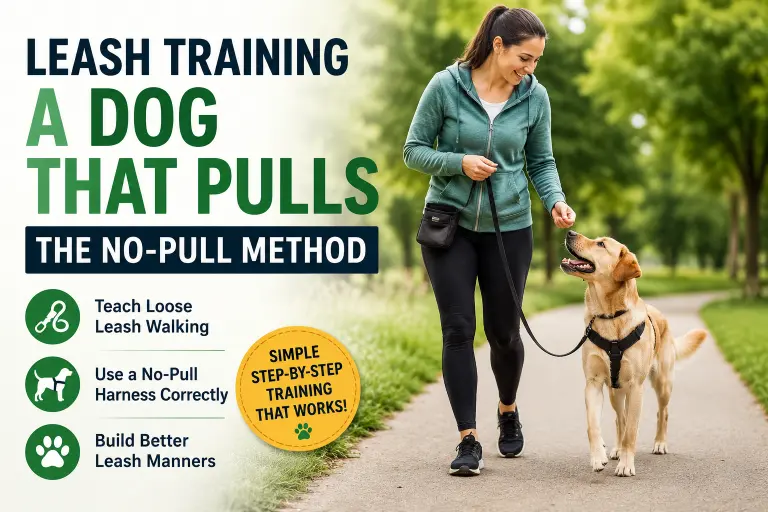
Leash Training a Dog That Pulls: The No-Pull Method
If every walk feels like your dog is dragging you down the street, you’re not alone. Pulling on the leash is one of the most common challenges dog owners face, and it can make walks frustrating instead of enjoyable.
Recommended Dog Care Products
Based on your dog’s age, these products may help with comfort, health, grooming, and daily care.

Purina Pro Plan Veterinary Supplements
Daily probiotics for dogs to support digestive and gut health.
View on Amazon ↗
Earth Rated Poop Bags for Dogs
Leak-proof, extra thick waste bag refill rolls with lavender scent.
View on Amazon ↗
Greenies Pill Pockets for Dogs
Large dog treats for capsule medication, peanut butter flavor.
View on Amazon ↗
HONEY CARE All-Absorb Dog Wrap
Small male dog wraps, 50 count, useful for daily care support.
View on Amazon ↗
Seresto Flea & Tick Collar
Flea and tick treatment and prevention for dogs over 18 lbs.
View on Amazon ↗
Milk-Bone MaroSnacks
Small dog treats with real bone marrow in a 40 oz canister.
View on Amazon ↗
Vital Essentials Dog Treats
Freeze dried beef liver dog treats, grain free and single ingredient.
View on Amazon ↗
Stain & Odor Eliminator
Enzyme cleaner for pet stains, carpet messes, and strong odors.
View on Amazon ↗
Pur Luv Chicken Jerky Treats
Dog treats made with real chicken breast, high protein and chew-friendly.
View on Amazon ↗
Milk-Bone Flavor Snacks
Mini crunchy dog biscuits in a 36 oz canister for small rewards.
View on Amazon ↗As an Amazon Associate, we may earn from qualifying purchases.
The good news is that pulling is usually a learned behavior, not a permanent habit. Dogs pull because it works. When they pull toward something they want and still get there, they learn that tension on the leash helps them move forward.
In this guide, you’ll learn a simple no-pull method that teaches your dog the opposite lesson: pulling stops progress, while walking calmly beside you makes good things happen. We’ll also cover how to build reliable loose leash walking habits and how a no-pull harness can support your training.
Why Your Dog Pulls on the Leash in the First Place
Before you can fix pulling, it helps to understand why it happens.
Most dogs naturally walk faster than humans. They’re also highly motivated by the environment around them. Every smell, sound, person, dog, squirrel, and interesting object gives them a reason to move forward quickly.
The problem starts when pulling gets rewarded.
Imagine your dog sees a patch of grass they want to sniff. They pull, you continue walking, and they reach the grass. From the dog’s perspective, pulling worked. The same thing happens when they pull toward another dog, a person, or even simply farther down the sidewalk.
Over time, the behavior becomes stronger because it consistently gets results.
Many owners accidentally reinforce pulling without realizing it. They may:
- Continue walking while the leash is tight
- Speed up to keep pace with the dog
- Allow the dog to reach exciting destinations after pulling
- Inconsistently correct the behavior
This doesn’t mean you’re doing something wrong. It simply means your dog has learned a pattern that makes sense from their perspective.
Recommended Dog Care Products
Based on your dog’s age, these products may help with comfort, health, grooming, and daily care.
Purina Pro Plan Veterinary Supplements
Daily probiotics for dogs to support digestive and gut health.
View on Amazon ↗
Earth Rated Poop Bags for Dogs
Leak-proof, extra thick waste bag refill rolls with lavender scent.
View on Amazon ↗
Greenies Pill Pockets for Dogs
Large dog treats for capsule medication, peanut butter flavor.
View on Amazon ↗
HONEY CARE All-Absorb Dog Wrap
Small male dog wraps, 50 count, useful for daily care support.
View on Amazon ↗
Seresto Flea & Tick Collar
Flea and tick treatment and prevention for dogs over 18 lbs.
View on Amazon ↗
Milk-Bone MaroSnacks
Small dog treats with real bone marrow in a 40 oz canister.
View on Amazon ↗
Vital Essentials Dog Treats
Freeze dried beef liver dog treats, grain free and single ingredient.
View on Amazon ↗
Stain & Odor Eliminator
Enzyme cleaner for pet stains, carpet messes, and strong odors.
View on Amazon ↗
Pur Luv Chicken Jerky Treats
Dog treats made with real chicken breast, high protein and chew-friendly.
View on Amazon ↗
Milk-Bone Flavor Snacks
Mini crunchy dog biscuits in a 36 oz canister for small rewards.
View on Amazon ↗As an Amazon Associate, we may earn from qualifying purchases.
It’s also important to understand what usually doesn’t solve the problem. Constant leash jerks, repeated verbal corrections, or physically dragging the dog into position may stop pulling temporarily, but they don’t teach the dog what behavior should replace it.
For lasting leash manners, your dog needs a clear and consistent rule they can understand and repeat.
The No-Pull Method Explained
The no-pull method is based on a simple principle:
Pulling makes the walk stop. A loose leash makes the walk continue.
That’s the entire foundation of the training.
Instead of trying to force your dog not to pull, you’re teaching them that the reward they want—forward movement—only happens when the leash stays loose.
Here’s how your dog experiences the process:
- The dog pulls.
- Forward movement stops.
- The dog releases tension on the leash.
- Forward movement resumes.
Over time, the dog begins to connect these outcomes. They learn that a loose leash is what gets them where they want to go.
This approach works because it uses something your dog already values: access to the environment.
Many owners make the mistake of focusing only on stopping unwanted behavior. The no-pull method focuses on teaching the desired behavior instead. Your goal isn’t simply to stop pulling. Your goal is to teach loose leash walking.
Recommended Dog Care Products
Based on your dog’s age, these products may help with comfort, health, grooming, and daily care.
Purina Pro Plan Veterinary Supplements
Daily probiotics for dogs to support digestive and gut health.
View on Amazon ↗
Earth Rated Poop Bags for Dogs
Leak-proof, extra thick waste bag refill rolls with lavender scent.
View on Amazon ↗
Greenies Pill Pockets for Dogs
Large dog treats for capsule medication, peanut butter flavor.
View on Amazon ↗
HONEY CARE All-Absorb Dog Wrap
Small male dog wraps, 50 count, useful for daily care support.
View on Amazon ↗
Seresto Flea & Tick Collar
Flea and tick treatment and prevention for dogs over 18 lbs.
View on Amazon ↗
Milk-Bone MaroSnacks
Small dog treats with real bone marrow in a 40 oz canister.
View on Amazon ↗
Vital Essentials Dog Treats
Freeze dried beef liver dog treats, grain free and single ingredient.
View on Amazon ↗
Stain & Odor Eliminator
Enzyme cleaner for pet stains, carpet messes, and strong odors.
View on Amazon ↗
Pur Luv Chicken Jerky Treats
Dog treats made with real chicken breast, high protein and chew-friendly.
View on Amazon ↗
Milk-Bone Flavor Snacks
Mini crunchy dog biscuits in a 36 oz canister for small rewards.
View on Amazon ↗As an Amazon Associate, we may earn from qualifying purchases.
When your dog walks beside you or keeps slack in the leash, reward that choice. Depending on your dog, rewards may include:
- Treats
- Praise
- Access to a sniffing spot
- Moving toward something interesting
- Continuing the walk
The key is consistency. If pulling sometimes works and sometimes doesn’t, your dog receives mixed messages. If pulling never moves them forward and a loose leash always does, learning happens much faster.
Think of every walk as a training session. Each step teaches your dog which behavior gets rewarded. The more consistently you apply the no-pull method, the faster your dog will develop reliable leash manners.
Step-by-Step Leash Training for a Dog That Pulls
Once you understand the no-pull method, the next step is applying it consistently during training sessions and daily walks.
The goal is not to keep your dog in a perfect heel position. Instead, you’re teaching them that they can explore and enjoy the walk as long as they maintain a loose leash.
Start in a Low-Distraction Area
Many owners begin training in the most challenging environment possible—a busy street, a crowded park, or a trail full of exciting smells.
That often sets the dog up for failure.
Start somewhere calm where your dog can pay attention to you. A backyard, driveway, quiet sidewalk, or empty parking area can work well.
Practice short sessions of 5 to 10 minutes rather than expecting a full walk to become a training session immediately.
Recommended Dog Care Products
Based on your dog’s age, these products may help with comfort, health, grooming, and daily care.
Purina Pro Plan Veterinary Supplements
Daily probiotics for dogs to support digestive and gut health.
View on Amazon ↗
Earth Rated Poop Bags for Dogs
Leak-proof, extra thick waste bag refill rolls with lavender scent.
View on Amazon ↗
Greenies Pill Pockets for Dogs
Large dog treats for capsule medication, peanut butter flavor.
View on Amazon ↗
HONEY CARE All-Absorb Dog Wrap
Small male dog wraps, 50 count, useful for daily care support.
View on Amazon ↗
Seresto Flea & Tick Collar
Flea and tick treatment and prevention for dogs over 18 lbs.
View on Amazon ↗
Milk-Bone MaroSnacks
Small dog treats with real bone marrow in a 40 oz canister.
View on Amazon ↗
Vital Essentials Dog Treats
Freeze dried beef liver dog treats, grain free and single ingredient.
View on Amazon ↗
Stain & Odor Eliminator
Enzyme cleaner for pet stains, carpet messes, and strong odors.
View on Amazon ↗
Pur Luv Chicken Jerky Treats
Dog treats made with real chicken breast, high protein and chew-friendly.
View on Amazon ↗
Milk-Bone Flavor Snacks
Mini crunchy dog biscuits in a 36 oz canister for small rewards.
View on Amazon ↗As an Amazon Associate, we may earn from qualifying purchases.
At this stage, focus on helping your dog understand the rule:
Loose leash = movement. Tight leash = stop.
If your dog can learn that in a quiet setting, you’ll have a much easier time applying it elsewhere.
Stop When the Leash Becomes Tight
This is the most important part of the entire training process.
The moment your dog creates tension on the leash, stop walking.
Don’t yank the leash. Don’t pull your dog back. Don’t continue moving forward.
Simply become still.
Wait patiently until your dog releases the tension. Some dogs will turn back toward you. Others may take a step backward or shift their position enough to loosen the leash.
The instant the leash becomes loose again, continue walking.
This timing matters.
Your dog needs to clearly experience the connection between their choice and the outcome:
- Pulling stops the walk.
- A loose leash restarts the walk.
Many dogs test this rule repeatedly at first. That’s normal. Stay consistent and avoid making exceptions.
Reward Slack in the Leash
Stopping when your dog pulls teaches what not to do. Rewarding a loose leash teaches what to do instead.
Whenever your dog walks beside you or keeps the leash relaxed, reinforce that behavior.
You can reward with:
- Small treats
- Verbal praise
- Permission to sniff
- Moving toward something the dog wants
Try to reward before pulling starts.
For example, if your dog is walking nicely for several steps, mark that behavior with praise or a treat. This helps your dog understand exactly what earns rewards.
Many owners only react when the dog makes a mistake. Dogs learn faster when you actively notice and reward the behavior you want repeated.
Gradually Increase Distractions
A dog that walks politely in the backyard may still pull at the park.
That’s normal because training doesn’t automatically transfer to every environment.
Once your dog consistently demonstrates loose leash walking in easier locations, gradually introduce more challenging settings.
You might progress like this:
- Backyard or quiet area
- Quiet neighborhood street
- Moderate walking path
- Busier public areas
- Parks and high-distraction locations
If your dog starts pulling heavily in a new environment, the distraction level may be too high for their current skill level.
Instead of pushing through, move farther away from the distraction or return to an easier setting and build back up.
Successful leash training comes from gradual progression, not from repeatedly placing your dog in situations they aren’t ready to handle.
Using a No-Pull Harness Correctly
A no-pull harness can make leash training easier, but it is not a substitute for training.
Many owners buy a harness expecting it to eliminate pulling immediately. While it may reduce the dog’s leverage and improve control, lasting results still come from teaching leash manners.
A properly fitted no-pull harness helps by:
- Redirecting the dog’s movement when they pull
- Reducing strain on the neck
- Giving the handler more control
- Making training sessions safer and more manageable
However, the harness should support the no-pull method rather than replace it.
Even with a no-pull harness, continue following the same training rules:
- Stop when the leash becomes tight
- Reward loose leash walking
- Allow movement only when the leash is relaxed
Fit is also important. A loose or poorly adjusted harness can rub, restrict movement, or allow the dog to slip out.
Before beginning training:
- Ensure the harness fits snugly without being tight
- Check that your dog can move comfortably
- Follow the manufacturer’s fitting instructions
- Inspect straps regularly for proper adjustment
Remember that equipment can help manage pulling, but behavior change comes from repetition and consistency. The harness may make training easier, but your dog’s understanding of the no-pull method is what ultimately creates reliable loose leash walking.
What to Do When Pulling Returns During Walks
Even after your dog starts making progress, there will be days when pulling comes back.
This doesn’t mean the training has failed.
Leash training is rarely a straight line. Dogs learn through repetition, and new environments, distractions, and excitement levels can temporarily affect their behavior.
The key is to respond consistently rather than becoming frustrated or abandoning the training process.
Pulling Around Other Dogs
Other dogs are one of the biggest distractions during walks.
Your dog may be excited to greet them, curious about them, or simply overstimulated by their presence.
When this happens, avoid allowing your dog to pull all the way to the other dog. If pulling succeeds, the behavior gets reinforced again.
Instead:
- Increase distance from the other dog if possible.
- Ask for attention before the pulling begins.
- Reward calm behavior and a loose leash.
- Move closer only when your dog remains under control.
Think of distance as a training tool. If your dog cannot focus, they’re probably too close to the distraction.
Over time, your dog learns that calm behavior—not pulling—is what creates opportunities to move closer.
Pulling Near Exciting Destinations
Many dogs develop predictable pulling habits near places they love.
Common examples include:
- The dog park
- Favorite walking routes
- A friend’s house
- A frequently visited field or trail
Because the destination is highly rewarding, dogs often start pulling long before they arrive.
The solution is the same no-pull rule you’ve been using all along.
If your dog begins pulling toward the destination:
- Stop moving forward.
- Wait for a loose leash.
- Continue only when the leash relaxes.
You may progress slowly at first, but consistency matters more than speed.
If your dog learns they can reach exciting places while pulling, those locations will continue to trigger the behavior.
Inconsistent Progress
One of the most common frustrations owners experience is seeing improvement one week and setbacks the next.
This is completely normal.
Several factors can influence your dog’s behavior, including:
- Excitement levels
- New environments
- Lack of recent practice
- Unexpected distractions
- Physical and mental energy levels
Instead of judging progress based on a single walk, look at the overall trend over several weeks.
Ask yourself:
- Is the pulling less intense than before?
- Is my dog recovering faster after pulling?
- Are there more moments of loose leash walking?
Small improvements add up.
When progress stalls, return to easier environments, increase rewards, and focus on consistency. Most setbacks are temporary when the training process remains the same.
How Long Does It Take to Teach Loose Leash Walking?
There is no single timeline that applies to every dog.
Some dogs begin showing noticeable improvement within a few days of consistent training. Others may need several weeks or longer before loose leash walking becomes reliable.
Factors that affect progress include:
- Your dog’s age
- Previous leash habits
- Consistency of training
- Distraction levels during walks
- How often you practice
The most important factor is consistency.
A dog that experiences the same rules on every walk will usually learn much faster than a dog that receives mixed signals. If pulling works sometimes and not others, learning slows down considerably.
Rather than focusing on a specific number of days, look for signs that the training is working:
- Your dog checks in with you more often.
- The leash stays loose for longer periods.
- Pulling episodes become shorter.
- Your dog recovers quickly after distractions.
- Walks feel calmer and more enjoyable.
Loose leash walking is a skill that develops over time. With patience and consistent application of the no-pull method, most dogs can learn better leash manners and become more pleasant walking companions.
FAQ
Should I stop walking when my dog pulls on the leash?
Yes. Stopping immediately when the leash becomes tight is the foundation of the no-pull method. It teaches your dog that pulling does not move them forward, while a loose leash does.
Does a no-pull harness stop pulling immediately?
A no-pull harness can reduce pulling and improve control, but it does not teach behavior on its own. For lasting results, it should be used alongside consistent leash training.
How often should I practice loose leash walking?
Daily practice is ideal. Even short training sessions of 5 to 10 minutes can help reinforce good habits when done consistently.
Can an older dog learn the no-pull method?
Yes. Dogs of all ages can learn loose leash walking. Older dogs may take time to replace established habits, but the training principles remain the same.
What should I do if my dog only pulls in certain places?
Those locations are likely more exciting or distracting. Increase distance from triggers when possible, reward calm behavior, and practice the same no-pull rules until your dog can remain successful in that environment.

Ata Ur Rehman is the founder of Pet Age in Human Years Calculator, an educational platform that provides age conversion charts and lifespan guides for dogs, cats, birds, and other companion animals. His work focuses on helping pet owners understand how animal ages translate into human years using commonly accepted age conversion formulas and published lifespan averages.
The website compiles breed and species lifespan data from kennel clubs, breed organizations, and general animal lifespan studies to present simple and easy-to-understand guides for pet owners worldwide.
This website was created to centralize animal age conversion charts into one easy reference platform for pet owners.