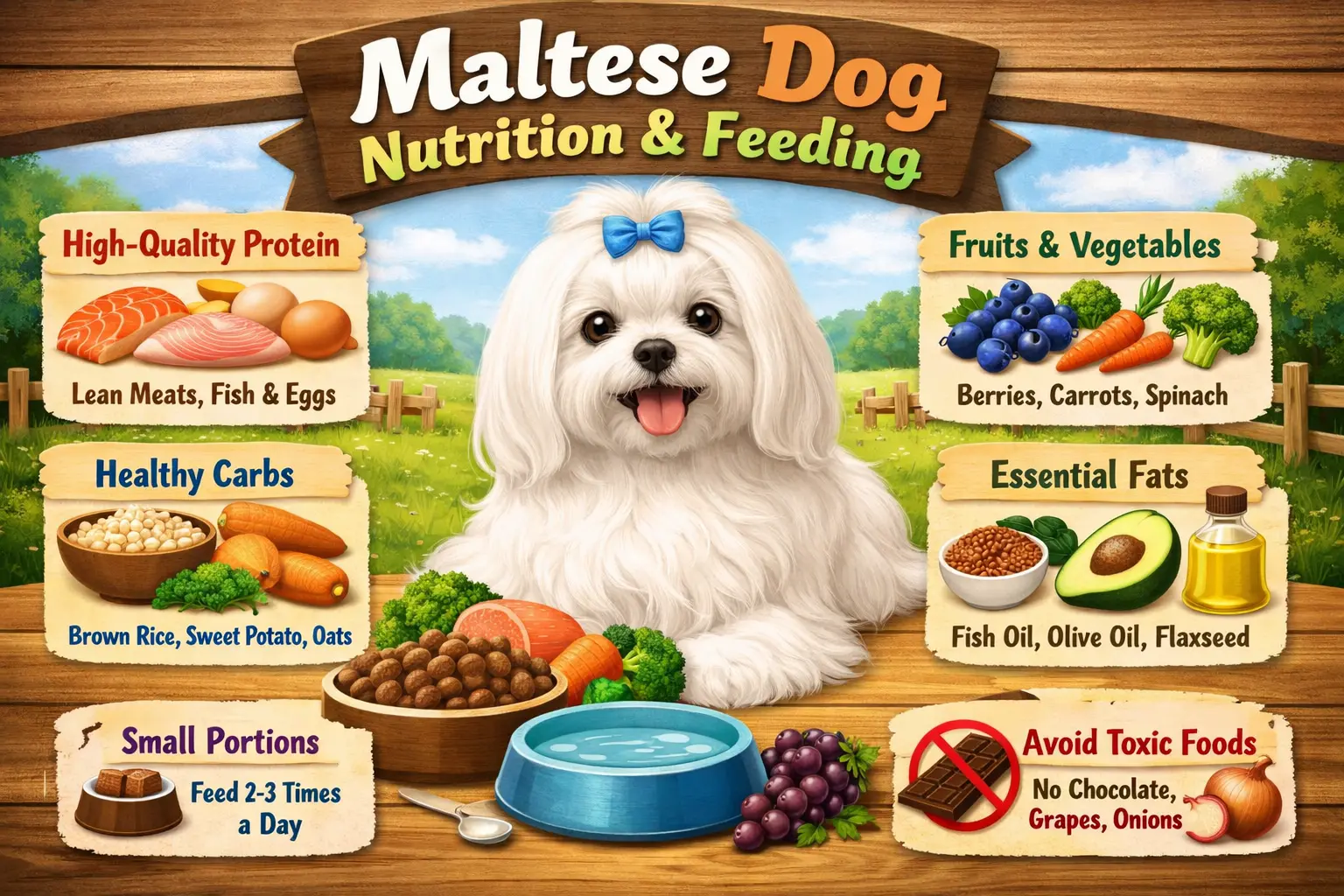
This Maltese feeding guide explains what to feed a Maltese, how much food a Maltese should eat per day, which human foods are safe, and how to avoid common feeding mistakes that can lead to weight gain, picky eating, stomach upset, or low energy.
Recommended Dog Care Products
Based on your dog’s age, these products may help with comfort, health, grooming, and daily care.

Purina Pro Plan Veterinary Supplements
Daily probiotics for dogs to support digestive and gut health.
View on Amazon ↗
Earth Rated Poop Bags for Dogs
Leak-proof, extra thick waste bag refill rolls with lavender scent.
View on Amazon ↗
Greenies Pill Pockets for Dogs
Large dog treats for capsule medication, peanut butter flavor.
View on Amazon ↗
HONEY CARE All-Absorb Dog Wrap
Small male dog wraps, 50 count, useful for daily care support.
View on Amazon ↗
Seresto Flea & Tick Collar
Flea and tick treatment and prevention for dogs over 18 lbs.
View on Amazon ↗
Milk-Bone MaroSnacks
Small dog treats with real bone marrow in a 40 oz canister.
View on Amazon ↗
Vital Essentials Dog Treats
Freeze dried beef liver dog treats, grain free and single ingredient.
View on Amazon ↗
Stain & Odor Eliminator
Enzyme cleaner for pet stains, carpet messes, and strong odors.
View on Amazon ↗
Pur Luv Chicken Jerky Treats
Dog treats made with real chicken breast, high protein and chew-friendly.
View on Amazon ↗
Milk-Bone Flavor Snacks
Mini crunchy dog biscuits in a 36 oz canister for small rewards.
View on Amazon ↗As an Amazon Associate, we may earn from qualifying purchases.
Maltese dogs are small, but their nutrition needs are not simple. As a toy breed with a fast metabolism, delicate digestion, and a long life expectancy, a Maltese needs a carefully portioned diet that supports steady energy, healthy weight, strong teeth, and a soft white coat. Feeding mistakes that may barely affect a larger dog can quickly cause problems in a Maltese because even small calorie changes matter.
If you are new to the breed, our complete Maltese dog breed guide explains their temperament, lifespan, and general care needs in more detail.
Because the Maltese has a small frame, small stomach, and fast metabolism, their food must be nutrient-dense, easy to chew, and measured carefully. Most Maltese dogs do best with a complete and balanced small-breed formula that provides quality animal protein, healthy fats, digestible carbohydrates, and enough calories for their age, weight, and activity level.
A well-fed Maltese usually shows clear signs of good nutrition:
- A soft, bright coat with minimal dryness or excessive shedding
- Steady energy without crashes or hyperactivity
- Firm, regular stools and minimal digestive upset
- A healthy body weight with a visible waist
- Good appetite without constant begging or food refusal
Small-breed dogs like the Maltese burn calories quickly, but they still need fewer total calories than medium or large dogs. This makes portion control extremely important. A few extra treats, oversized scoops, or table scraps can quickly push a Maltese above their daily calorie needs.
Food size and texture also matter. Maltese dogs have small mouths and closely spaced teeth, so large-breed kibble may be difficult to chew and can lead to food refusal, poor chewing, or dental buildup. Small-breed kibble, soft wet food, or a carefully balanced mix usually works better.
This guide covers the main feeding decisions Maltese owners search for most:
- How much should a Maltese eat a day?
- How much food should a Maltese eat per day by weight?
- What is the best food for a Maltese?
- What human food can Maltese eat safely?
- How often should puppies, adults, and seniors be fed?
- Which feeding mistakes should Maltese owners avoid?
For age-based feeding decisions, you can also use our Maltese Dog Age Calculator to understand whether your Maltese is still in a growth stage, stable adulthood, or entering senior years.
How Much Should a Maltese Eat Per Day?
Most adult Maltese dogs should eat about 160–310 calories per day, usually split into two meals. In cup measurements, this often equals about 1/4 to 3/4 cup of dry food per day, depending on the dog’s weight, activity level, age, and the calories in the food.
Recommended Dog Care Products
Based on your dog’s age, these products may help with comfort, health, grooming, and daily care.
Purina Pro Plan Veterinary Supplements
Daily probiotics for dogs to support digestive and gut health.
View on Amazon ↗
Earth Rated Poop Bags for Dogs
Leak-proof, extra thick waste bag refill rolls with lavender scent.
View on Amazon ↗
Greenies Pill Pockets for Dogs
Large dog treats for capsule medication, peanut butter flavor.
View on Amazon ↗
HONEY CARE All-Absorb Dog Wrap
Small male dog wraps, 50 count, useful for daily care support.
View on Amazon ↗
Seresto Flea & Tick Collar
Flea and tick treatment and prevention for dogs over 18 lbs.
View on Amazon ↗
Milk-Bone MaroSnacks
Small dog treats with real bone marrow in a 40 oz canister.
View on Amazon ↗
Vital Essentials Dog Treats
Freeze dried beef liver dog treats, grain free and single ingredient.
View on Amazon ↗
Stain & Odor Eliminator
Enzyme cleaner for pet stains, carpet messes, and strong odors.
View on Amazon ↗
Pur Luv Chicken Jerky Treats
Dog treats made with real chicken breast, high protein and chew-friendly.
View on Amazon ↗
Milk-Bone Flavor Snacks
Mini crunchy dog biscuits in a 36 oz canister for small rewards.
View on Amazon ↗As an Amazon Associate, we may earn from qualifying purchases.
This is the most important feeding question for Maltese owners because the breed is small enough that overfeeding by even a small amount can cause weight gain. Underfeeding can also cause low energy, weakness, or blood sugar problems, especially in puppies.
The goal is simple: feed enough to maintain energy and lean body condition, but not so much that your Maltese slowly gains weight.
Maltese Feeding Chart by Weight
The chart below gives estimated daily calorie needs for adult Maltese dogs. These are daily totals, not per-meal amounts. Treats should be included inside the same daily calorie limit.
| Maltese Weight | Low Activity | Moderate Activity | High Activity |
|---|---|---|---|
| 4 lb (1.8 kg) | 160–180 kcal/day | 180–200 kcal/day | 200–220 kcal/day |
| 5 lb (2.3 kg) | 180–200 kcal/day | 200–220 kcal/day | 220–250 kcal/day |
| 6 lb (2.7 kg) | 200–220 kcal/day | 220–250 kcal/day | 250–280 kcal/day |
| 7 lb (3.2 kg) | 220–250 kcal/day | 250–280 kcal/day | 280–310 kcal/day |
Most adult Maltese dogs weigh between 4 and 7 pounds. A typical 5-pound Maltese usually needs around 200–220 calories per day if moderately active. Very inactive, senior, spayed, or neutered dogs may need less.
How Much Food Should a Maltese Eat Per Day in Cups?
Many Maltese dogs eat between 1/4 and 3/4 cup of dry food per day, but cup amounts are only estimates because every dog food has a different calorie density. One brand may contain 300 calories per cup, while another may contain 450 calories per cup.
To calculate the right portion, check the food label for calories per cup, then divide your Maltese’s daily calorie target into two meals. For example, if your Maltese needs 220 calories per day and the food contains 400 calories per cup, the total daily amount is a little over 1/2 cup per day, split into two meals.
Maltese Feeding Schedule by Life Stage
How often you feed a Maltese matters as much as how much you feed. Puppies need smaller, more frequent meals, while most adult Maltese dogs do best with two measured meals per day.
| Life Stage | Meals per Day | General Feeding Guidance |
|---|---|---|
| Puppy (2–4 months) | 3–4 meals | Small, frequent meals to help prevent low blood sugar |
| Puppy (4–10 months) | 3 meals | Gradually increase portions as growth continues |
| Adult Maltese | 2 meals | Split daily calories into morning and evening meals |
| Senior Maltese | 2 smaller meals | Use easier-to-digest food and monitor weight closely |
Puppies need more frequent meals, not oversized meals. Adults need consistency. Seniors may need slightly fewer calories, softer texture, or easier digestion depending on dental health, activity level, and body condition.
If you are unsure which life stage your Maltese is in, check their age using the Maltese Dog Age Calculator before adjusting puppy, adult, or senior feeding portions.
Portion Size Tips for Maltese Owners
Portion control is one of the most important parts of a Maltese feeding guide. Because Maltese dogs are so small, guessing portions can quickly lead to overfeeding or underfeeding.
Recommended Dog Care Products
Based on your dog’s age, these products may help with comfort, health, grooming, and daily care.
Purina Pro Plan Veterinary Supplements
Daily probiotics for dogs to support digestive and gut health.
View on Amazon ↗
Earth Rated Poop Bags for Dogs
Leak-proof, extra thick waste bag refill rolls with lavender scent.
View on Amazon ↗
Greenies Pill Pockets for Dogs
Large dog treats for capsule medication, peanut butter flavor.
View on Amazon ↗
HONEY CARE All-Absorb Dog Wrap
Small male dog wraps, 50 count, useful for daily care support.
View on Amazon ↗
Seresto Flea & Tick Collar
Flea and tick treatment and prevention for dogs over 18 lbs.
View on Amazon ↗
Milk-Bone MaroSnacks
Small dog treats with real bone marrow in a 40 oz canister.
View on Amazon ↗
Vital Essentials Dog Treats
Freeze dried beef liver dog treats, grain free and single ingredient.
View on Amazon ↗
Stain & Odor Eliminator
Enzyme cleaner for pet stains, carpet messes, and strong odors.
View on Amazon ↗
Pur Luv Chicken Jerky Treats
Dog treats made with real chicken breast, high protein and chew-friendly.
View on Amazon ↗
Milk-Bone Flavor Snacks
Mini crunchy dog biscuits in a 36 oz canister for small rewards.
View on Amazon ↗As an Amazon Associate, we may earn from qualifying purchases.
- Always check the calories per cup or per can on the food label
- Use a measuring cup or kitchen scale instead of estimating by eye
- Split the daily amount into two meals for most adult Maltese dogs
- If your Maltese is spayed, neutered, senior, or inactive, they may need 10–20% fewer calories
- Treats should make up no more than 10% of daily calories
- Adjust portions slowly if your Maltese starts gaining or losing weight
If your Maltese needs to lose weight, reduce treats first before cutting meal nutrition. If your Maltese needs to gain weight, increase calories gradually and check for dental problems, stomach issues, or poor appetite.
How to Tell If You Are Feeding the Right Amount
A healthy Maltese should have a lean body shape, steady energy, and a good appetite without constant begging. Body condition is usually more useful than weight alone because some Maltese dogs are naturally smaller or larger than others.
A healthy Maltese should:
- Have a visible waist when viewed from above
- Have ribs you can feel easily but not see sharply
- Show a slight abdominal tuck from the side
- Move easily without tiring quickly
- Maintain steady weight from week to week
If your Maltese feels round, heavy, or always hungry, portions or treats may need adjusting. If ribs are clearly visible, energy is low, or weight drops quickly, your Maltese may need more calories or a vet check.
Age also affects feeding needs. A growing puppy, stable adult, and senior Maltese should not always eat the same amount. You can use the Maltese Dog Age Calculator to better understand your dog’s life stage before changing feeding amounts.
Best Food for Maltese Dogs: Kibble, Wet, Fresh, Raw, and Homemade
The best food for a Maltese is usually a complete and balanced small-breed formula with quality animal protein, controlled calories, digestible ingredients, and a texture small enough for a toy breed to chew comfortably.
There is no single best food for every Maltese dog. The right choice depends on age, weight, dental health, digestion, activity level, and whether your dog is picky, overweight, underweight, or sensitive to certain ingredients.
The best food for a Maltese should be:
- Made for small or toy breeds
- Easy to chew and digest
- High in quality animal protein
- Moderate in calories to prevent weight gain
- Complete and balanced for your dog’s life stage
- Clear about calories per cup, can, or serving
For most healthy adult Maltese dogs, small-breed kibble works well because it is easy to measure, helps with portion control, and can support dental health. Wet food, fresh food, or a kibble-and-wet mix may work better for picky eaters, seniors, or dogs with chewing difficulty.
Dog Food Types for Maltese Dogs: Pros and Cons
| Food Type | Benefits | Downsides | Best For |
|---|---|---|---|
| Dry food / kibble | Easy to measure, stores well, supports portion control | Can be too hard or large if not small-breed size | Most adult Maltese dogs |
| Wet food | Soft, tasty, easier to chew | Can be higher cost and may contribute to dental buildup | Picky eaters, seniors, dogs with dental issues |
| Fresh food | High moisture and often highly palatable | More expensive and needs careful portion control | Sensitive stomachs or picky eaters |
| Freeze-dried food | Nutrient-dense and convenient for rotation feeding | Can be calorie-dense and expensive | Travel, toppers, or controlled rotation |
| Raw diet | High protein and highly palatable for some dogs | Safety and balance risks if not handled correctly | Only with vet or nutritionist guidance |
| Homemade food | Full ingredient control | Easy to create nutrient deficiencies if unbalanced | Only with a vet-formulated recipe |
Many Maltese owners use a measured mix of kibble and wet food to balance taste, texture, dental support, and calorie control.
Recommended Dog Care Products
Based on your dog’s age, these products may help with comfort, health, grooming, and daily care.
Purina Pro Plan Veterinary Supplements
Daily probiotics for dogs to support digestive and gut health.
View on Amazon ↗
Earth Rated Poop Bags for Dogs
Leak-proof, extra thick waste bag refill rolls with lavender scent.
View on Amazon ↗
Greenies Pill Pockets for Dogs
Large dog treats for capsule medication, peanut butter flavor.
View on Amazon ↗
HONEY CARE All-Absorb Dog Wrap
Small male dog wraps, 50 count, useful for daily care support.
View on Amazon ↗
Seresto Flea & Tick Collar
Flea and tick treatment and prevention for dogs over 18 lbs.
View on Amazon ↗
Milk-Bone MaroSnacks
Small dog treats with real bone marrow in a 40 oz canister.
View on Amazon ↗
Vital Essentials Dog Treats
Freeze dried beef liver dog treats, grain free and single ingredient.
View on Amazon ↗
Stain & Odor Eliminator
Enzyme cleaner for pet stains, carpet messes, and strong odors.
View on Amazon ↗
Pur Luv Chicken Jerky Treats
Dog treats made with real chicken breast, high protein and chew-friendly.
View on Amazon ↗
Milk-Bone Flavor Snacks
Mini crunchy dog biscuits in a 36 oz canister for small rewards.
View on Amazon ↗As an Amazon Associate, we may earn from qualifying purchases.
Choosing the Right Kibble for a Maltese
Kibble can work very well for Maltese dogs when the size, texture, and calorie density are appropriate. Avoid large-breed kibble because it may be too big or hard for a Maltese to chew properly.
Look for:
- Small-breed or toy-breed kibble size
- Animal protein listed clearly on the label
- Calories per cup listed clearly
- No extreme “miracle” health claims
- A formula made for your Maltese’s life stage
How to Read a Dog Food Label for Maltese Dogs
Food labels can be confusing, but Maltese owners should focus on the basics: life stage, calorie density, ingredient quality, and whether the food is complete and balanced for daily feeding.
| Label Item | What It Means | Why It Matters for Maltese |
|---|---|---|
| Complete & balanced | Designed to meet daily nutrition needs | Safer for long-term feeding |
| Life stage | Puppy, adult, senior, or all life stages | Puppies and seniors have different needs |
| Protein source | Main animal protein in the food | Supports lean muscle and energy |
| Calories per cup/can | Energy amount per serving | Prevents overfeeding |
| Small-breed formula | Designed for small mouths and fast metabolism | Better fit for Maltese dogs |
Avoid foods that rely on vague marketing claims, do not show calories clearly, or are not appropriate for your Maltese’s age and size.
Do Maltese Dogs Need Supplements?
Most Maltese dogs do not need supplements if they eat a complete and balanced diet. Adding vitamins, minerals, or oils without a clear reason can create problems instead of solving them.
Supplements may be useful only when:
- Your vet recommends them
- Your Maltese has a diagnosed health condition
- You are feeding homemade food under professional guidance
- Your dog has coat, joint, digestive, or allergy issues that need targeted support
For most Maltese dogs, consistent food quality, correct portions, and dental care matter more than extra supplements.
What Human Food Can Maltese Eat Safely?
Maltese dogs can eat some plain human foods in small amounts, including cooked chicken, cooked turkey, carrots, apple pieces without seeds, blueberries, plain rice, banana, and plain pumpkin. These foods should be given as treats or meal additions, not as the main diet unless a vet has approved a balanced homemade plan.
This section is important because “human food” does not automatically mean safe food. Maltese dogs are very small, so even tiny amounts of toxic or fatty foods can cause serious problems.
Safe Human Foods Maltese Dogs Can Eat
Safe foods should be plain, unseasoned, and served in small portions. Avoid salt, sugar, butter, sauces, garlic, onion, and spices.
| Human Food | Safe Portion for Maltese | How Often | Notes |
|---|---|---|---|
| Cooked chicken | 1–2 small bites | Occasionally | Plain only, no skin, bones, garlic, or seasoning |
| Cooked turkey | 1–2 small bites | Occasionally | Plain lean turkey only |
| Carrots | A few thin slices | Often | Good low-calorie snack |
| Apple | Few small pieces | Occasionally | Remove seeds and core |
| Blueberries | 2–3 berries | Occasionally | Small treat only |
| Plain rice | 1 small spoon | As needed | May help during mild stomach upset |
| Banana | 1–2 thin slices | Occasionally | High in natural sugar, keep portions tiny |
| Plain pumpkin | 1–2 teaspoons | Occasionally | Use plain pumpkin, not pie filling |
Always introduce new foods slowly. If your Maltese develops vomiting, diarrhea, itching, or appetite changes, stop the new food and return to their normal diet.
Can Maltese Eat Chicken?
Yes, Maltese dogs can eat plain cooked chicken in small amounts. It should be boneless, skinless, and unseasoned. Do not give fried chicken, chicken bones, chicken skin, or chicken cooked with garlic, onion, butter, or heavy seasoning.
Can Maltese Eat Rice?
Yes, Maltese dogs can eat small amounts of plain cooked rice. Rice is sometimes used short-term for mild stomach upset, but it should not replace a complete diet. Too much rice can add unnecessary calories and may unbalance the meal.
Can Maltese Eat Banana?
Yes, Maltese dogs can eat banana, but only in tiny portions. One or two thin slices are enough for most Maltese dogs because banana is high in natural sugar. Avoid banana bread, banana desserts, or anything with added sweeteners.
Foods Maltese Dogs Must Never Eat
Some foods are unsafe or toxic for Maltese dogs, even in small amounts. Because of their tiny body size, a dangerous food can affect a Maltese faster than a larger dog.
| Unsafe Food | Why It’s Dangerous | Risk Level |
|---|---|---|
| Chocolate | Toxic to dogs and can affect the heart and nervous system | Very high |
| Grapes and raisins | Can cause kidney failure | Very high |
| Onions and garlic | Can damage red blood cells | High |
| Xylitol | Can cause dangerous low blood sugar | Extremely high |
| Alcohol | Can cause nervous system and breathing problems | Very high |
| Cooked bones | Can splinter and injure the mouth, stomach, or intestines | High |
| Fatty or fried foods | Can trigger vomiting, diarrhea, or pancreatitis | High |
If your Maltese eats chocolate, grapes, raisins, xylitol, onion, garlic, alcohol, or cooked bones, contact a veterinarian or emergency pet clinic right away.
Maltese Diet Plan: Puppy, Adult, and Senior Feeding Examples
A Maltese diet plan should be simple, measured, and based on your dog’s age, weight, activity level, and food label. The examples below are not fixed prescriptions, but they show how to structure meals during different life stages.
| Life Stage | Daily Feeding Pattern | Example Diet Structure | Main Goal |
|---|---|---|---|
| Maltese puppy | 3–4 small meals | Small-breed puppy food split throughout the day | Growth and stable blood sugar |
| Adult Maltese | 2 measured meals | Small-breed adult food with limited treats | Healthy weight and steady energy |
| Senior Maltese | 2 smaller meals | Easy-to-chew adult or senior food, adjusted for activity | Digestibility and weight control |
Before changing from puppy to adult feeding or adult to senior feeding, check your dog’s age and life stage with the Maltese Dog Age Calculator. Age-based feeding transitions should be gradual, not sudden.
Treat Rules for Maltese Dogs
Treats should be rewards, not extra meals. For a small Maltese, even a few large treats can take up too much of the daily calorie allowance.
- Keep treats under 10% of daily calories
- Use tiny soft treats made for small dogs
- Break larger treats into small pieces
- Avoid feeding table scraps throughout the day
- Count dental chews as calories, not free extras
Common Feeding Mistakes Maltese Owners Make
Most Maltese feeding problems come from simple habits repeated every day. Fixing these habits can improve weight, digestion, appetite, and energy.
- Free-feeding food all day
- Giving too many treats or table scraps
- Guessing portion sizes instead of measuring
- Feeding large-breed kibble
- Changing food too quickly
- Using toppers so often that picky eating gets worse
- Ignoring calories from dental chews or training treats
Small dogs feel these mistakes faster than big dogs. A few extra bites per day can become a major calorie increase for a Maltese.
How to Fix Feeding Problems Early
- Feed meals at the same times each day
- Measure food every time
- Remove uneaten food after a set meal window
- Reduce treats if weight starts to rise
- Switch foods slowly over 7–10 days
- Use the same bowl and feeding location to build routine
Good feeding routines help prevent picky eating, overeating, digestive upset, and unnecessary weight gain.
Special Diets, Common Problems, and Real Maltese Feeding Scenarios
Maltese dogs can be sensitive when it comes to food. Some struggle with picky eating, soft stool, tear staining, weight gain, low weight, or sensitive stomachs. Most issues improve when feeding is consistent, portions are measured, and food changes are made slowly.
Feeding Maltese Puppies, Adults, and Seniors
Maltese dogs need different feeding routines as they age:
- Puppies need more meals each day to support growth and stable blood sugar
- Adults need steady measured portions to prevent weight gain
- Seniors may need fewer calories, softer texture, or easier-to-digest food
Always switch food slowly when changing life stages. Sudden diet changes can cause vomiting, diarrhea, or food refusal.
How Much Should a Maltese Puppy Eat?
Maltese puppies need more frequent meals than adults because toy-breed puppies can be prone to low blood sugar. Most Maltese puppies need 3–4 small meals per day, with calories adjusted by age, growth rate, body condition, and the puppy food label.
Puppies between 2–4 months often need meals every 4–6 hours. After 4–6 months, many Maltese puppies can gradually transition to three meals per day before eventually moving to two meals as adults.
Do not force adult feeding portions onto a young puppy. Puppy feeding should support growth without causing rapid weight gain.
Best Food for Maltese to Prevent Tear Stains
No dog food can guarantee that it will prevent tear stains in every Maltese. Tear staining can be affected by genetics, eye shape, moisture, grooming, water quality, allergies, and irritation. A better diet may help some dogs, but food is not the only cause.
For tear-stain support, focus on a complete and balanced food that your Maltese digests well. Avoid constantly switching foods or using unproven supplements without guidance. If your Maltese has red, painful, watery, or irritated eyes, treat it as a health issue rather than only a diet issue.
Diets for Common Maltese Health Issues
Some feeding problems are common in Maltese dogs. The table below shows what to try first and when the issue may need professional help.
| Problem | Possible Cause | What to Try | When to See a Vet |
|---|---|---|---|
| Picky eating | Too many treats, frequent food changes, learned behavior | Fixed meal times, fewer toppers, measured meals | If eating stops for 24 hours |
| Soft stool | Fast food changes, sensitivity, rich treats | Simple diet, slow transition, fewer scraps | If it lasts more than 2 days |
| Tear staining | Genetics, moisture, irritation, allergies, diet sensitivity | Consistent food, clean water, regular face cleaning | If eyes are red, painful, or swollen |
| Weight gain | Overfeeding, treats, low activity | Measure food, reduce treats, increase gentle activity | If weight keeps increasing |
| Low weight | Not enough calories, dental pain, illness, poor appetite | Slight portion increase and appetite tracking | If ribs show clearly or weight drops quickly |
Avoid jumping between foods too often. Frequent changes can make picky eating and soft stool worse.
Feeding a Maltese With a Sensitive Stomach
If your Maltese has a sensitive stomach, start by simplifying the diet and feeding routine. Many dogs improve when meals are consistent and food changes are slower.
- Choose food with simple, digestible ingredients
- Avoid fatty foods and rich table scraps
- Switch foods slowly over 7–10 days
- Feed smaller measured meals
- Limit new treats during food transitions
- Track vomiting, stool changes, itching, and appetite
If vomiting, diarrhea, appetite loss, or weight loss continues, your Maltese should be checked by a vet.
Real-Life Maltese Feeding Situations
Many Maltese feeding problems are routine-based, not food-based. Begging, refusing meals, or waiting for toppers often happens when dogs learn that ignoring food leads to something better.
- If your Maltese begs constantly, check treat calories and avoid feeding from the table.
- If your Maltese refuses kibble, avoid changing foods immediately. Try a fixed meal window first.
- If your Maltese gains weight, reduce treats before reducing balanced meals.
- If your Maltese eats too fast, use smaller portions, slow feeders, or food puzzles.
If begging has become a habit, structured routines from this Maltese dog training guide can help reinforce healthier feeding behavior.
When to See a Vet or Nutrition Expert
You should get professional help if your Maltese has sudden appetite loss, repeated vomiting, ongoing diarrhea, fast weight change, or difficulty chewing. These can be signs of health problems rather than simple food preference.
- Your Maltese suddenly stops eating
- Weight changes quickly
- Vomiting or diarrhea keeps happening
- Your Maltese seems painful when chewing
- You want to feed homemade or raw food
- Your Maltese has a medical condition that affects diet
A vet or qualified pet nutrition professional can help prevent nutrient deficiencies, unsafe feeding choices, and long-term health problems.
Final Thoughts for Maltese Owners
Feeding a Maltese well does not need to be complicated. The most important rules are to choose a complete small-breed food, measure portions carefully, feed on a schedule, limit treats, and adjust food as your Maltese moves from puppyhood to adulthood and senior age.
For age-based care planning, use the Maltese Dog Age Calculator and pair that with measured feeding, regular weight checks, and consistent routines.
Maltese Dog Feeding FAQs
How often should you feed a Maltese?
Most adult Maltese dogs should be fed twice per day, once in the morning and once in the evening. Maltese puppies usually need 3–4 small meals per day to support growth and help maintain stable blood sugar.
How much should a Maltese eat a day?
Most adult Maltese dogs need about 160–310 calories per day, depending on weight, age, activity level, and body condition. In dry food, this often equals about 1/4 to 3/4 cup per day, but the exact amount depends on calories per cup.
What human food can Maltese eat?
Maltese dogs can eat small amounts of plain cooked chicken, cooked turkey, carrots, apple pieces without seeds, blueberries, plain rice, banana, and plain pumpkin. Human foods should be plain, unseasoned, and limited to small portions.
Is wet or dry food better for Maltese dogs?
Both wet and dry food can work well for Maltese dogs. Small-breed kibble is easier to measure and can support dental health, while wet food may help picky eaters, seniors, or dogs with chewing difficulty. Many owners use a measured mix of both.
Can Maltese dogs eat homemade food?
Maltese dogs can eat homemade food only if the diet is properly balanced and approved by a vet or qualified pet nutrition expert. Unbalanced homemade diets can cause nutrient deficiencies over time, especially in small breeds.
Why is my Maltese always hungry?
A Maltese may seem always hungry because of learned begging, too many treats, small meal sizes, or an unbalanced routine. Measure meals carefully and keep treats under 10% of daily calories. Persistent hunger with weight loss should be checked by a vet.
What is the best food for Maltese to prevent tear stains?
No food can guarantee tear-stain prevention in every Maltese. Choose a complete and balanced food your dog digests well, avoid frequent food changes, keep the face clean, and check with a vet if the eyes are red, painful, watery, or irritated.

Ata Ur Rehman is the founder of Pet Age in Human Years Calculator, an educational platform that provides age conversion charts and lifespan guides for dogs, cats, birds, and other companion animals. His work focuses on helping pet owners understand how animal ages translate into human years using commonly accepted age conversion formulas and published lifespan averages.
The website compiles breed and species lifespan data from kennel clubs, breed organizations, and general animal lifespan studies to present simple and easy-to-understand guides for pet owners worldwide.
This website was created to centralize animal age conversion charts into one easy reference platform for pet owners.