Havanese dogs do not age in a straight line the way humans do. Their bodies mature rapidly in the first years of life, then aging slows during adulthood before gradually accelerating again in senior years. This uneven aging pattern is the main reason simple formulas like “1 dog year equals 7 human years” fail to describe a Havanese dog’s true age.
As a small companion breed, the Havanese follows a different aging trajectory than medium or large dogs. Small dogs generally live longer, mature earlier, and experience age-related decline later in life. A Havanese puppy reaches physical maturity far sooner than a human child, yet a healthy adult Havanese can remain active and playful well into their senior years.
The first year of a Havanese’s life represents the most dramatic aging period. During this time, the dog transitions from a newborn puppy to a fully developed young adult, something that would take well over a decade in human terms. After this early phase, aging becomes more gradual, which is why adult Havanese dogs often appear youthful for many years.
Another important difference is lifespan. Havanese dogs typically live longer than many other breeds, often reaching their mid to late teens with proper care. This extended lifespan means their aging process stretches out more evenly after early adulthood, making breed-specific age calculations far more accurate than generic dog-age rules.
Understanding how Havanese dogs age compared to humans is the foundation for using an age calculator or chart correctly. Without this context, age numbers can be misleading. In the next section, we’ll explain how a Havanese dog age calculator works and why it provides a more realistic human-age comparison than outdated rules of thumb.
Havanese Dog Age Calculator: Dog Years to Human Years
A Havanese dog age calculator helps you understand your dog’s age in a way that actually makes sense. Instead of using one fixed rule, it looks at how dogs grow and age at different stages of life.
Dogs age very fast when they are young. A Havanese puppy changes more in its first year than a human does in many years. After that, aging slows down during adult life and then slowly speeds up again as the dog becomes senior. This is why a calculator is much more accurate than guessing.
The calculator works by breaking your dog’s life into stages:
- puppy years (fast growth)
- adult years (slow, steady aging)
- senior years (aging becomes more noticeable)
Each stage is compared to human aging in a realistic way.
How the Havanese Dog Age Calculator Works (Simple View)
| Dog Life Stage | What Happens in the Body | How Aging Is Counted |
|---|---|---|
| Puppy years | Very fast growth and development | Each year equals many human years |
| Adult years | Body is mature and stable | Aging slows down |
| Senior years | Body slows, health needs change | Aging increases again |
To use a Havanese dog age calculator, you simply enter your dog’s age in years. The calculator then adjusts that age based on these life stages and shows the human-age equivalent.
This method is more helpful for owners because it explains why a 2-year-old Havanese is not the same as a 2-year-old human, and why a 10-year-old Havanese may still act younger than expected.
Havanese Dog Age to Human Years Chart
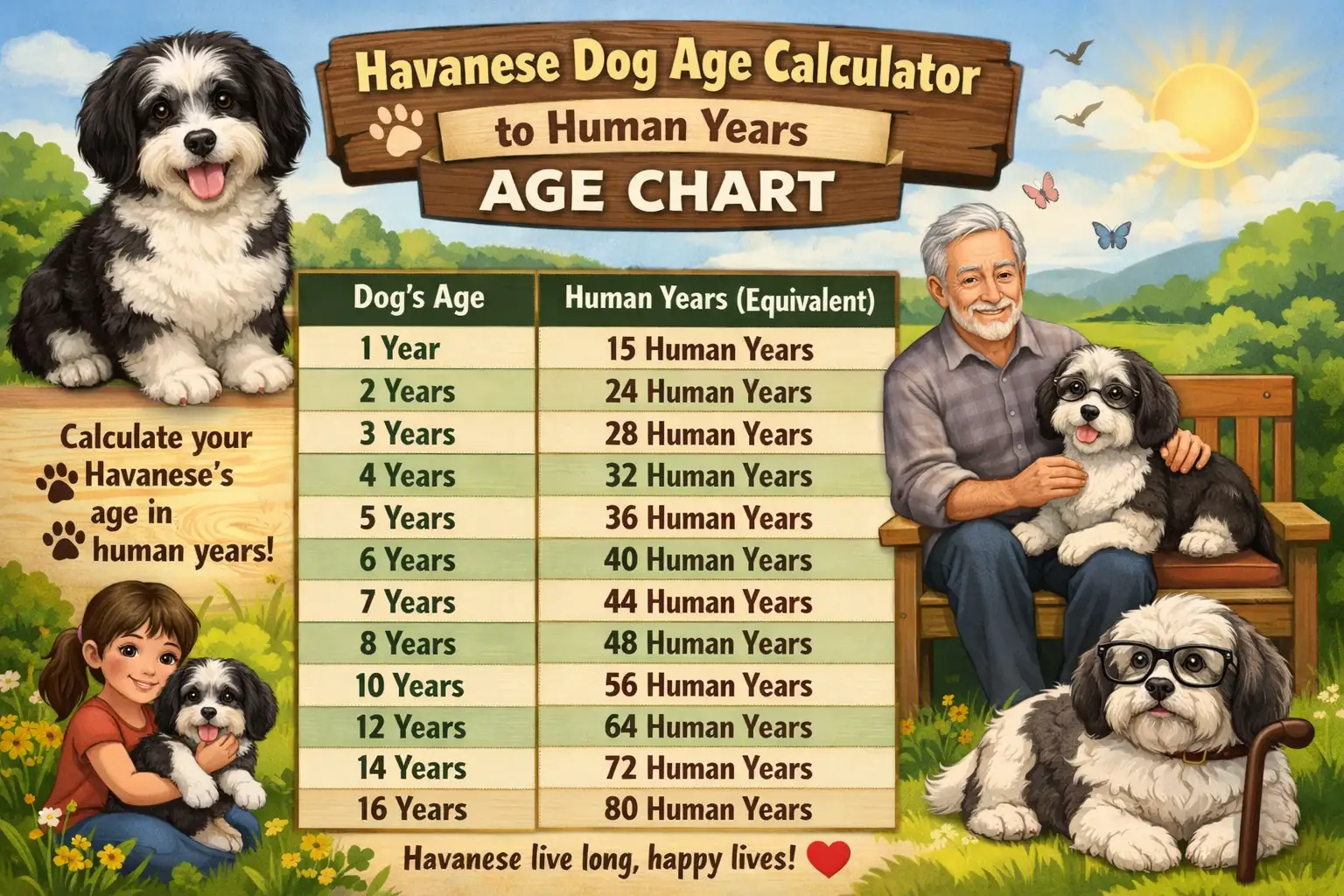
This age chart shows how a Havanese dog’s age compares to human years. It is made for small-breed dogs, so it is more accurate than general dog age charts.
Use this table if you want a quick and clear answer to the question:
“How old is my Havanese in human years?”
Havanese Dog Age to Human Years Chart
| Havanese Age (Dog Years) | Human Age Equivalent | Life Stage |
|---|---|---|
| 1 year | About 15 years | Puppy |
| 2 years | About 24 years | Young Adult |
| 3 years | About 28 years | Adult |
| 4 years | About 32 years | Adult |
| 5 years | About 36 years | Adult |
| 6 years | About 40 years | Adult |
| 7 years | About 44 years | Adult |
| 8 years | About 48 years | Senior |
| 9 years | About 52 years | Senior |
| 10 years | About 56 years | Senior |
| 11 years | About 60 years | Senior |
| 12 years | About 64 years | Senior |
| 13 years | About 68 years | Senior |
| 14 years | About 72 years | Senior |
| 15 years | About 76 years | Senior |
This chart shows two important things:
- Havanese dogs age very fast in the first two years
- After that, aging becomes slower and more even
For example, a 2-year-old Havanese is already like a young adult human. But a 10-year-old Havanese is closer to a healthy older adult, not extremely old.
Remember, this chart gives an estimate, not an exact number. Health, diet, exercise, and vet care can all affect how fast a dog ages.
Havanese Life Stages and Aging Signs
As your Havanese grows, their needs and behavior change. Knowing these life stages helps you care for your dog in the right way at the right time. Each stage comes with clear signs that are easy to notice if you know what to look for.
Havanese Life Stages and What to Expect
| Life Stage | Dog Age Range | Common Physical Changes | Common Behavior Changes |
|---|---|---|---|
| Puppy | 0–1 year | Fast growth, baby teeth, high energy | Curious, playful, short focus |
| Young Adult | 1–3 years | Full body growth, strong muscles | More calm, learns faster |
| Adult | 3–7 years | Stable weight, steady energy | Confident, predictable habits |
| Senior | 8+ years | Slower movement, gray hair, joint stiffness | More sleep, less energy |
What Aging Looks Like in a Havanese
Puppy Havanese dogs grow very fast. They need training, play, and good food to support healthy growth. This stage passes quickly.
Adult Havanese dogs are usually the easiest to care for. Their energy levels are balanced, and their personality is fully developed. Most Havanese stay playful and alert during these years.
Senior Havanese dogs may slow down, but many still enjoy walks and playtime. You might notice:
- longer sleep time
- slower walking or jumping
- less interest in long play sessions
- cloudy eyes or hearing loss
These signs are normal with age, but sudden changes should always be checked by a vet.
Understanding life stages helps you know what is normal and what is not. It also helps you plan food, exercise, and vet care as your dog grows older.
Helping Your Havanese Live a Longer, Healthier Life
A Havanese can live a long and happy life with the right daily care. Small habits make a big difference, especially as your dog gets older. This section focuses on simple steps any owner can follow.
Healthy Aging Tips for Havanese Dogs
| Life Stage | Food Focus | Exercise Needs | Vet Care Priority |
|---|---|---|---|
| Puppy | High-quality puppy food | Short play sessions | Vaccines and growth checks |
| Adult | Balanced diet and healthy weight | Daily walks and playtime | Yearly checkups |
| Senior | Easy-to-digest food | Gentle walks and light play | Blood tests and joint checks |
Simple Ways to Support Healthy Aging
This table helps Havanese owners quickly understand how care needs change as their dog moves from puppyhood to senior years.
Good food is the base of good health. Feeding the right amount helps prevent weight gain, which is very important for small dogs like the Havanese. Extra weight can hurt joints and make aging harder.
Exercise keeps your Havanese strong and happy. Younger dogs enjoy active play, while older dogs do better with shorter walks and calm activities. Even senior dogs still need daily movement.
Mental activity is just as important as physical exercise. Simple games, toys, and short training sessions help keep your dog’s brain sharp as they age.
Vet visits become more important as your Havanese gets older. Regular checkups can catch health problems early, before they become serious. Never ignore sudden changes in behavior, appetite, or movement.
With good care, many Havanese dogs stay cheerful and loving well into their senior years.
For more breed-specific health, lifespan, and care information, you can also explore the official Havanese breed guide from the American Kennel Club (AKC): https://www.akc.org/dog-breeds/havanese/

Ata Ur Rehman is the founder of Pet Age in Human Years Calculator, an educational platform that provides age conversion charts and lifespan guides for dogs, cats, birds, and other companion animals. His work focuses on helping pet owners understand how animal ages translate into human years using commonly accepted age conversion formulas and published lifespan averages.
The website compiles breed and species lifespan data from kennel clubs, breed organizations, and general animal lifespan studies to present simple and easy-to-understand guides for pet owners worldwide.
This website was created to centralize animal age conversion charts into one easy reference platform for pet owners.