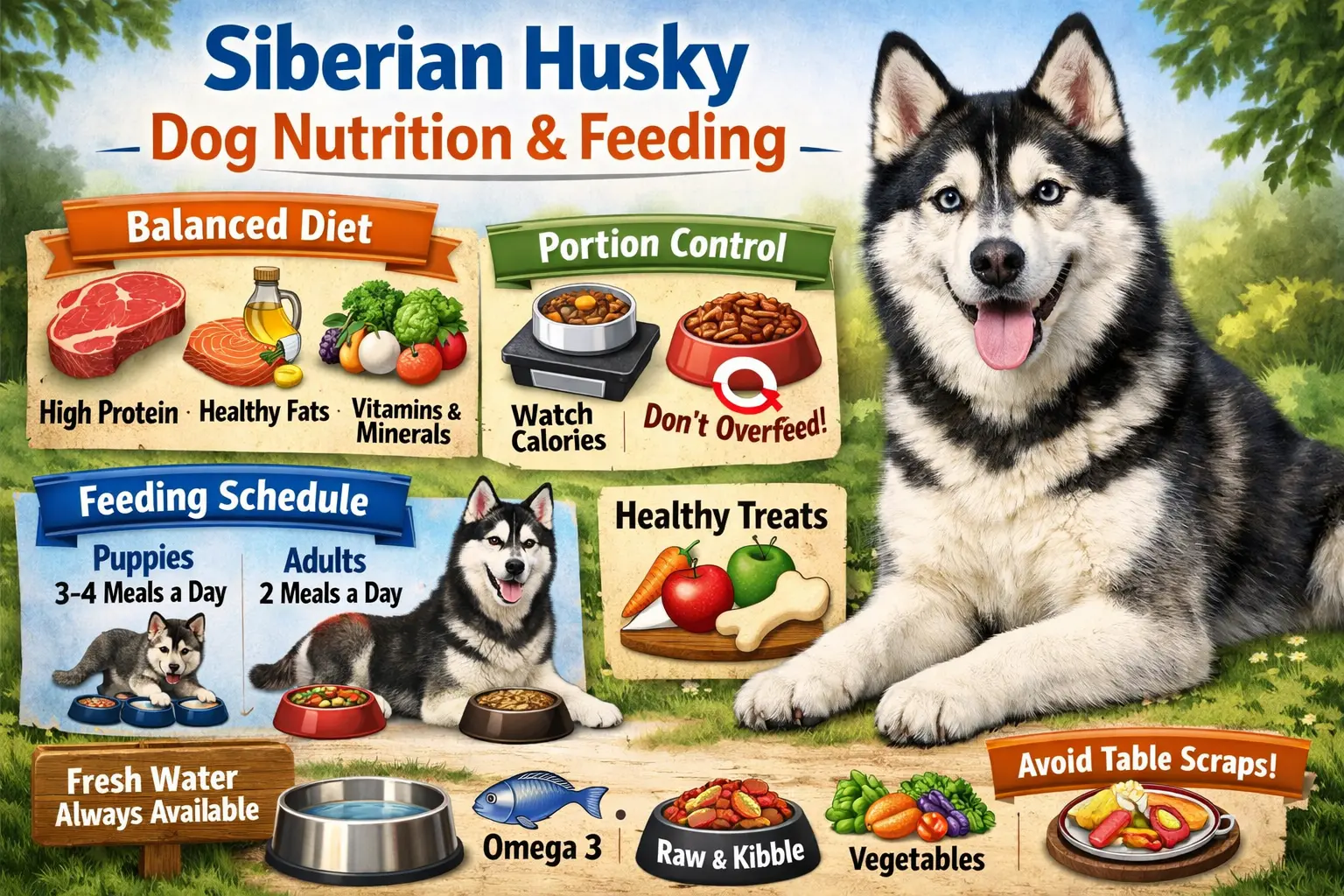
Siberian Huskies are not “typical” dogs when it comes to food. Many owners are surprised by how little some Huskies eat, how easily others gain weight, or how dramatically diet affects coat quality and energy. This guide is designed to help you feed a Siberian Husky correctly—without guesswork, overfeeding, or chasing food trends.
Siberian Huskies evolved to work efficiently in harsh environments, pulling sleds over long distances on limited rations. That history still shows up today. Compared to many breeds of similar size, Huskies often have a more efficient metabolism, meaning they may require fewer calories than expected for their body weight—especially when they are not working or exercising heavily. Feeding them like a Labrador or German Shepherd often leads to unwanted weight gain.
Proper nutrition directly influences several key areas of a Husky’s health and behavior:
- Energy and endurance: Too few calories or poor-quality protein can lead to fatigue, while excess calories can cause restlessness and weight gain.
- Weight stability: Huskies are known for either staying very lean or suddenly gaining weight if portions are not adjusted correctly.
- Coat and skin health: Their thick double coat depends heavily on adequate protein, essential fatty acids, and micronutrients.
- Digestive health: Many Huskies have sensitive stomachs and respond poorly to sudden diet changes or low-quality ingredients.
- Long-term health: Consistent, balanced nutrition supports joint health, immune function, and healthy aging.
Another important trait to understand is appetite variability. Some Siberian Huskies self-regulate well and skip meals when they are not very active. This can be normal. Others become picky eaters if they learn that refusing food leads to better options. Knowing the difference between normal Husky behavior and a real nutritional problem is critical—and this guide will help you tell them apart.
The goal of feeding a Siberian Husky is not to maximize food intake, but to match calories and nutrients to the dog in front of you: their age, activity level, metabolism, and overall condition. that follow, you’ll learn exactly how much to feed, what types of food work best, how to spot problems early, and how to keep your Husky healthy without overcomplicating mealtime.
How Much to Feed a Siberian Husky (Calories, Portions, Schedule)
This is the question most Husky owners ask first: “How much should my Siberian Husky eat?”
The answer depends on weight, activity level, and age. Huskies are efficient dogs, so feeding too much is a common mistake.
Use the tables below to get a clear starting point, then adjust based on your dog’s body shape and energy.
Daily calorie needs for a Siberian Husky
Most adult Siberian Huskies fall between 35–60 pounds, but their calorie needs change a lot with activity.
| Husky Weight | Low Activity (home, short walks) | Moderate Activity (daily walks/play) | High Activity / Working |
|---|---|---|---|
| 35 lb (16 kg) | 800–900 kcal | 1,000–1,100 kcal | 1,300–1,400 kcal |
| 45 lb (20 kg) | 900–1,050 kcal | 1,100–1,300 kcal | 1,500–1,700 kcal |
| 55 lb (25 kg) | 1,050–1,200 kcal | 1,300–1,500 kcal | 1,700–2,000 kcal |
| 60 lb (27 kg) | 는 1,100–1,300 kcal | 1,400–1,600 kcal | 1,900–2,200 kcal |
These numbers are daily totals, not per meal.
Feeding portions and meal frequency by age
| Life Stage | Meals Per Day | General Feeding Guidance |
|---|---|---|
| Puppy (2–6 months) | 3–4 meals | Higher calories for growth, small portions |
| Puppy (6–12 months) | 2–3 meals | Gradually reduce calories as growth slows |
| Adult Husky | 2 meals | Most Huskies do best with two meals daily |
| Senior Husky | 2 smaller meals | Slightly lower calories, easy-to-digest food |
Puppies need more calories per pound than adults, but adults usually eat more total food.
Portion size example (using dry food)
Always check the calorie count on your dog food bag. Kibble can range from 300 to 450 calories per cup.
Example:
- If your adult Husky needs 1,200 calories per day
- And the food has 400 calories per cup
- Your dog needs about 3 cups per day, split into two meals
This is why measuring by calories, not just cups, matters.
Body condition score: the easiest way to adjust food
Instead of guessing, look at your dog’s body shape.
| Body Condition | What You See | What to Do |
|---|---|---|
| Too thin | Ribs and hips very visible | Increase food slightly |
| Ideal | Ribs easy to feel, waist visible | Keep feeding the same |
| Overweight | No waist, ribs hard to feel | Reduce food and treats |
A healthy Husky should look lean, not round.
Why some Siberian Huskies eat less than expected
Many Huskies self-regulate. They may:
- Skip meals on low-activity days
- Eat less during hot weather
- Eat more in winter or during heavy exercise
This can be normal if your dog keeps a healthy body condition and has good energy.
It becomes a concern if your Husky:
- Loses weight fast
- Seems weak or tired
- Refuses food for more than 24–48 hours
In those cases, a vet check is important.
Best Food for Siberian Huskies: Diet Types, Ingredients, and Labels
Many Husky owners ask, “What is the best food for a Siberian Husky?”
There is no one perfect food, but there is a best choice for your dog’s body, activity, and stomach.
The goal is simple:
Good energy, healthy weight, shiny coat, and easy digestion.
Common dog food types for Siberian Huskies
Each food type has good and bad points. The table below makes it easy to compare.
| Food Type | Pros | Cons | Best For |
|---|---|---|---|
| Dry food (kibble) | Easy, affordable, long shelf life | Can be low quality if cheap | Most Husky owners |
| Canned food | Tasty, more moisture | Expensive, less teeth cleaning | Picky eaters |
| Fresh food | High quality, easy to digest | Costly, needs storage | Sensitive stomachs |
| Raw diet | High protein, fewer fillers | Safety risk if unbalanced | Experienced owners only |
| Freeze-dried | Nutritious, easy to store | Expensive | Travel or rotation |
| Homemade | Full control of ingredients | Easy to do wrong | Vet-guided diets only |
Most Siberian Huskies do very well on a high-quality kibble or a kibble + fresh food mix.
Grain-free vs grain-inclusive food
Grain-free food is popular, but it is not always better.
- Huskies do not need grain-free food
- Many Huskies digest rice, oats, or barley just fine
- Grain-free food is only helpful if a dog has a real grain allergy, which is rare
Unless your vet says otherwise, a grain-inclusive food is usually safer and cheaper.
Ideal nutrient levels for Siberian Huskies
Huskies need the right balance of protein and fat, not extreme amounts.
| Nutrient | Good Range for Huskies | Why It Matters |
|---|---|---|
| Protein | 22–30% | Muscle, energy, coat |
| Fat | 12–18% | Energy, skin, coat |
| Fiber | 3–6% | Digestion, stool quality |
Very high protein or fat is not needed unless your Husky is a working dog.
How to read a dog food label (simple guide)
When you read a dog food bag, focus on these points:
- First ingredient should be a real meat (chicken, beef, fish)
- Avoid foods with many fillers at the top
- Protein and fat should fit Husky needs
- Ignore marketing words like “premium” or “natural” without proof
If a food keeps your Husky lean, active, and regular, it is doing its job.
Treats and human foods for Huskies
Treats should make up less than 10% of daily calories.
Safe human foods (small amounts):
- Cooked chicken
- Plain rice
- Carrots
- Apples (no seeds)
- Plain yogurt
Avoid feeding table scraps often. Too many treats can cause weight gain fast.
Special Feeding Needs and Common Husky Nutrition Problems
Siberian Huskies are known for being a little different when it comes to eating. Some eat very little. Some are picky. Others have sensitive stomachs This helps you understand what is normal, what is not, and what you can do.
Feeding Siberian Husky puppies, adults, and seniors
Huskies need different food at different ages.
- Puppies need more calories for growth, but in small meals. Too much food can harm growing joints.
- Adult Huskies need steady calories to stay lean and active.
- Senior Huskies often need fewer calories and food that is easy to digest.
As your Husky ages, food amounts usually go down, not up.
Picky eating and food refusal in Huskies
Many Huskies are naturally picky. This does not always mean something is wrong.
Common reasons Huskies refuse food:
- Too many treats
- Free-feeding all day
- Learning that skipping meals brings better food
- Low activity days or hot weather
If your Husky is healthy and keeps a good weight, skipping a meal now and then can be normal.
Weight gain and weight loss problems
Some Huskies stay thin easily. Others gain weight fast.
- Weight gain usually comes from too many calories, not bad food
- Weight loss can happen if calories are too low or digestion is poor
Always check body shape, not just the scale.
Sensitive stomachs and food allergies
Many Huskies have sensitive digestion.
Signs include:
- Loose stool
- Gas
- Vomiting
- Itchy skin or ears
Slow food changes and simple ingredient diets often help.
Common Husky feeding problems and simple solutions
| Problem | Likely Cause | What to Try First | When to See a Vet |
|---|---|---|---|
| Skipping meals | Normal Husky behavior | Set meal times, limit treats | Weight loss or weakness |
| Loose stool | Food change too fast | Switch food slowly | Lasts over 2–3 days |
| Weight gain | Too many calories | Reduce portions and treats | No improvement |
| Picky eating | Learned behavior | Stop food swaps | Refuses food for 48 hrs |
| Gas or bloating | Poor digestion | Try simpler food | Repeated vomiting |
Switching dog food safely
Never change food suddenly.
A safe switch usually takes 7–10 days:
- Mix a little new food with old food
- Slowly increase the new food
- Watch stool and energy
This helps prevent stomach upset.
Foods to Avoid, FAQs, and When to See a Vet
focuses on safety and common questions Husky owners ask. Knowing what not to feed is just as important as knowing what to feed.
Foods Siberian Huskies can and cannot eat
Some foods are safe in small amounts. Others are dangerous and should never be given.
| Safe Foods (Small Amounts) | Unsafe / Toxic Foods | Why Unsafe |
|---|---|---|
| Cooked chicken (plain) | Chocolate | Toxic to dogs |
| Plain rice | Grapes & raisins | Can cause kidney failure |
| Carrots | Onions & garlic | Damage red blood cells |
| Apples (no seeds) | Xylitol (sweetener) | Can cause liver failure |
| Plain yogurt | Alcohol | Very dangerous |
| Pumpkin (plain) | Cooked bones | Choking and injury risk |
When in doubt, do not feed it.
Common feeding mistakes Husky owners make
These mistakes are very common but easy to fix:
- Feeding too many treats
- Free-feeding all day instead of set meals
- Switching food too fast
- Feeding based on cup size, not calories
- Assuming a skinny Husky is underfed
Most problems improve with routine and portion control.
Quick answers to common Husky nutrition questions
| Question | Short Answer |
|---|---|
| Why does my Husky skip meals? | Often normal if weight and energy are good |
| Is grain-free food better? | No, most Huskies do not need it |
| Can Huskies eat human food? | Some foods, in small amounts only |
| How do I know if I feed enough? | Check body shape, not the bowl |
| Should I change food often? | No, consistency is better |
Signs your Husky’s diet is working
Your Husky is likely eating well if you see:
- Steady energy
- Lean body shape
- Shiny coat
- Firm stool
- Normal appetite most days
When to see a vet or nutrition expert
You should talk to a vet if your Husky:
- Refuses food for more than 2 days
- Loses or gains weight quickly
- Has long-term diarrhea or vomiting
- Has itchy skin that does not improve
- Needs a special diet for health reasons
A vet or pet nutritionist can help create a safe feeding plan.
Final takeaway
Feeding a Siberian Husky does not need to be complicated. Focus on:
- Right calories
- Good-quality food
- Regular meals
- Watching your dog’s body and energy
Small changes can make a big difference.
For official, science-based standards on dog nutrition and feeding requirements, you can review the guidelines published by the Association of American Feed Control Officials (AAFCO), which set nutrient profiles used by reputable dog food brands worldwide.

Ata Ur Rehman is the founder of Pet Age in Human Years Calculator, an educational platform that provides age conversion charts and lifespan guides for dogs, cats, birds, and other companion animals. His work focuses on helping pet owners understand how animal ages translate into human years using commonly accepted age conversion formulas and published lifespan averages.
The website compiles breed and species lifespan data from kennel clubs, breed organizations, and general animal lifespan studies to present simple and easy-to-understand guides for pet owners worldwide.
This website was created to centralize animal age conversion charts into one easy reference platform for pet owners.