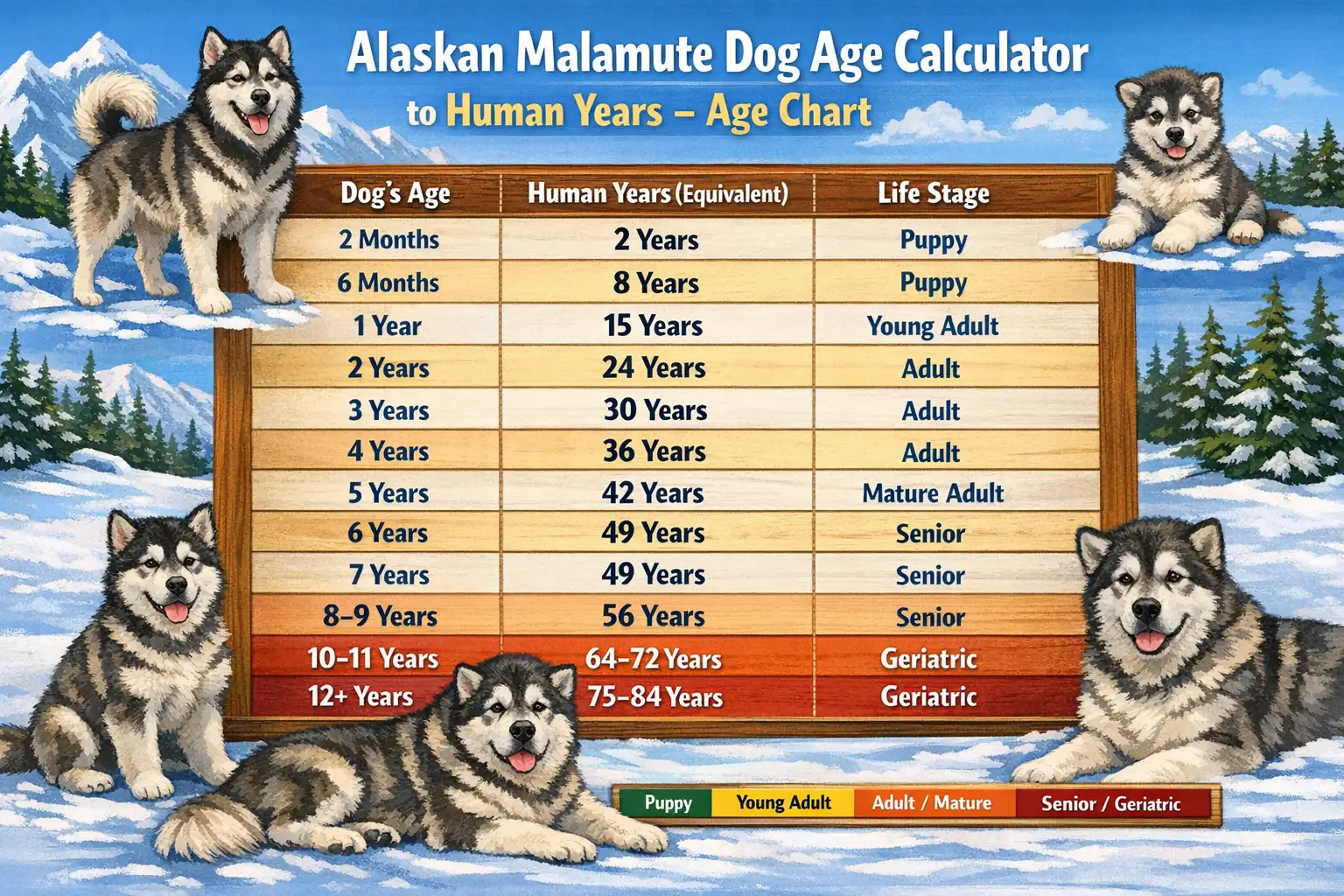
Alaskan Malamutes are a large, strong, and active breed known for their endurance and working capabilities. Understanding how they age is essential for providing the right care at each stage of life. Unlike the old belief that one dog year equals seven human years, the aging process of Malamutes—and large breeds in general—is more complex and depends on size, genetics, and lifestyle.
Large breeds like Alaskan Malamutes tend to age faster in their early years and show signs of seniority sooner than smaller breeds. A 1-year-old Malamute is roughly equivalent to a 15-year-old human in terms of growth and physical development, while aging slows slightly as they enter adulthood.
Life stages in Malamutes can be broadly divided into three main phases:
- Puppy (0–1 year): Rapid growth, teething, and early socialization.
- Adult (1–7 years): Peak physical condition, high activity levels, and full maturity.
- Senior (7+ years): Slower metabolism, early signs of aging in joints, muscles, and sometimes cognition.
| Breed | Size Category | Average Lifespan (Years) |
|---|---|---|
| Alaskan Malamute | Large | 10–14 |
| Labrador Retriever | Large | 10–12 |
| German Shepherd | Large | 9–13 |
| Beagle | Medium | 12–15 |
| Chihuahua | Small | 14–18 |
Scientific Basis of Dog-to-Human Age Conversion
Many people think that one dog year equals seven human years, but this is not accurate, especially for large breeds like Alaskan Malamutes. Dogs age differently at each stage of life. In their first year, they grow very fast, almost like a teenager in human terms. After that, aging slows down and changes depending on the dog’s size, breed, and health.
Scientists have studied how dogs age and found that age is not linear. Smaller dogs often live longer and age more slowly, while large breeds like Malamutes mature quickly and may show signs of aging sooner. A 1-year-old Malamute is roughly 15 in human years, but by the time the dog reaches 5, it may already be around 36 in human years.
Recent research using epigenetics, the study of DNA changes as dogs age, shows that dog aging follows a logarithmic pattern rather than a straight line. This means that dogs grow very fast at first, then age more slowly during adulthood, and accelerate aging again as they become seniors.
| Dog Age (Years) | Small Breed Human Age | Medium Breed Human Age | Large Breed Human Age | Giant Breed Human Age |
|---|---|---|---|---|
| 1 | 15 | 15 | 15 | 15 |
| 2 | 24 | 24 | 24 | 24 |
| 3 | 28 | 28 | 28 | 30 |
| 4 | 32 | 32 | 34 | 38 |
| 5 | 36 | 36 | 36 | 45 |
| 6 | 40 | 42 | 42 | 52 |
| 7 | 44 | 47 | 47 | 59 |
| 8 | 48 | 51 | 52 | 66 |
| 9 | 52 | 56 | 57 | 73 |
| 10 | 56 | 60 | 62 | 80 |
| 11 | 60 | 65 | 66 | 87 |
| 12 | 64 | 69 | 71 | 94 |
This table shows that large breeds like Malamutes age faster than small dogs after the first few years. Understanding this helps owners provide better care, plan vet visits, and watch for early signs of aging.
Alaskan Malamute Age Calculator & Conversion Chart
If you own an Alaskan Malamute, it is helpful to know how their age compares to human years. Large breeds like Malamutes grow fast in their first year, then age more slowly in adulthood, and start showing senior signs around 7 years.
The table below shows Alaskan Malamute age in dog years and the equivalent in human years,
| Dog Age (Years) | Human Equivalent Age | Life Stage |
|---|---|---|
| 1 | 15 | Puppy |
| 2 | 24 | Puppy |
| 3 | 28 | Young Adult |
| 4 | 34 | Adult |
| 5 | 36 | Adult |
| 6 | 42 | Adult |
| 7 | 47 | Senior |
| 8 | 52 | Senior |
| 9 | 57 | Senior |
| 10 | 62 | Senior |
| 11 | 66 | Senior |
| 12 | 71 | Senior |
| 13 | 76 | Senior |
| 14 | 81 | Senior |
This chart shows that after about 7 years, Malamutes start entering their senior phase. Owners should watch for slower movement, stiffness, or changes in behavior and appetite.
Real-life examples:
- A 3-year-old Malamute is like a 28-year-old human, fully grown and active.
- A 7-year-old Malamute is like a 47-year-old human, entering senior years and needing more care.
- A 12-year-old Malamute is like a 71-year-old human, and should have regular vet checkups and gentle exercise.
Life Stages and What to Expect
Alaskan Malamutes go through three main life stages: puppy, adult, and senior. Knowing what to expect at each stage helps owners give the right care, nutrition, and exercise.
The table below summarizes the life stages, age ranges, and key physical and behavioral changes for Malamutes.
| Life Stage | Dog Age Range | Key Physical Changes | Behavior/Activity | Care Tips |
|---|---|---|---|---|
| Puppy | 0–1 year | Rapid growth, teething | High energy, learning social skills | Early training, socialization, puppy vaccinations, proper nutrition |
| Young Adult | 2–3 years | Full size reached, muscles developed | Very active, playful, needs mental stimulation | Consistent exercise, training reinforcement, healthy diet |
| Adult | 4–6 years | Steady metabolism, peak strength | Stable behavior, high activity, social | Balanced nutrition, regular vet checkups, joint care if needed |
| Senior | 7+ years | Slower metabolism, signs of aging in joints, teeth | Less active, may show stiffness, cognitive changes | Gentle exercise, weight management, regular vet screenings, comfortable bedding |
Some key points to remember:
- Puppies need lots of socialization and training to grow into well-behaved adults.
- Adult Malamutes are at their peak strength and require consistent exercise to stay healthy.
- Senior Malamutes may show stiff joints, slower movement, or changes in appetite, so gentle care and regular vet visits are important.
Understanding these stages helps owners adjust feeding, exercise, and health monitoring based on the dog’s age.
Tips to Help Your Malamute Age Healthily
As your Alaskan Malamute grows older, it’s important to make sure they stay healthy and happy through each stage of life. Proper care, nutrition, and exercise can help them live longer, more comfortable lives.
The table below gives a quick-reference checklist for owners to care for their Malamute at each age.
| Age Range | Care Tips | Nutrition | Exercise | Vet Visits |
|---|---|---|---|---|
| Puppy (0–1 year) | Early training, socialization | High-quality puppy food, high protein | Playtime, training sessions | Regular vet checkups, vaccinations |
| Young Adult (2–3 years) | Consistent training, social activities | Balanced diet with lean protein | Daily walks, running, mental challenges | Annual checkup, heartworm prevention |
| Adult (4–6 years) | Maintain training, prevent boredom | Nutrient-rich food for energy and joints | Regular activity, moderate exercise | Biannual checkup, dental care |
| Senior (7+ years) | Gentle exercise, comfortable environment | Weight management food, joint supplements | Short walks, mental enrichment games | Semi-annual checkups, arthritis care, blood tests |
Some important points for healthy aging:
- Nutrition: Make sure you’re feeding your Malamute a diet that matches their age and activity level. As they age, their metabolism slows, so feeding them the right balance of nutrients is important to prevent obesity.
- Exercise: Puppies need plenty of active play, while older dogs benefit from gentle exercise to keep their joints moving without strain.
- Vet Care: Regular vet visits are essential to catch any health problems early. Senior dogs, in particular, need frequent checkups to monitor their heart, joints, and overall health.
- Lifestyle: Keep your Malamute mentally stimulated with interactive toys and puzzles, especially as they age. A happy mind can help keep the body healthy!
For more information on the care and health of Alaskan Malamutes, visit the American Kennel Club’s Alaskan Malamute breed page here for detailed breed information, training tips, and more.

Ata Ur Rehman is the founder of Pet Age in Human Years Calculator, an educational platform that provides age conversion charts and lifespan guides for dogs, cats, birds, and other companion animals. His work focuses on helping pet owners understand how animal ages translate into human years using commonly accepted age conversion formulas and published lifespan averages.
The website compiles breed and species lifespan data from kennel clubs, breed organizations, and general animal lifespan studies to present simple and easy-to-understand guides for pet owners worldwide.
This website was created to centralize animal age conversion charts into one easy reference platform for pet owners.