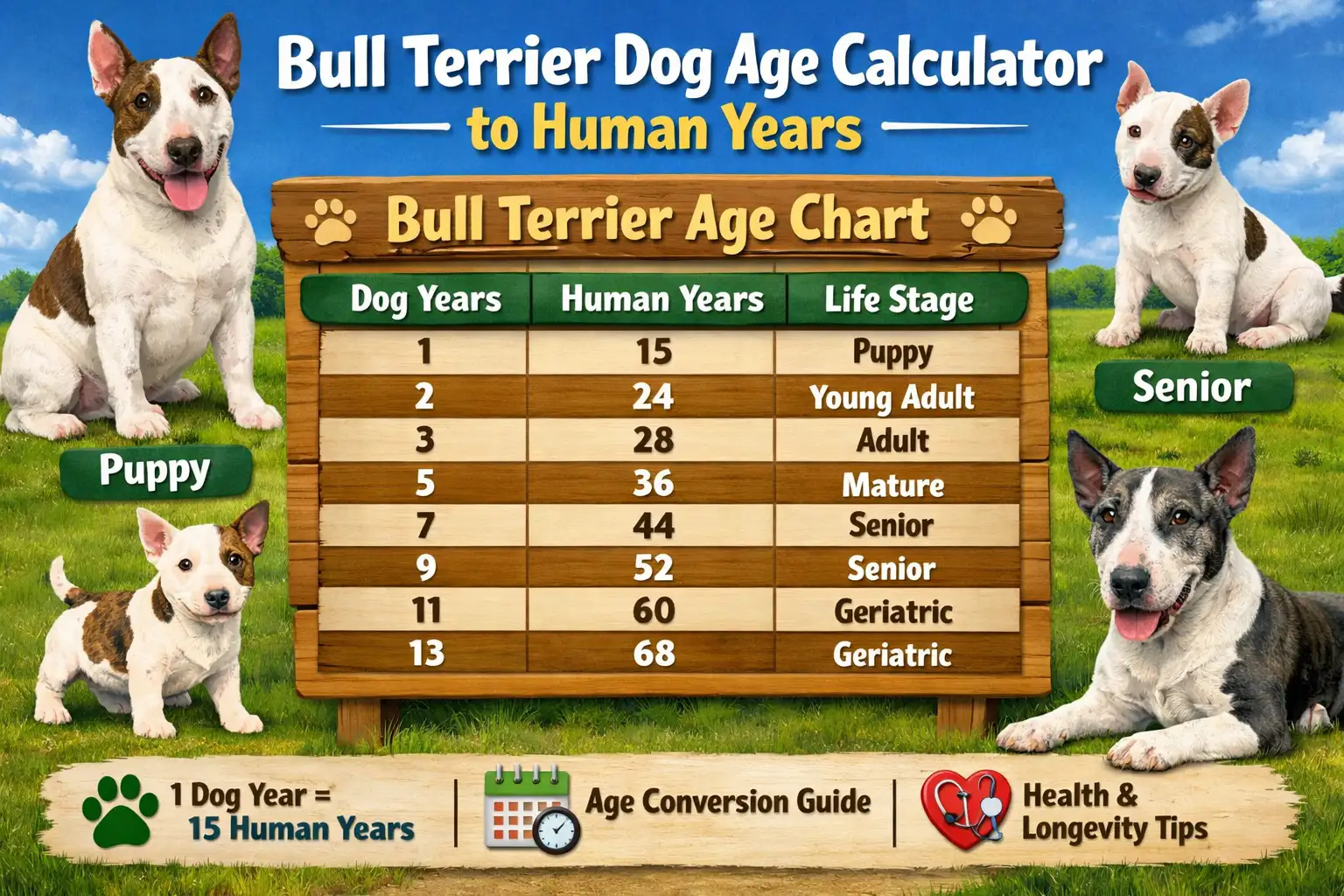
Bull Terriers grow and age differently from humans, and it’s a common mistake to think that one dog year equals seven human years. In reality, dogs mature faster in their first few years and then age more slowly, with the exact rate depending on their breed, size, and genetics.
Bull Terriers are medium-sized, muscular dogs. Their bodies reach adulthood quickly, usually by 1–2 years of age. Because of this early growth, a 1-year-old Bull Terrier can already be roughly equivalent to a 15-year-old human in physical and developmental terms.
Life stages for Bull Terriers can be divided into three main categories:
- Puppy: Birth to about 1 year
- Adult: 1 to 7 years
- Senior: 7 years and older
Breed, size, and genetic factors all play a role in how fast a Bull Terrier ages. While small breeds may live longer, Bull Terriers have an average lifespan of around 10–12 years. Understanding these stages helps owners provide the right care at the right time and prepares them for changes in behavior, energy levels, and health needs.
By knowing how Bull Terriers age compared to humans, you can make better decisions about nutrition, exercise, and preventive health care for your dog.
The Science Behind Bull Terrier Aging
Bull Terriers, like all dogs, do not age at a constant rate. They grow quickly during the first year, slow down as adults, and show signs of aging around 7 years old. Understanding the science of their aging helps owners know what to expect and how to care for their dog.
The rate at which a Bull Terrier ages depends on several factors:
- Size and breed: Medium-sized, muscular breeds like Bull Terriers have a lifespan of about 10–12 years. They age faster than small breeds but slower than giant breeds.
- Growth curve: Bull Terriers reach full size and maturity quickly, usually by 1–2 years. After that, the aging process becomes steadier.
- Genetics and health: Dogs with strong genetics and proper care tend to live longer and age more gracefully.
- Lifestyle and neutering: Active dogs with a balanced diet often age slower. Neutering or spaying can also influence lifespan slightly.
Recent studies, including the 2019 canine epigenetic methylation study, show that dog aging is logarithmic, not linear. This means dogs age rapidly in the early years and then the rate slows down as they get older.
To make this easier to understand, here’s a general overview of Bull Terrier growth and aging:
| Life Stage | Age Range | Key Changes |
|---|---|---|
| Puppy | 0–1 year | Rapid growth, learning basic skills, teething |
| Young Adult | 1–3 years | Full physical maturity, high energy, strong muscles |
| Adult | 3–7 years | Stable energy, consistent health, peak performance |
| Senior | 7+ years | Slower metabolism, signs of aging like graying fur, lower energy, possible joint stiffness |
By understanding these stages, owners can better plan for exercise, nutrition, and vet visits to keep their Bull Terrier healthy throughout their life.
Bull Terrier Age Calculator & Age Chart
Many people still think one dog year equals seven human years, but that is not accurate for Bull Terriers. Their early years are faster, and later years are slower. Using modern science and breed-specific data, we can estimate Bull Terrier age in human years more realistically.
Here is a Bull Terrier age-to-human years chart based on life stage and size:
| Bull Terrier Age (Years) | Human Age Equivalent | Life Stage |
|---|---|---|
| 0.5 | 7 | Puppy |
| 1 | 15 | Puppy |
| 2 | 24 | Young Adult |
| 3 | 28 | Adult |
| 4 | 32 | Adult |
| 5 | 36 | Adult |
| 6 | 40 | Adult |
| 7 | 44 | Adult |
| 8 | 48 | Senior |
| 9 | 52 | Senior |
| 10 | 56 | Senior |
| 11 | 60 | Senior |
| 12 | 64 | Senior |
Examples:
- A 1-year-old Bull Terrier is like a 15-year-old human: full of energy and learning new skills.
- A 5-year-old Bull Terrier is like a 36-year-old human: mature, steady, and in peak health.
- A 10-year-old Bull Terrier is like a 56-year-old human: may start showing signs of aging, slower energy, and needs more rest.
This chart helps owners understand their dog’s age in a human context, plan for proper care, and notice when special attention is needed for senior dogs.
Bull Terrier Life Stages: Puppy, Adult, Senior
Bull Terriers go through three main life stages: puppy, adult, and senior. Each stage comes with changes in behavior, energy, and health. Understanding these stages helps owners give the right care at the right time.
Here is a summary of Bull Terrier life stages and what to expect:
| Life Stage | Age Range | Key Behavioral/Physical Signs | Care Tips |
|---|---|---|---|
| Puppy | 0–1 year | Rapid growth, teething, learning basic commands, high energy | Socialize early, basic training, proper diet, regular vet checks |
| Young Adult | 1–3 years | Full physical maturity, strong muscles, very playful and active | Consistent training, maintain exercise, balanced nutrition |
| Adult | 3–7 years | Stable energy, steady behavior, peak health | Monitor weight, regular vet check-ups, mental stimulation |
| Senior | 7+ years | Slower metabolism, lower energy, possible joint stiffness, gray fur, cognitive changes | Adjust diet, gentle exercise, joint supplements, routine vet visits, more rest |
By knowing these life stages, Bull Terrier owners can anticipate behavior changes, support development, and adjust care as their dog ages.
Helping Your Bull Terrier Age Healthily
| Health Aspect | Recommendation | Frequency |
|---|---|---|
| Nutrition | Feed high-quality, age-appropriate food | Daily |
| Weight Management | Monitor weight and adjust food as needed | Weekly check |
| Exercise | Gentle walks, play, and mental enrichment | Daily |
| Vet Check-ups | Routine exams, vaccinations, and blood work | Every 6–12 months |
| Joint Health | Consider supplements for senior dogs | As advised by vet |
| Dental Care | Brush teeth or use dental chews | Several times a week |
| Cognitive Stimulation | Training, puzzle toys, and interaction | Daily |
| Rest & Comfort | Provide soft bedding and quiet space | Always available |
These steps help prevent obesity, maintain joint health, keep the mind active, and catch health issues early. Even small daily habits can improve the quality of life for a senior Bull Terrier.
By following these guidelines, owners can support their Bull Terrier through every stage, from energetic puppy to senior dog, ensuring a longer, healthier, and happier life.
“For more detailed information on the official Bull Terrier breed standards, you can visit the AKC’s Bull Terrier page here.”

Ata Ur Rehman is the founder of Pet Age in Human Years Calculator, an educational platform that provides age conversion charts and lifespan guides for dogs, cats, birds, and other companion animals. His work focuses on helping pet owners understand how animal ages translate into human years using commonly accepted age conversion formulas and published lifespan averages.
The website compiles breed and species lifespan data from kennel clubs, breed organizations, and general animal lifespan studies to present simple and easy-to-understand guides for pet owners worldwide.
This website was created to centralize animal age conversion charts into one easy reference platform for pet owners.