Many people still believe that one dog year equals seven human years, but this rule is especially inaccurate for Greyhounds. Greyhounds mature very quickly in their early years, then age more slowly through adulthood before entering senior years earlier than many medium or small breeds. Because of this non-linear aging pattern, Greyhound age conversion must be approached differently.
Greyhounds are a unique combination of large-breed physiology and sighthound genetics. They grow rapidly as puppies, reach physical maturity earlier than many dogs, and often show senior changes sooner despite having a lifespan that can rival or exceed other large breeds when properly cared for.
To understand Greyhound age in human years, it’s important to compare how aging actually works in both species.
Why Greyhound Aging Is Different From Human Aging
| Factor | Humans | Greyhounds |
|---|---|---|
| Early growth speed | Slow, gradual | Extremely fast |
| Physical maturity | ~18–21 years | ~18–24 months |
| Aging pattern | Mostly linear | Rapid early, slower adult, faster senior |
| Senior stage begins | ~60+ years | ~7–8 years |
| Lifespan variation | Moderate | Strongly influenced by size & breed |
This table highlights why the “7-year rule” fails. A Greyhound doesn’t age evenly year by year. The first two years represent a huge biological leap, similar to humans going from infancy to young adulthood in a short span. After that, aging slows until later adulthood, when age-related changes begin to accelerate again.
What This Means for Greyhound Owners
- A 2-year-old Greyhound is already a fully mature adult, not a “teenager”
- A 7- or 8-year-old Greyhound is often entering senior status, even if they still appear energetic
- Lifestyle, nutrition, and veterinary care can significantly influence how quickly aging signs appear
Understanding this aging pattern is essential before using a Greyhound age calculator or age chart. Without this context, numbers alone can be misleading.
Greyhound Age Calculator: Convert Greyhound Years to Human Years
A Greyhound age calculator helps you quickly understand how old your Greyhound is in human years. Instead of guessing or using the old 7-year rule, this calculator follows how Greyhounds actually grow and age.
The idea is simple:
Greyhounds age very fast when they are young, then more slowly as adults, and faster again when they become seniors. The calculator adjusts for these changes so the result makes sense in real life.
How the Greyhound Age Calculator Works
The calculator does not multiply age by seven. Instead, it breaks aging into stages and converts each stage differently.
| Greyhound Age Range | How Aging Is Calculated |
|---|---|
| 0–2 years | Very fast aging (puppy to full adult) |
| 2–6 years | Slower, steady adult aging |
| 7+ years | Faster aging as a senior dog |
This method reflects how Greyhounds develop:
- The first two years cover a lot of physical and mental growth
- Adult years are more stable
- Senior years bring quicker age-related changes
How to Use a Greyhound Age Calculator
Using the calculator is easy:
- Enter your Greyhound’s age in years
- The calculator adjusts for early growth and senior aging
- You get a human-age equivalent that matches real Greyhound aging
For example:
- A 2-year-old Greyhound is similar to a young adult human
- An 8-year-old Greyhound is closer to a human in their late 50s or early 60s
This gives you a clearer picture of your dog’s life stage, health needs, and care priorities.
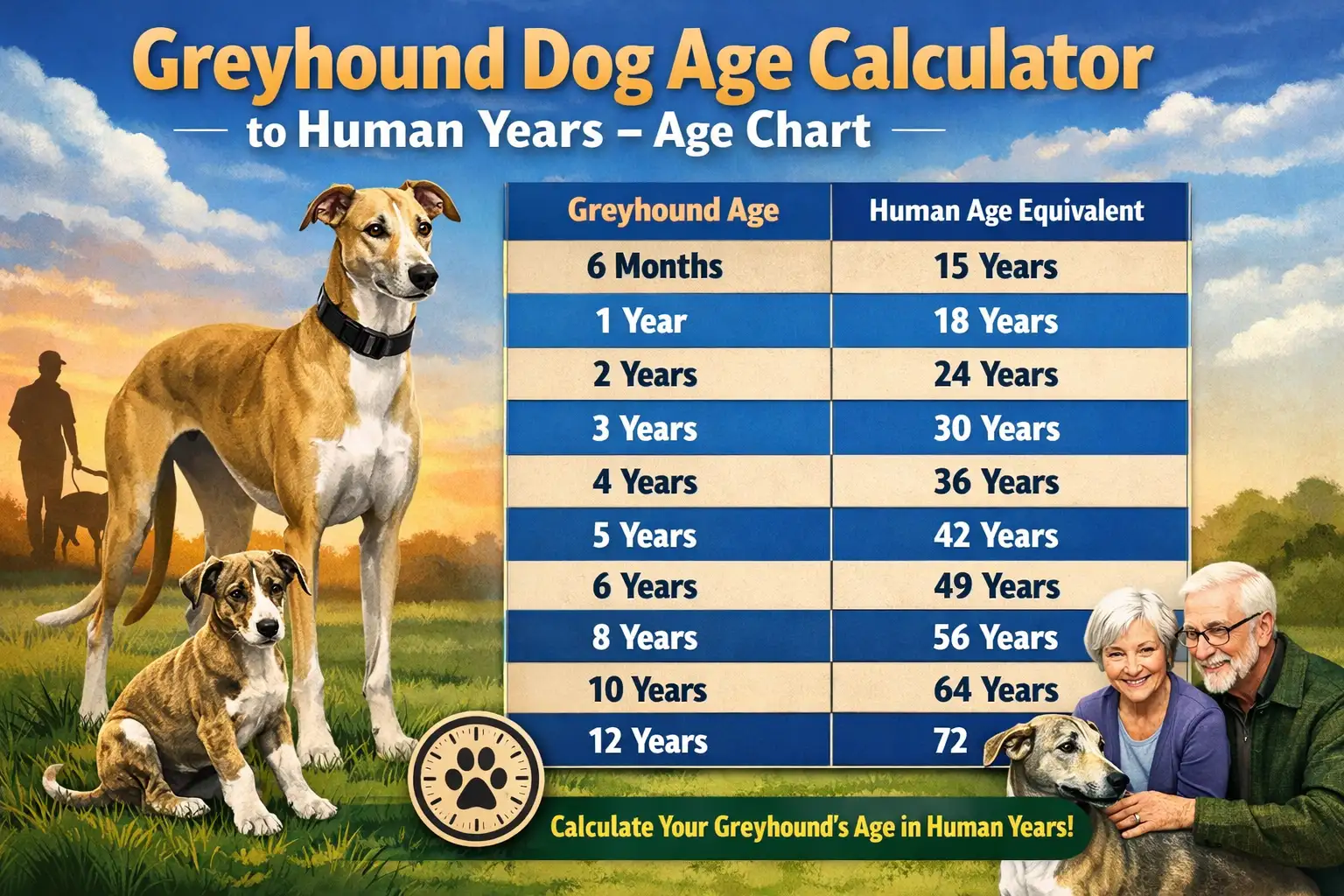
Greyhound Age Chart (Greyhound Years to Human Years)
Some readers don’t want to use a calculator. They just want a simple chart they can look at and get an answer right away.
The table below shows Greyhound age compared to human age, based on how Greyhounds really grow and age. It follows fast early aging, slower adult years, and faster senior aging.
Greyhound Age to Human Age Chart
| Greyhound Age | Human Age Equivalent | Life Stage |
|---|---|---|
| 1 year | 15–18 years | Puppy |
| 2 years | ~24 years | Young adult |
| 3 years | ~30 years | Adult |
| 4 years | ~36 years | Adult |
| 5 years | ~40 years | Adult |
| 6 years | ~45 years | Mature adult |
| 7 years | ~50 years | Mature adult |
| 8 years | 55–60 years | Senior |
| 9 years | ~62 years | Senior |
| 10 years | 65–70 years | Senior |
| 11 years | ~73 years | Geriatric |
| 12 years | 75+ years | Geriatric |
How to Read This Chart
- The first two years show big jumps because Greyhounds grow very fast
- Adult years increase more slowly
- After 7–8 years, aging speeds up again as senior changes begin
This chart gives a quick answer, but it does not replace real-life observation. Two Greyhounds of the same age can still feel very different depending on health, weight, and lifestyle.
Greyhound Life Stages and Aging Milestones
Knowing your Greyhound’s age is helpful, but understanding what that age looks like in daily life is even more important. Greyhounds move through life stages faster than many dogs, and the changes can be easy to miss if you don’t know what to watch for.
The table below explains each Greyhound life stage in a simple way.
| Life Stage | Greyhound Age | What Owners Often Notice |
|---|---|---|
| Puppy | 0–1.5 years | Fast growth, long legs, clumsy movement, playful bursts |
| Young Adult | 2–3 years | Full size reached, calmer indoors, high sprint energy |
| Adult | 4–6 years | Stable routine, strong muscles, good stamina |
| Mature Adult | 7–8 years | Slower recovery after runs, more rest time |
| Senior | 9+ years | Stiff joints, more sleep, less interest in long activity |
When Is a Greyhound Considered Senior?
Most Greyhounds are considered senior dogs around 7–8 years old. Some may still act young, while others begin slowing down earlier. This is normal.
Common early signs of aging include:
- Taking longer to stand up
- Sleeping more during the day
- Less interest in running or playing
- Mild stiffness after rest
A Greyhound can still enjoy life fully during senior years, but their needs change.
Understanding these life stages helps you:
- Adjust exercise safely
- Watch for health changes early
- Provide the right care at the right time
How to Help a Greyhound Age Healthily and Live Longer
A Greyhound’s age does not tell the whole story. Good care can slow aging and improve quality of life, especially as your dog gets older. Small changes in daily care can make a big difference.
The table below shows what to focus on at each age.
| Greyhound Age | Main Care Focus |
|---|---|
| Puppy | Safe exercise, bone growth, gentle training |
| Young Adult | Lean weight, muscle strength, routine vet checks |
| Adult | Regular exercise, dental care, balanced diet |
| Mature Adult | Joint support, weight control, yearly blood work |
| Senior | Comfort, mobility help, pain monitoring |
Senior Greyhound Health Warning Signs
| Sign You Notice | What It May Mean |
|---|---|
| Stiff legs or limping | Joint or arthritis pain |
| Weight loss | Dental or digestion problems |
| Confusion or pacing | Brain aging or stress |
| Trouble standing | Muscle weakness or pain |
| Less interest in food | Illness or dental issues |
Simple Tips That Help at Any Age
- Keep your Greyhound lean, not overweight
- Use soft bedding to protect joints
- Give short, regular walks instead of long hard exercise
- Visit the vet at least once a year, twice for seniors
- Watch small changes — they matter
For more breed-specific health, lifespan, and care information, you can also explore the official Greyhound resources provided by the American Kennel Club (AKC), which offers reliable, vet-reviewed guidance for dog owners.

Ata Ur Rehman is the founder of Pet Age in Human Years Calculator, an educational platform that provides age conversion charts and lifespan guides for dogs, cats, birds, and other companion animals. His work focuses on helping pet owners understand how animal ages translate into human years using commonly accepted age conversion formulas and published lifespan averages.
The website compiles breed and species lifespan data from kennel clubs, breed organizations, and general animal lifespan studies to present simple and easy-to-understand guides for pet owners worldwide.
This website was created to centralize animal age conversion charts into one easy reference platform for pet owners.