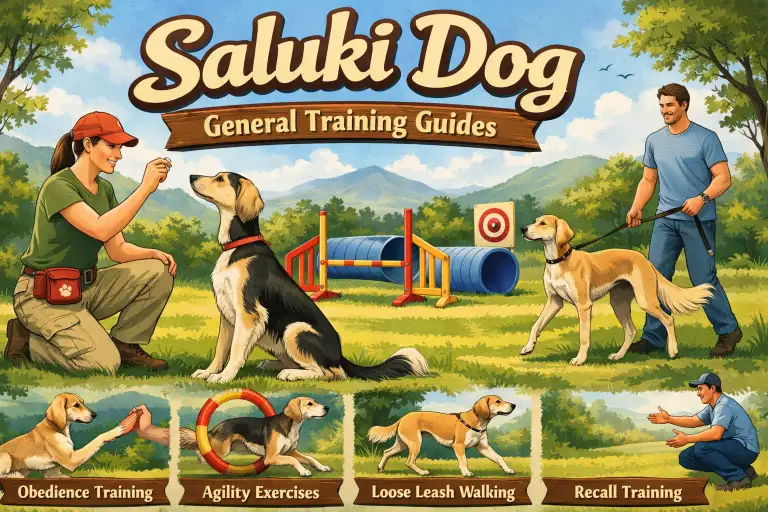
Training a Saluki is not about forcing obedience or drilling commands until they comply. It’s about understanding how this breed thinks, what motivates them, and why traditional “one-size-fits-all” dog training advice often fails with sighthounds.
Salukis were bred to hunt independently, make fast decisions at a distance, and rely on their own judgment rather than constant human direction. That heritage still shapes how they learn today. As a result, many owners mistakenly label Salukis as stubborn, aloof, or untrainable—when in reality, they are selective learners who respond best to thoughtful, trust-based training.
This guide is designed to help you train a Saluki in a way that respects their independence while still building reliable, safe, and practical behaviors for everyday life. It’s written for:
- First-time Saluki owners who feel overwhelmed or confused by inconsistent results
- Experienced dog owners struggling with recall, attention, or “selective listening”
- Owners of Saluki puppies and adult rescues who need realistic guidance
Rather than promising perfect obedience, this article focuses on achievable training success: better communication, safer management, improved responsiveness, and a stronger partnership between you and your dog. If you approach Saluki training with the right expectations and methods, meaningful progress is absolutely possible.
Why Saluki Training Is Different (And Why It Matters)
Many people struggle with Saluki training because they expect this breed to learn like a Labrador or German Shepherd. Salukis are not disobedient. They are independent thinkers. They were bred to chase prey far away from humans and make quick decisions on their own. This changes how they learn today.
If training is done the wrong way, Salukis may:
- Ignore commands
- Lose interest quickly
- Shut down or walk away
- Become unsafe off leash due to chasing instincts
When training is done the right way, Salukis can:
- Respond reliably in calm environments
- Learn household rules well
- Build strong trust with their owner
- Stay safer and more controlled outdoors
Good training is important for safety, not just manners. A Saluki that runs after something without recall can easily get injured or lost. Training also reduces stress for both the dog and the owner because expectations are clear.
Below is a simple table to help you understand why normal training advice often fails with Salukis—and what works better instead.
Saluki Training Reality vs Common Expectations
| Saluki Trait | What Owners Often Expect | What Works Better |
|---|---|---|
| Independent nature | Immediate obedience | Choice-based training |
| High prey drive | Reliable recall anywhere | Controlled environments and long lines |
| Low repetition tolerance | Repeating commands many times | Short sessions with variety |
| Sensitive personality | Firm corrections | Calm guidance and rewards |
| Selective attention | Constant focus on owner | Training when motivation is high |
Understanding these differences early prevents frustration and mistakes. Once owners stop fighting the Saluki’s nature and start working with it, training becomes much easier and more successful.
Why Saluki Training Is Different (And Why It Matters)
Many people struggle with Saluki training because they expect this breed to learn like a Labrador or German Shepherd. Salukis are not disobedient. They are independent thinkers. They were bred to chase prey far away from humans and make quick decisions on their own. This changes how they learn today.
If training is done the wrong way, Salukis may:
- Ignore commands
- Lose interest quickly
- Shut down or walk away
- Become unsafe off leash due to chasing instincts
When training is done the right way, Salukis can:
- Respond reliably in calm environments
- Learn household rules well
- Build strong trust with their owner
- Stay safer and more controlled outdoors
Good training is important for safety, not just manners. A Saluki that runs after something without recall can easily get injured or lost. Training also reduces stress for both the dog and the owner because expectations are clear.
Below is a simple table to help you understand why normal training advice often fails with Salukis—and what works better instead.
Saluki Training Reality vs Common Expectations
| Saluki Trait | What Owners Often Expect | What Works Better |
|---|---|---|
| Independent nature | Immediate obedience | Choice-based training |
| High prey drive | Reliable recall anywhere | Controlled environments and long lines |
| Low repetition tolerance | Repeating commands many times | Short sessions with variety |
| Sensitive personality | Firm corrections | Calm guidance and rewards |
| Selective attention | Constant focus on owner | Training when motivation is high |
Understanding these differences early prevents frustration and mistakes. Once owners stop fighting the Saluki’s nature and start working with it, training becomes much easier and more successful.
How to Train a Saluki the Right Way
Training a Saluki works best when it feels fair, calm, and rewarding. This breed does not respond well to pressure or force. Instead of trying to control them, the goal is to guide them and make training worth their effort.
Salukis learn fastest when:
- Training sessions are short
- Rewards are meaningful to them
- The space is quiet and controlled
- You stop before they get bored
They are smart dogs, but they do not enjoy repeating the same task many times. One or two good responses are often better than ten forced ones.
The table below shows the most effective training principles for Salukis and how to use them in daily life.
Effective Training Principles for Salukis
| Training Principle | Why It Matters for Salukis | How to Use It |
|---|---|---|
| Positive rewards | Salukis choose what feels good | Use treats, praise, or a favorite toy |
| Short sessions | They lose focus quickly | Train for a few minutes only |
| Calm environment | Distractions are very powerful | Start training indoors or fenced areas |
| Clear timing | Late rewards confuse learning | Reward right after the behavior |
| Choice-based learning | They dislike being forced | Invite the behavior instead of demanding it |
Another common mistake is training for too long or too often. Salukis can shut down if they feel pushed. Use the guide below to keep sessions safe and effective.
Saluki Training Session Timing and Frequency
| Dog Type | Session Length | Sessions Per Day | Signs of Progress |
|---|---|---|---|
| Saluki puppy | 2–4 minutes | 3–4 short sessions | Quick response, happy focus |
| Adult Saluki | 3–6 minutes | 2–3 sessions | Calm cooperation |
| Rescue Saluki | 1–3 minutes | 1–2 sessions | Growing trust, less avoidance |
| High-energy Saluki | 3–5 minutes | 2 sessions | Better engagement outdoors |
Always stop training while your Saluki is still interested. Ending early helps them look forward to the next session instead of avoiding it.
Training should feel like teamwork, not a test. When Salukis feel respected and rewarded, they learn much faster.
Common Saluki Training Problems and How to Fix Them
Many Saluki owners feel stuck because their dog listens one day and ignores them the next. This is normal for this breed. Most problems come from strong instincts, too many distractions, or training that moves too fast.
Here are common issues and simple ways to fix them.
- If your Saluki ignores you outside, it does not mean they forgot the command. The environment is just more exciting than the reward.
- If your Saluki runs after animals, this is prey drive, not bad behavior.
- If your Saluki walks away during training, they may be bored, tired, or confused.
The table below helps you quickly match the problem with the real cause and a safe solution.
Saluki Training Problems and Practical Fixes
| Problem | Likely Cause | Practical Fix | Safety Tip |
|---|---|---|---|
| Ignores commands outdoors | Too many sights and smells | Train first in quiet areas, then slowly add distractions | Use a long line outside |
| Poor recall | Prey drive is stronger than reward | Practice recall only when success is likely | Never trust recall near roads |
| Chasing animals | Natural hunting instinct | Manage with leash and fenced areas | Avoid off-leash freedom early |
| Loses interest fast | Sessions are too long | End training early while dog is happy | Short wins build confidence |
| Seems stubborn | Feels pressured or forced | Use calm voice and rewards | Avoid yelling or punishment |
Many owners repeat commands louder or more often. This usually makes things worse. Salukis respond better when:
- Commands are said once
- Rewards come fast
- Training feels optional, not forced
Progress with Salukis is not straight. Some days will feel great, others slow. This is normal and does not mean training failed.
When to Get Professional Help With Saluki Training
Most Saluki training problems can be improved with time, patience, and the right method. However, some situations are not safe to handle alone. Getting help early can prevent stress, fear, or accidents.
You should consider professional help if:
- Your Saluki runs away and cannot be safely controlled
- Chasing behavior puts them near roads or danger
- Your dog shows fear, panic, or shuts down during training
- Aggression appears toward people or other animals
- Training feels worse instead of better over time
A good trainer does not force a Saluki to obey. They understand sighthounds, prey drive, and sensitive dogs. They focus on safety, trust, and smart management.
The table below helps you decide when home training is enough and when expert help is needed.
DIY Training vs Professional Help for Salukis
| Situation | Can You Train at Home? | Professional Help Needed | Best Type of Expert |
|---|---|---|---|
| Basic manners indoors | Yes | No | General positive trainer |
| Loose leash walking | Yes | Sometimes | Sighthound-aware trainer |
| Recall in fenced areas | Yes | Sometimes | Experienced recall trainer |
| Chasing near roads | No | Yes | Behavior-focused trainer |
| Fear or anxiety | No | Yes | Certified behaviorist |
| Aggression signs | No | Yes | Veterinary behaviorist |
Asking for help is not a failure. It is a smart step that keeps your Saluki safe and improves quality of life for both of you.
To learn more about the Saluki’s breed history, temperament, and care standards from an authoritative source, you can also visit the American Kennel Club Saluki breed profile, which provides reliable background information that helps put training needs into proper context.

Ata Ur Rehman is the founder of Pet Age in Human Years Calculator, an educational platform that provides age conversion charts and lifespan guides for dogs, cats, birds, and other companion animals. His work focuses on helping pet owners understand how animal ages translate into human years using commonly accepted age conversion formulas and published lifespan averages.
The website compiles breed and species lifespan data from kennel clubs, breed organizations, and general animal lifespan studies to present simple and easy-to-understand guides for pet owners worldwide.
This website was created to centralize animal age conversion charts into one easy reference platform for pet owners.