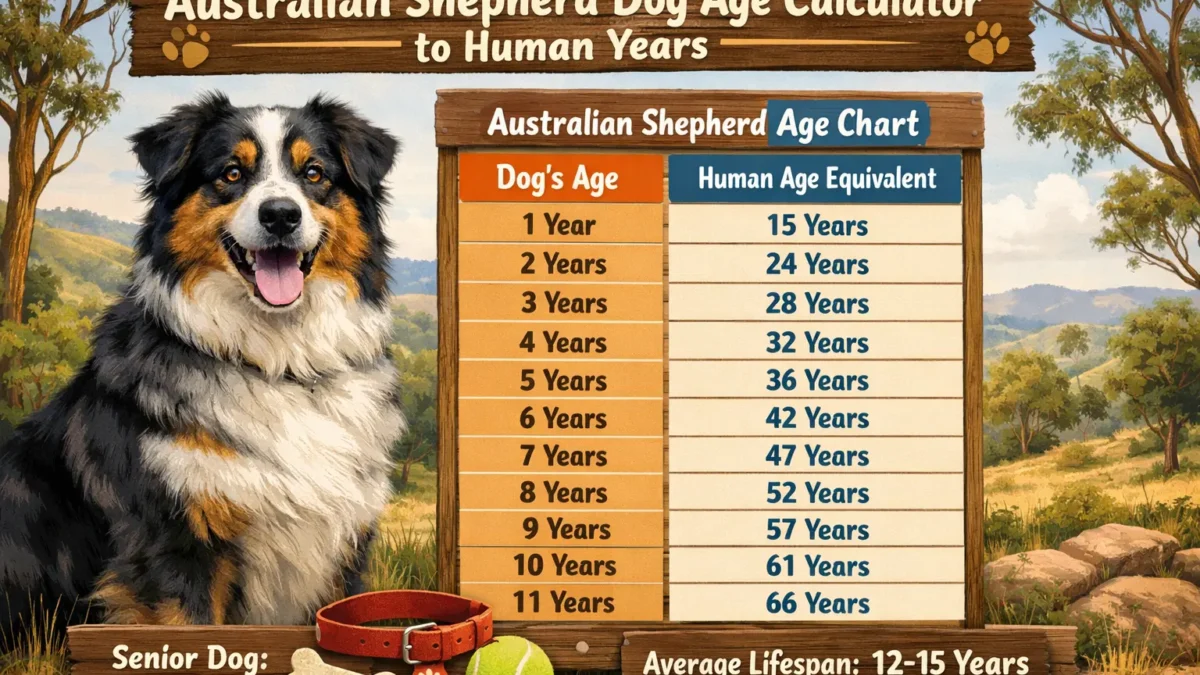
Australian Shepherd Dog Age Calculator to Human Years – Complete Age Chart
Many dog owners have grown up hearing the old rule that one dog year equals seven human years, but this simple formula is far from accurate—especially for Australian Shepherds. Dogs age differently depending on their breed, size, and lifestyle, and medium-sized breeds like Australian Shepherds don’t follow a linear pattern of aging.
Australian Shepherds are considered a medium-sized breed, typically living 12 to 15 years. They age faster during their early years, with puppies reaching adolescence and full maturity much quicker than a human child. After the first few years, the aging process slows down, meaning a 5-year-old Aussie is not equivalent to a 35-year-old human, as the 7-year rule would suggest. In reality, a 5-year-old Australian Shepherd is closer to 36 human years, reflecting their breed-specific growth and lifespan.
Understanding these differences is important because it affects how you care for your dog at every stage of life. By knowing the realistic age equivalence, you can anticipate their health needs, energy levels, and behavioral changes more accurately, ensuring your Australian Shepherd lives a long, healthy, and happy life.
Dogs, including Australian Shepherds, do not age in a straight line like humans. They grow and develop very fast in their first years and slow down as they get older. Understanding how Australian Shepherds age helps you care for them at the right time.
Medium-sized dogs like Australian Shepherds have a lifespan of about 12–15 years. This is longer than giant breeds but shorter than small breeds. Their body changes, energy levels, and health needs depend on their size and age.
Researchers have studied dog aging more closely using DNA and epigenetics. A 2019 study showed that dogs age in a logarithmic pattern, meaning they grow faster in the first years and slower later on. This is why a puppy quickly becomes a teenager, but a 10-year-old dog does not age as fast as a human in the same time.
Table 1 shows how Australian Shepherds age compared to other dogs:
Australian Shepherd vs. Other Breeds Aging Speed
| Breed Type | Average Lifespan (Years) | Aging Speed (Human Years per Dog Year) |
|---|---|---|
| Small Breeds | 12–16 | Slower |
| Medium Breeds | 12–15 | Moderate |
| Large Breeds | 8–12 | Faster |
| Giant Breeds | 6–10 | Fastest |
As you can see, medium dogs like Australian Shepherds age at a moderate pace. They do not age as quickly as giant breeds, but they do not live as long as small dogs. This makes it very important to monitor their health and activity as they grow.
Table 2 shows a quick comparison of dog age in “human years” for different sizes at key dog ages:
Dog Age Comparison by Size
| Dog Age (Years) | Small Breed (Human Years) | Medium Breed (Human Years) | Large Breed (Human Years) |
|---|---|---|---|
| 1 | 15 | 15 | 15 |
| 2 | 24 | 24 | 24 |
| 5 | 36 | 36 | 42 |
| 10 | 56 | 56 | 66 |
These tables help you see the difference between small, medium, and large dogs. Medium dogs like Australian Shepherds are easier to plan care for because their growth and aging is predictable.
How the Australian Shepherd Age-to-Human Conversion Works
Knowing your Australian Shepherd’s age in human years helps you understand their health, energy, and care needs. The old “1 dog year = 7 human years” rule is not accurate, especially for Australian Shepherds. Dogs grow faster in their first years and slow down later, so a better method is needed.
For Australian Shepherds, you can use this simple formula to get a rough idea of their human age:
- First year = 15 human years
- Second year = +9 human years (so 2 years old = 24 human years)
- Each year after = +4–5 human years
This method shows that a 5-year-old Australian Shepherd is about 36 human years, and a 10-year-old is about 56 human years.
Australian Shepherd Age Conversion Chart
| Dog Age (Years) | Human Years Equivalent |
|---|---|
| 1 | 15 |
| 2 | 24 |
| 3 | 28 |
| 4 | 32 |
| 5 | 36 |
| 7 | 47 |
| 10 | 56 |
| 12 | 64 |
Comparison with the 7-Year Rule
| Dog Age (Years) | 7-Year Rule (Human Years) | Accurate Conversion (Human Years) |
|---|---|---|
| 1 | 7 | 15 |
| 5 | 35 | 36 |
| 10 | 70 | 56 |
| 12 | 84 | 64 |
These tables make it easy for dog owners to quickly see how their Australian Shepherd’s age compares to human years. Using this method, you can better plan for nutrition, exercise, and health care at each life stage.
Life Stages of an Australian Shepherd: From Puppy to Senior
Australian Shepherds grow and change a lot throughout their lives. Knowing their life stages helps you give them the right care at the right time. There are three main stages: puppy, adult, and senior.
Puppies grow very fast in the first year. They learn social skills, need vaccinations, and start training. Adult Australian Shepherds are fully grown, active, and smart. Seniors are slower, may have health issues, and need more rest.
Australian Shepherd Life Stages and Key Changes
| Life Stage | Age Range (Dog Years) | Key Changes |
|---|---|---|
| Puppy | 0–1 | Rapid growth, socialization, vaccinations |
| Adult | 1–7 | Peak health, high energy, full maturity |
| Senior | 7+ | Slower activity, joint issues, more rest |
Energy levels and health needs change in each stage. Puppies need lots of exercise and mental stimulation to grow properly. Adults still need regular exercise but also mental challenges to stay happy. Seniors may need shorter walks and more comfortable living spaces.
Key Care Tips by Life Stage
| Life Stage | Care Tips |
|---|---|
| Puppy | Socialize, basic training, vaccinations |
| Adult | Daily exercise, mental games, regular vet visits |
| Senior | Joint supplements, lighter exercise, monitor health |
By understanding these stages, you can plan nutrition, exercise, and vet care that matches your Australian Shepherd’s age. This helps them stay healthy and happy throughout their life.
Helping Your Australian Shepherd Age Healthily
Caring for your Australian Shepherd as they get older helps them live longer and feel better. Good nutrition, exercise, and regular vet check-ups are important at every stage, especially for adult and senior dogs.
Nutrition and Weight Management Tips
| Topic | Recommendation |
|---|---|
| Food Type | High-quality, balanced diet |
| Portions | Adjust for activity level and age |
| Treats | Limit high-calorie treats |
| Supplements | Consider joint supplements for seniors |
Exercise is also key. Puppies need play and short walks. Adults need daily walks and mental challenges. Seniors may need shorter, gentler exercise but still require mental stimulation to stay sharp.
Exercise and Mental Enrichment
| Life Stage | Exercise Recommendations |
|---|---|
| Puppy | Short walks, playtime, basic training |
| Adult | Daily walks, fetch, agility, puzzle toys |
| Senior | Gentle walks, short play sessions, mental games |
Regular vet visits help catch problems early. Screenings for hips, eyes, and teeth are important, especially for seniors. Lifestyle factors like neutering/spaying, maintaining a healthy weight, and avoiding stress also support longevity.
Senior Dog Care Checklist
| Health Topic | Recommended Action | Frequency |
|---|---|---|
| Vet Check-up | General health check and blood tests | Annually |
| Joint Care | Supplements or vet-recommended diet | Daily |
| Weight Management | Monitor weight, adjust diet | Ongoing |
| Exercise | Gentle walks, play | Regular |
| Mental Stimulation | Puzzle toys, training sessions | Regular |
By following these tips, your Australian Shepherd can stay active, healthy, and happy through all life stages. Understanding their age in human years helps you plan care that matches their needs and improves quality of life.
For more information on how to care for your Australian Shepherd as they age, check out this veterinary guide on senior dog care.