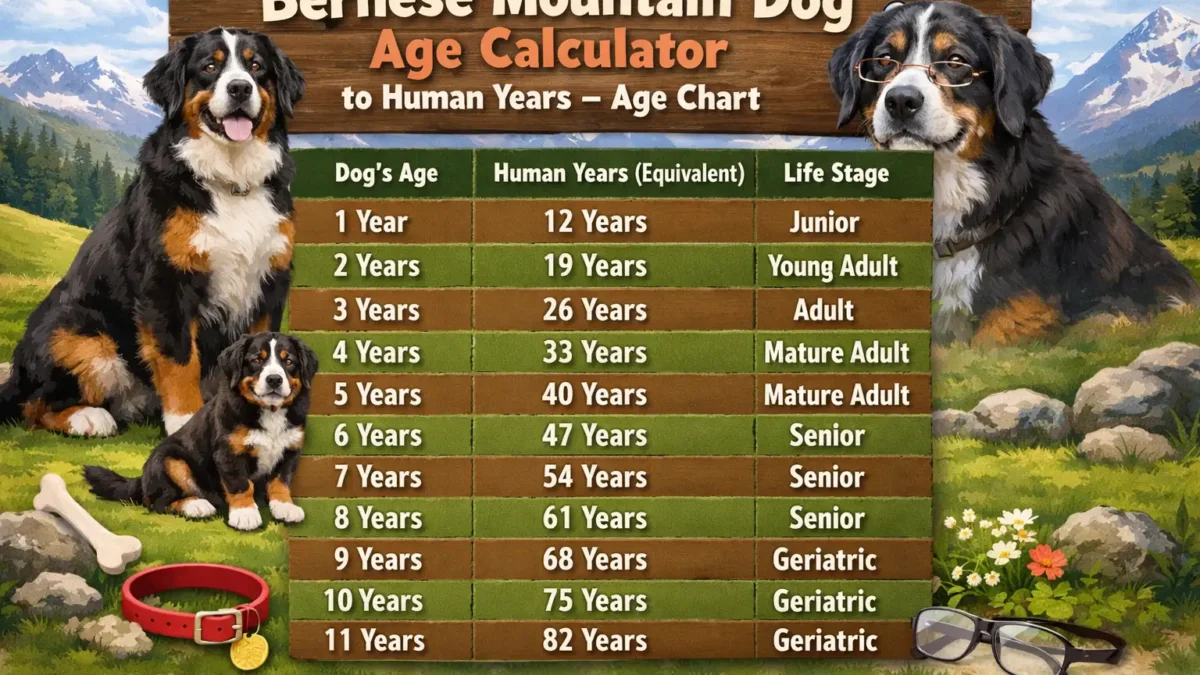
Bernese Mountain Dog Age Calculator: Convert Dog Years to Human Years
If you’ve ever been told to multiply your dog’s age by seven, that rule simply doesn’t work for a Bernese Mountain Dog. Large and giant breeds age on a very different biological timeline than humans—and much faster than small dogs.
Bernese Mountain Dogs mature rapidly in their early years, reach adulthood sooner, and typically enter their senior years earlier than many other breeds. This means a one-size-fits-all formula can seriously misrepresent how old your dog really is in human terms.
This guide uses a large-breed–specific aging approach that reflects how Bernese Mountain Dogs actually grow, mature, and age. Instead of a straight-line conversion, it accounts for:
- rapid aging during puppyhood and adolescence
- slower, steadier aging in adulthood
- accelerated aging again as senior years begin
The goal of this age calculator is not just to give you a number, but to help you understand what your Bernese Mountain Dog’s age means biologically and practically—so you can make better decisions about care, nutrition, exercise, and veterinary planning.
The Science Behind Bernese Mountain Dog Aging
Bernese Mountain Dogs do not age like humans, and they do not age like small dogs either. Their bodies grow fast early in life, then wear out sooner. This is why their average lifespan is shorter than many other breeds.
One main reason is size. Large and giant dogs grow very quickly as puppies. Their bones, joints, heart, and organs all develop at a faster pace. This early growth puts more stress on the body over time.
Another reason is biology. Modern research shows that dogs age in a curved pattern, not in a straight line. Puppies age very fast in the first two years. Adult dogs age more slowly for a short time. Then, in large breeds like the Bernese Mountain Dog, aging speeds up again in the later years.
This is why using one fixed number, like “7 human years,” gives the wrong answer for this breed.
To make this easier to understand, here is a simple comparison.
Dog Size and Average Lifespan Comparison
| Dog Size | Typical Lifespan | How Aging Feels |
|---|---|---|
| Small dogs | 12–16 years | Slow aging, long adult life |
| Medium dogs | 10–14 years | Balanced aging pattern |
| Bernese Mountain Dog | 7–10 years | Fast early aging, earlier senior years |
Because Bernese Mountain Dogs age faster:
- a 2-year-old Bernese is already a full adult
- middle age starts earlier than many breeds
- senior changes can appear as early as 6–7 years
This does not mean your dog is unhealthy. It simply means their body clock runs faster.
Understanding this science helps explain why Bernese Mountain Dogs need earlier health checks, careful weight control, and age-appropriate care sooner than smaller dogs.
Bernese Mountain Dog Age Calculator & Human Years Chart
This section helps you quickly find out how old your Bernese Mountain Dog is in human years. You do not need math skills or complex formulas. Just match your dog’s age with the chart below.
This age chart is made only for Bernese Mountain Dogs, not for small or medium breeds. It reflects their faster aging speed and shorter lifespan.
Bernese Mountain Dog Age to Human Years Chart
| Bernese Mountain Dog Age | Human Age Equivalent | Life Stage |
|---|---|---|
| 1 year | about 15 years | Late puppy |
| 2 years | about 24 years | Young adult |
| 3 years | about 32 years | Adult |
| 4 years | about 38 years | Adult |
| 5 years | about 45 years | Mature adult |
| 6 years | about 52 years | Early senior |
| 7 years | about 59 years | Senior |
| 8 years | about 65 years | Senior |
| 9 years | about 70 years | Senior |
| 10 years | about 75 years | Very senior |
You can use this chart like a simple age calculator:
- Find your dog’s age on the left
- Read across to see the human age
- Check the life stage to understand what this age means
Real-Life Age Examples
| Dog Age | What This Age Usually Means |
|---|---|
| 1 year | Big puppy, full size but still maturing |
| 3 years | Strong adult, high energy, peak health |
| 5 years | Calm adult, needs joint and weight care |
| 7 years | Senior stage begins, slower movement |
| 9 years | Older senior, needs close health support |
These numbers are estimates, not exact rules. Some Bernese Mountain Dogs age a little slower or faster depending on genetics, weight, activity level, and health care.
The chart gives you a realistic picture of where your dog is in life, so you can plan food, exercise, vet visits, and daily care the right way.
Bernese Mountain Dog Life Stages by Age
Bernese Mountain Dogs move through life stages faster than many other breeds. Knowing these stages helps you understand your dog’s behavior, energy level, and health needs at each age.
The table below shows the main life stages of a Bernese Mountain Dog, based on age.
Bernese Mountain Dog Life Stages Chart
| Age Range | Life Stage | What Owners Usually Notice |
|---|---|---|
| 0–1 year | Puppy | Fast growth, clumsy movement, high energy |
| 1–3 years | Young adult | Full size, strong muscles, playful and active |
| 3–5 years | Adult | Calm behavior, steady energy, peak health |
| 5–6 years | Mature adult | Slower pace, needs joint and weight care |
| 6–8 years | Senior | Stiff joints, longer rest times, gray fur |
| 8+ years | Older senior | Lower energy, mobility changes, more vet care |
Many owners are surprised to learn that Bernese Mountain Dogs are often considered senior by 6–7 years old. This is normal for the breed and does not mean your dog is sick.
Here are some common age-related changes owners notice:
- Puppies grow very fast and need careful joint support
- Adults stay strong but can gain weight easily
- Seniors may walk slower, nap more, and have trouble jumping
- Older seniors may need help with stairs and daily comfort
Understanding these stages helps you adjust food, exercise, and vet visits at the right time instead of waiting too long.
Helping Your Bernese Mountain Dog Age Healthily
Bernese Mountain Dogs may have a shorter life than some breeds, but good daily care can help them stay comfortable and happy for longer. Small changes made at the right age can make a big difference.
The table below shows what to focus on at each life stage.
Age-Based Care Guide for Bernese Mountain Dogs
| Life Stage | Main Health Focus | What Owners Should Do |
|---|---|---|
| Puppy | Bones and joints | Feed proper puppy food, avoid hard jumping |
| Young adult | Muscles and weight | Regular exercise, healthy diet |
| Adult | Joint health | Keep weight steady, daily walks |
| Mature adult | Early aging signs | Vet checkups, joint support |
| Senior | Comfort and mobility | Softer exercise, pain monitoring |
| Older senior | Quality of life | Easy movement, close vet care |
For more detailed, breed-specific information about health, lifespan, and care recommendations, you can visit the American Kennel Club official Bernese Mountain Dog breed page, which provides trusted guidance based on veterinary and breed-club data.