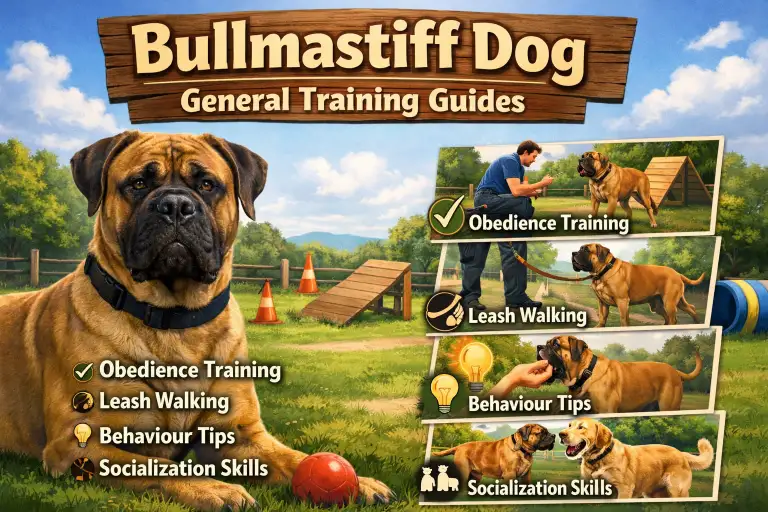
Bullmastiff Training Guide for Calm, Obedient Dogs
Bullmastiff training is not about drilling commands or overpowering a large dog—it’s about building clarity, trust, and control with a calm, independent guardian breed. When owners search for “bullmastiff training,” they’re usually dealing with real frustrations: a dog that seems stubborn, ignores commands outside the home, pulls on the leash despite its size, or becomes overly protective of family or property.
This guide is designed to address those exact concerns in a practical, breed-specific way. Bullmastiffs are intelligent and deeply loyal, but they are not eager-to-please in the same way as herding or sporting breeds. Training methods that work well for Labradors or Border Collies often fail with Bullmastiffs, leading owners to believe the dog is “hard to train” when the issue is actually mismatched expectations and methods.
You’ll find guidance here for both Bullmastiff puppies and adult dogs, whether you’re a first-time large-breed owner or someone with prior experience who wants better results. This article focuses on general obedience, behavior foundations, and real-world control—not advanced sport training, feeding plans, grooming routines, or cost considerations, which are covered elsewhere.
The goal is simple: help you raise or manage a Bullmastiff that is calm, responsive, and safe in everyday life, without force, dominance myths, or unrealistic timelines.
Is This Guide Right for Your Bullmastiff?
| Your Situation | This Guide Helps With | What to Expect |
|---|---|---|
| Bullmastiff puppy (under 12 months) | Foundations, impulse control, early obedience | Slower pace, strong long-term results |
| Adolescent Bullmastiff (8–24 months) | Regression, ignoring commands, leash pulling | Consistency is critical |
| Adult Bullmastiff | Rebuilding obedience, behavior clarity | Progress is possible with structure |
| First-time large-dog owner | Understanding temperament, avoiding mistakes | Confidence and safety |
| Experienced owner | Refining methods for guardian breeds | Better reliability, fewer conflicts |
Understanding Bullmastiff Temperament and Behavior
To train a Bullmastiff successfully, you must first understand how they think. Bullmastiffs were developed as silent estate guardians—dogs expected to assess situations independently and act with restraint, not constant direction. That history shapes their modern behavior far more than most owners realize.
Bullmastiffs are typically calm, observant, and confident. They are not hyperactive, nor are they instinctively responsive to repetitive commands. When a Bullmastiff pauses before obeying, it is rarely defiance—it is decision-making. This is why many owners label them as stubborn when, in reality, the dog is evaluating whether the request makes sense in that moment.
A critical distinction must be made between guardian instinct and aggression. Healthy Bullmastiffs are naturally protective but stable. They watch, position themselves, and intervene only when they believe it’s necessary. Poor training, harsh corrections, or unclear boundaries can push this instinct in the wrong direction, creating confusion, anxiety, or overprotective behavior.
Age also plays a major role. Bullmastiffs mature mentally and emotionally more slowly than many breeds. Puppies may appear compliant, adolescents often test boundaries, and adults usually settle into a calm, reliable presence—if training has been consistent. Expecting fast obedience or constant enthusiasm sets both owner and dog up for frustration.
Understanding these traits allows you to adjust your training approach: fewer repetitions, clearer communication, calmer leadership, and realistic expectations.
Bullmastiff Traits vs What They Mean for Training
| Trait | What Owners Often See | What It Means for Training |
|---|---|---|
| Independent thinker | Delayed response to commands | Needs clarity, not pressure |
| Calm demeanor | Low excitement during training | Motivation must be meaningful |
| Strong guardian instinct | Protective positioning or blocking | Teach boundaries early |
| Large size and strength | Hard to physically manage | Training must start early |
| Slow maturity | Regression during adolescence | Consistency over time matters |
Best Training Methods for Bullmastiffs
Training a Bullmastiff works best when it is calm, clear, and consistent. This breed does not respond well to shouting, harsh corrections, or long, boring sessions. Because Bullmastiffs are strong and independent, the goal is not to control them with force, but to teach them to choose the right behavior.
The most effective approach is positive reinforcement, which means rewarding good behavior the moment it happens. Rewards can be food, praise, toys, or calm affection. What matters most is timing. The reward must come right after the correct action so the dog understands what it did right.
Short training sessions work better than long ones. Bullmastiffs get bored quickly if training feels repetitive. Two or three short sessions each day are far more effective than one long session. Each session should focus on just one or two skills, such as sit, leash walking, or staying calm around people.
Consistency is critical. Everyone in the household should use the same commands and rules. If one person allows jumping or pulling while another does not, the Bullmastiff will become confused and ignore both.
Training should also match the dog’s age. Puppies need gentle guidance and structure. Adolescents need patience and firm boundaries. Adult Bullmastiffs can still learn, but progress is slower and requires routine.
Bullmastiff Training Do’s and Don’ts
| Do | Don’t |
|---|---|
| Use calm voice and body language | Yell or show anger |
| Reward good behavior right away | Punish after the fact |
| Keep sessions short and focused | Repeat commands again and again |
| Be consistent every day | Change rules often |
| Start training early | Wait until problems grow |
Training must also fit real life. Busy homes, children, visitors, and daily walks are part of training. Practice commands in different places, not just inside the house. A Bullmastiff that listens only indoors is not fully trained.
Recommended Bullmastiff Training Session Structure
| Dog Age | Session Length | Sessions Per Day | Main Focus |
|---|---|---|---|
| Puppy | 5–10 minutes | 2–3 | Basics, calm behavior |
| Adolescent | 10–15 minutes | 2 | Leash skills, impulse control |
| Adult | 10–20 minutes | 1–2 | Reliability, real-life situations |
Training a Bullmastiff is not about speed. It is about building trust, clear rules, and steady progress. When done correctly, Bullmastiffs become calm, reliable dogs that listen because they understand, not because they are forced.
Common Bullmastiff Training Problems and Solutions
Many Bullmastiff training problems come from confusion, mixed signals, or late training, not from a “bad” dog. Because Bullmastiffs are calm and strong, small issues can grow into big ones if they are ignored early.
One common problem is not listening. Bullmastiffs may hear the command but choose not to respond if it feels unclear or pointless. This often happens when commands are repeated too many times or used without rewards. Saying a command once and rewarding the correct response works much better.
Another issue is pulling on the leash. Bullmastiffs are powerful dogs, and pulling quickly becomes unsafe. Pulling usually means the dog was never taught how to walk calmly or was allowed to pull as a puppy. The fix is slow walking, stopping when the leash tightens, and rewarding calm steps.
Overprotective behavior is also common. Bullmastiffs may block visitors, stand between people, or watch closely. This is normal guarding behavior, but it becomes a problem when the dog feels it must make decisions alone. Clear rules, calm leadership, and controlled social exposure help prevent this.
Many owners face training regression during adolescence. Around 8 to 24 months, Bullmastiffs may ignore commands they once knew. This is normal. The solution is patience, structure, and going back to basics instead of increasing pressure.
Owner mistakes often slow progress. Inconsistent rules, emotional reactions, and lack of daily practice confuse the dog and delay results.
Common Bullmastiff Training Problems, Causes, and Fixes
| Problem | Likely Cause | What Helps Most |
|---|---|---|
| Not listening | Repeating commands, weak rewards | Clear commands, better timing |
| Pulling on leash | No leash training early | Stop-and-reward walking |
| Overprotective behavior | Unclear boundaries | Calm control and structure |
| Regression in adolescence | Normal maturity stage | Consistency and patience |
| Slow progress | Inconsistent training | Daily short sessions |
Progress may feel slow at times, but steady training always wins. Bullmastiffs respond best when they trust their owner and clearly understand what is expected.
When to Get Professional Help for Bullmastiff Training
Some training problems are safe to handle at home, but others need professional help early. Because Bullmastiffs are large and strong, waiting too long can create safety risks for the family and the dog.
You should seek help if your Bullmastiff shows fear, aggression, or strong guarding behavior that does not improve with basic training. Growling, snapping, lunging, or refusing to calm down are warning signs. These behaviors do not mean the dog is bad, but they do mean the dog is stressed or confused.
Professional help is also important if training feels overwhelming. If you feel nervous walking your dog, struggle to control it around people, or cannot make progress after weeks of effort, a trainer can help guide you safely.
It is important to choose the right kind of help. A general dog trainer works well for obedience and manners. A behavior specialist is needed for fear, aggression, or anxiety. In some cases, a veterinarian may be involved to rule out pain or medical causes.
Getting help early saves time, stress, and money. It also protects your Bullmastiff from learning bad habits that are harder to fix later.
When DIY Training Is Enough vs When to Get Professional Help
| Situation | DIY Training | Professional Help |
|---|---|---|
| Basic obedience issues | Yes | No |
| Leash pulling | Yes | Sometimes |
| Mild guarding | Sometimes | Yes |
| Fear or aggression | No | Yes |
| Safety concerns | No | Yes |
Strong Bullmastiffs need calm guidance and clear rules. Asking for help is a smart step, not a failure.
For readers who want deeper, science-based guidance on dog behavior and training principles, the American Veterinary Society of Animal Behavior provides trusted, veterinarian-led resources on humane training methods and behavior management.