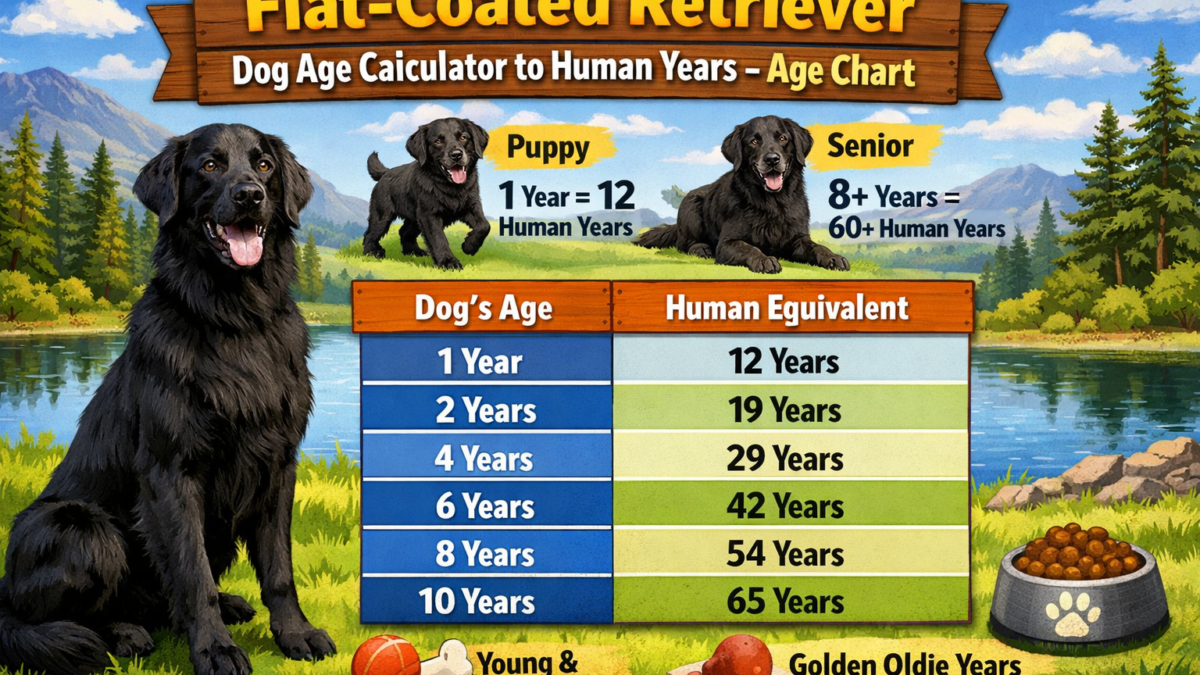
Flat-Coated Retriever Age Calculator: Dog Years to Human Years Chart
If you’re wondering “How old is my Flat-Coated Retriever in human years?”, this age calculator is designed to give you a clear, breed-specific estimate—not a generic guess.
Unlike the outdated “1 dog year = 7 human years” rule, Flat-Coated Retrievers follow a non-linear aging pattern. They mature rapidly in their first years, then age more gradually through adulthood, before entering a comparatively compressed senior phase. This calculator reflects that reality by using modern canine aging research and large-breed aging trends.
How to use this age calculator
You don’t need formulas or charts to get started:
- Find your dog’s current age in years (use decimals for puppies, e.g., 0.5 years).
- Match it to the closest age range in the examples or age chart below.
- Use the result as an approximate human-age equivalent, not an exact number.
This estimate helps you understand:
- Which life stage your Flat-Coated Retriever is in
- What kinds of health, nutrition, and activity needs are typical at that age
- When to start thinking about senior care and preventive screenings
Quick Flat-Coated Retriever age examples
The table below gives instant answers for the most common ages owners search for.
| Flat-Coated Retriever Age | Approximate Human Age |
|---|---|
| 1 year | ~15 human years |
| 2 years | ~24 human years |
| 5 years | ~40 human years |
| 8 years | ~55 human years |
| 10 years | ~66 human years |
These numbers represent averages, not guarantees. Individual dogs may age faster or slower depending on genetics, health history, body condition, activity level, and veterinary care.
Flat-Coated Retriever Age Chart (Dog Years to Human Years)
Many owners prefer a simple age chart instead of doing calculations. This chart shows how a Flat-Coated Retriever’s age roughly compares to human years at different stages of life.
Remember, this chart gives estimates, not exact ages. Every dog is unique, but this helps you understand where your dog fits in life.
Flat-Coated Retriever age chart
| Dog Age (Years) | Human Age Equivalent | Life Stage |
|---|---|---|
| 0.5 | ~10 years | Puppy |
| 1 | ~15 years | Puppy |
| 2 | ~24 years | Young Adult |
| 3 | ~30 years | Adult |
| 4 | ~35 years | Adult |
| 5 | ~40 years | Adult |
| 6 | ~45 years | Mature Adult |
| 7 | ~50 years | Mature Adult |
| 8 | ~55 years | Senior |
| 9 | ~60 years | Senior |
| 10 | ~66 years | Senior |
| 11 | ~72 years | Senior |
| 12 | ~78 years | Geriatric |
How to read this chart
- Find your dog’s current age on the left.
- Look across to see the human-age equivalent.
- Check the life stage to understand what changes may happen next.
Flat-Coated Retrievers often stay playful and puppy-like longer than many breeds. Even so, their bodies still age, especially after about 7–8 years, when senior changes become more noticeable.
Use this chart to:
- Plan vet visits and health checks
- Adjust food and exercise as your dog ages
- Understand behavior changes that come with age
Why Flat-Coated Retriever Dog Years Aren’t Equal to 7 Human Years
Many people still believe that 1 dog year equals 7 human years, but this rule is not correct. Dogs, including Flat-Coated Retrievers, do not age at the same speed as humans.
Dogs grow very fast when they are young. A one-year-old Flat-Coated Retriever is already close to a human teenager. After that, aging slows down during adult years. Later in life, aging speeds up again as the dog becomes a senior. This is why a simple 7-year rule does not work.
Flat-Coated Retrievers are a medium-to-large breed, which also affects aging. Larger dogs usually:
- Grow fast as puppies
- Reach adulthood earlier
- Become seniors sooner than small dogs
How Flat-Coated Retrievers age at different life stages
| Life Stage | Dog Age Range | How Aging Works |
|---|---|---|
| Puppy | 0–1 year | Ages very fast, both body and mind change quickly |
| Young Adult | 1–3 years | Aging slows, growth levels off |
| Adult | 4–6 years | Aging is steady and gradual |
| Senior | 7+ years | Aging speeds up again, health changes appear |
Because of this pattern, two dogs with the same age can feel very different depending on their life stage. A 2-year-old dog is not “14 in human years,” and a 10-year-old dog is not just “70.” Their bodies age in a more complex way.
This is also why breed-specific age charts and calculators are more helpful than simple math rules. They match how dogs really grow and age.
Flat-Coated Retriever Life Stages: Puppy, Adult, and Senior Years
Knowing your dog’s life stage helps you understand their behavior, energy level, and health needs. Flat-Coated Retrievers are known for acting playful for a long time, but their bodies still move through clear aging stages.
Below is a simple way to see what usually happens at each stage.
Flat-Coated Retriever life stages at a glance
| Life Stage | Age Range | What Owners Commonly Notice |
|---|---|---|
| Puppy | 0–1 year | Fast growth, lots of energy, short attention span |
| Young Adult | 2–3 years | Strong body, high play drive, learning improves |
| Adult | 4–6 years | Steady energy, calmer behavior, peak fitness |
| Senior | 7+ years | Slower movement, more rest, gray hair on face |
As puppies, Flat-Coated Retrievers grow quickly and can seem “wild.” Their bodies and brains are changing fast, so patience and training are important.
During the adult years, most Flat-Coated Retrievers are at their best physically. They are strong, active, and enjoy long walks and games. This is the stage when good habits matter most.
Around 7 years and older, most Flat-Coated Retrievers enter the senior stage. You may notice they rest more, move slower, or take longer to recover after exercise. These changes are normal and happen slowly.
Understanding these stages helps you:
- Adjust food and exercise
- Spot early signs of aging
- Give the right care at the right time
Helping Your Flat-Coated Retriever Age Healthily
Every Flat-Coated Retriever can age better with the right care. Small daily choices can make a big difference in how your dog feels as they grow older. This applies to puppies, adults, and especially senior dogs.
The goal is not to stop aging, but to help your dog stay comfortable, active, and happy for as long as possible.
Age-based care priorities
| Age Range | Main Care Focus |
|---|---|
| Puppy | Healthy growth, safe exercise, training habits |
| Adult | Weight control, regular activity, dental care |
| Senior | Joint support, gentle exercise, vet checkups |
As a puppy, good food and safe play help build strong bones and muscles. Avoid too much jumping or hard exercise while your dog is still growing.
In the adult years, keeping a healthy weight is very important. Extra weight can stress the joints and heart. Regular walks, playtime, and mental games help keep your dog fit.
When your Flat-Coated Retriever becomes a senior, care needs change. You may need shorter walks, softer bedding, and more rest time. Regular vet visits help catch health problems early, which can improve quality of life.
Simple things that help at any age include:
- Feeding the right amount of food
- Keeping your dog active but not overworked
- Watching for changes in behavior or movement
- Visiting the vet regularly
Aging is natural, but good care helps your dog stay comfortable and enjoy life at every stage.
For more detailed information on Flat-Coated Retriever health and lifespan, you can visit the American Kennel Club’s breed page: https://www.akc.org/dog-breeds/flat-coated-retriever/