Understanding your Scottish Fold Longhair’s age in human terms is more than just a fun curiosity—it helps you track your cat’s health, development, and life stage. Cats, especially Scottish Fold Longhairs, age much faster than humans in their first years. Knowing the human equivalent of your cat’s age can guide decisions about diet, exercise, veterinary care, and even how you interact with your furry companion. A cat that is one year old is very different developmentally from a five-year-old, and understanding these differences can enhance your cat’s well-being.
Many cat owners rely on the old idea that one cat year equals seven human years. While simple, this rule is misleading. Cats develop rapidly in their first two years, reaching full physical and sexual maturity much faster than humans. For instance, a one-year-old cat is more like a 15-year-old human in terms of growth and mental development, not seven. A two-year-old cat corresponds roughly to a 24-year-old human, showing the uneven pace of feline aging in early life. After the first two years, the aging process slows, with each additional cat year approximating four human years.
Scottish Fold Longhairs are known for their long, plush fur and the distinctive folded ears, which make them one of the most recognizable cat breeds. This breed typically has a moderate to long lifespan, often living into their mid to late teens if well cared for. However, like all breeds, their exact lifespan depends on genetics, lifestyle, and preventive health care. A human-age calculator tailored for Scottish Fold Longhairs allows owners to better understand their cat’s life stage, from playful kitten to active adult and eventually to wise senior.
The purpose of this age calculator is not to provide an exact number for health or lifespan but to offer a scientifically grounded estimate of your cat’s developmental stage in human terms. It also helps new cat owners plan for veterinary visits, understand behavior changes, and manage their expectations as their Scottish Fold Longhair grows. Using this calculator gives a clearer picture of how your cat compares to a human’s developmental and aging timeline, making it easier to provide appropriate care and companionship throughout their life.
How Scottish Fold Longhairs Age Compared to Humans
Cats do not age in a linear way like humans. In the first year of life, a Scottish Fold Longhair grows rapidly, both physically and mentally. By the end of the first year, most cats have reached puberty, their adult teeth are fully grown, and their body proportions resemble an adult cat. In human terms, this equates roughly to a 15-year-old teenager. This is why it’s inaccurate to use the “1 cat year = 7 human years” formula, which oversimplifies early development and ignores later stages of life.
The second year of life sees continued growth and development, but at a slower pace than the first year. By the end of year two, a Scottish Fold Longhair is considered a young adult. In human terms, this is approximately 24 years old. At this stage, your cat will have reached full size, but their behavior and maturity may still resemble a young adult human, with bursts of energy, curiosity, and learning. Understanding this stage is critical for managing activity levels, feeding schedules, and playtime.
After the first two years, feline aging slows down and becomes more predictable. Each additional year of a cat’s life roughly equals four human years. For example, a 5-year-old Scottish Fold Longhair would be around 36 in human years. This slower aging phase allows owners to anticipate life stage changes and care needs more accurately. Senior cats, typically considered to start at around 10 years old, may experience slower metabolism, reduced activity, and the onset of age-related health concerns.
Life expectancy for Scottish Fold Longhairs can range from 12 to 16 years, and sometimes longer with excellent care. Indoor cats generally live longer than outdoor cats due to lower exposure to accidents, predators, and infectious diseases. By comparing your cat’s age to human years, you can better plan veterinary checkups, diet adjustments, and enrichment activities to maintain a high quality of life throughout each stage. This comparison also provides a framework to understand behavior changes, such as decreased playfulness in older cats, in human-age terms.
Scottish Fold Longhair Age to Human Years Chart
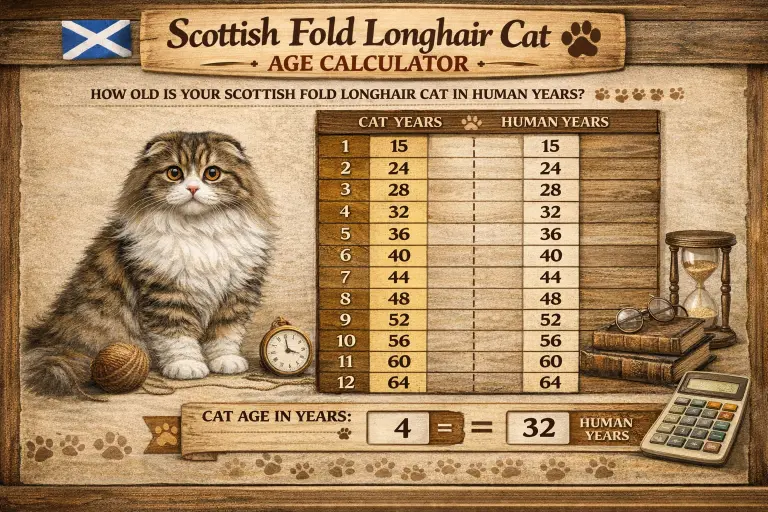
To make it easy for owners to understand how their Scottish Fold Longhair ages, the table below converts cat years to human equivalent years, broken down by life stages:
| Cat Age (Years) | Human Age Equivalent | Life Stage |
|---|---|---|
| 0.5 | 7 | Kitten |
| 1 | 15 | Kitten |
| 2 | 24 | Young Adult |
| 3 | 28 | Adult |
| 4 | 32 | Adult |
| 5 | 36 | Adult |
| 6 | 40 | Mature Adult |
| 7 | 44 | Mature Adult |
| 8 | 48 | Senior |
| 9 | 52 | Senior |
| 10 | 56 | Senior |
| 11 | 60 | Senior |
| 12 | 64 | Geriatric |
| 13 | 68 | Geriatric |
| 14 | 72 | Geriatric |
| 15 | 76 | Geriatric |
| 16 | 80 | Geriatric |
| 17 | 84 | Geriatric |
| 18 | 88 | Geriatric |
| 19 | 92 | Geriatric |
| 20 | 96 | Geriatric |
This chart allows owners to quickly see where their Scottish Fold Longhair falls in human years and life stages. You can also use this information to anticipate health needs, activity adjustments, and behavioral changes. The table is easy to read and designed to give a clear picture of your cat’s growth from kittenhood through geriatric stages. It is especially useful for planning veterinary visits, dietary changes, or lifestyle adjustments as your cat ages.
For younger cats, the first two years are the most dramatic in terms of development. A cat younger than one year develops rapidly in size, motor skills, and social behavior. By contrast, changes after age six are subtler and mostly involve slower metabolism and potential joint or organ concerns. Keeping track of age in human-equivalent terms makes it easier to interpret these changes and provide the right care for each life stage.
How to Use the Scottish Fold Longhair Age Calculator
Using the age calculator is simple and can be done in a few steps. First, determine your cat’s current age in years. If your cat is younger than one year, you may want to convert months into fractions of a year (for example, six months = 0.5 years). Enter this age into the calculator to get the human-equivalent age. The calculator uses the accepted veterinary model: the first year equals 15 human years, the second year equals 9 human years, and each year after equals 4 human years.
Once you have the human age equivalent, you can interpret what this means in terms of life stage, behavior, and health. For example, a 3-year-old Scottish Fold Longhair corresponds to about 28 human years. At this age, cats are generally fully grown adults, active, and playful, similar to a 28-year-old human. Knowing this helps you plan the right amount of exercise, social interaction, and monitoring for any early health issues.
The calculator also provides insights for senior cats. For instance, a 12-year-old Scottish Fold Longhair is roughly 64 in human years. Cats at this stage may begin showing signs of slower mobility, decreased activity, or early age-related conditions. Understanding these equivalencies allows owners to adjust their cat’s environment, encourage gentle activity, and schedule more frequent veterinary checks to maintain quality of life.
This tool is also valuable for behavioral interpretation. For example, a young adult cat may be energetic, curious, and prone to playful mischief, whereas a senior cat may prefer quiet activities and rest. By using the age calculator, you can align your expectations and interactions with your cat’s stage in life. This ensures a happier, healthier relationship between you and your Scottish Fold Longhair and helps in making informed decisions about health, diet, and lifestyle.
Accuracy, Limitations & FAQs
It’s important to remember that the age calculator provides estimates, not precise predictions. Genetics, lifestyle, diet, and indoor versus outdoor living all influence a cat’s lifespan. Scottish Fold Longhairs may experience slight variations in growth and aging, but the calculator gives a scientifically based approximation that aligns with veterinary studies. This makes it a useful guide for owners to track development, anticipate behavioral changes, and plan for preventive care.
Some common questions owners ask include: “Can my Scottish Fold Longhair live past 20?” While some cats do exceed 20 years, most live between 12 and 16 years. Another frequent question is: “Does indoor living extend life?” Yes, indoor cats generally face fewer risks than outdoor cats, contributing to a slightly longer average lifespan. Owners also ask whether aging is faster for longhair cats; while fur type doesn’t change developmental biology, longhairs may require more grooming and joint care as they age.
Many owners wonder why the first year is counted as 15 human years. This is because kittens experience rapid physical, mental, and social development during their first year, which is unmatched by the linear 7-year myth. Similarly, the second year of life adds roughly 9 human years, reflecting continued growth and maturity. Each subsequent year is approximately four human years, representing a slower but steady aging process that aligns with veterinary observations.
Using the age calculator can also help with preventive care planning. For example, senior cats (7 years and older) may benefit from specialized diets, joint supplements, or regular check-ups. Middle-aged cats can benefit from enrichment and regular veterinary visits to catch early signs of health issues. The calculator, combined with observational awareness, provides a practical framework for maintaining your Scottish Fold Longhair’s health and quality of life throughout every stage.
For further detailed guidance on feline aging and life stages, you can visit the American Association of Feline Practitioners for authoritative veterinary advice.

Ata Ur Rehman is the founder of Pet Age in Human Years Calculator, an educational platform that provides age conversion charts and lifespan guides for dogs, cats, birds, and other companion animals. His work focuses on helping pet owners understand how animal ages translate into human years using commonly accepted age conversion formulas and published lifespan averages.
The website compiles breed and species lifespan data from kennel clubs, breed organizations, and general animal lifespan studies to present simple and easy-to-understand guides for pet owners worldwide.
This website was created to centralize animal age conversion charts into one easy reference platform for pet owners.