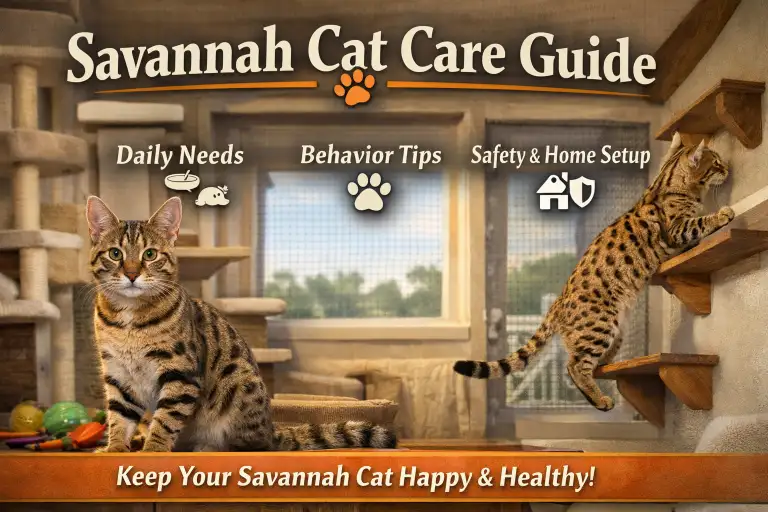
Savannah cat care starts with understanding that this is not a “high-energy domestic cat” — it’s a cat with exceptional physical ability, intelligence, and emotional needs. Most care problems people experience don’t come from bad cats, but from misaligned expectations.
Savannahs are typically more active, more curious, and more people-oriented than the average cat. If those needs aren’t met consistently, the result is often frustration-driven behavior that owners label as “destructive” or “difficult,” when it’s actually under-stimulation.
Many owners notice that their Savannah:
- Is constantly moving, climbing, or exploring
- Gets bored quickly with the same toys
- Seeks attention persistently and follows them room to room
- Learns patterns fast (including how to open doors, cabinets, or screens)
None of this is abnormal — it’s feedback.
Savannah cat traits and what they mean for care
| Savannah trait | What owners commonly notice | What this means for care |
|---|---|---|
| High energy | Running, jumping, zoomies well into adulthood | Daily structured play is not optional |
| High intelligence | Figuring out puzzles, opening doors | Needs mental challenges, not just toys |
| Strong bonding | Shadowing owners, vocalizing for attention | Requires regular interaction and routine |
| Athletic build | Higher jumps, longer climbs | Extra focus on vertical space and safety |
| Curiosity | Exploring everything, escaping attempts | Thorough cat-proofing is essential |
A common mistake is assuming Savannah cats will “settle down” if ignored or left alone more often. In reality, lack of engagement usually escalates behavior, not reduces it. These cats do best with predictable routines, clear boundaries, and outlets for both physical and mental energy.
Another important care consideration is emotional sensitivity. Savannah cats often bond deeply with their primary caregivers and can show stress through vocalization, restlessness, or changes in behavior when routines shift. This doesn’t mean they’re anxious by nature — it means they’re highly responsive to their environment.
Understanding these core traits early makes every other aspect of Savannah cat care easier: daily routines feel purposeful, home setup choices make sense, and behavior issues are easier to prevent rather than correct.
When you care for a Savannah cat in a way that matches how their mind and body work, they’re not difficult — they’re deeply engaging, loyal, and rewarding companions.
Daily and Weekly Savannah Cat Care Routine
Savannah cats need daily structure, not random attention. A clear routine helps prevent boredom, stress, and problem behavior. The good news is that once you build a habit, care becomes meaningfully easier.
This section focuses on what most owners ask first: What do I need to do every day, and what can wait?
Daily care basics
Most Savannah cats need at least 30 to 60 minutes of active play every day. This should be broken into short sessions, not done all at once.
Daily care usually includes:
- Interactive play with wand toys or chase games
- Short training or puzzle play to challenge the mind
- Talking, petting, and bonding time with their person
- Checking food, water, and litter box cleanliness
Savannah cats get bored quickly with the same toy. Rotating toys every few days keeps play exciting and prevents frustration.
Weekly and occasional care tasks
Some care tasks don’t need to be done every day, but they still matter for long-term health and behavior.
Weekly or occasional tasks include:
- Brushing the coat to reduce loose hair
- Cleaning food and water bowls
- Checking nails and trimming when needed
- Refreshing play areas or moving toys to new spots
- Washing bedding or blankets
Savannah cat care frequency overview
| Care task | How often |
|---|---|
| Active play | Every day |
| Mental games or puzzles | Every day |
| Litter box check | Every day |
| Brushing | Once a week |
| Nail trimming | Every 2 to 4 weeks |
| Deep toy rotation | Once a week |
Time and effort expectations
Savannah cats are not low-effort pets. Skipping play for a few days often leads to:
- Restless behavior
- Excessive meowing
- Scratching furniture
- Trying to escape the house
These behaviors are signs your cat needs more engagement, not punishment.
A steady routine helps Savannah cats feel calm and secure. When they know play, food, and attention happen at predictable times, they are less likely to act out.
Home Setup and Environment for Savannah Cats
Savannah cats need a home that matches their energy, size, and curiosity. A normal cat setup is often not enough. The right environment helps prevent stress, damage, and escape attempts.
This section explains how to set up your home so your Savannah can move, explore, and relax safely.
Space and movement needs
Savannah cats love to climb and jump. They need both floor space and vertical space.
Good home setups include:
- Tall cat trees or wall shelves
- Strong scratching posts that do not tip over
- Clear jumping paths between furniture
If a Savannah cannot climb or explore, they often create their own fun by jumping on counters, shelves, or doors.
Indoor safety and escape prevention
Savannah cats are very curious and smart. Many learn how to open doors, windows, and cabinets.
To keep them safe:
- Secure window screens tightly
- Keep doors closed or use child locks
- Store breakable or dangerous items out of reach
Never assume a Savannah will stay inside just because they have before. Escape usually happens when owners least expect it.
Indoor-only vs outdoor access
Free roaming outdoors is risky for Savannah cats. Their size and bold behavior can put them in danger.
Safer options include:
- A secure catio
- Leash and harness training
- Supervised outdoor time only
These options allow outdoor experience without the risks of traffic, wildlife, or getting lost.
Home setup comparison
| Area | Good setup | Common mistake |
|---|---|---|
| Vertical space | Tall trees, shelves | Only floor toys |
| Windows | Locked or screened | Open windows |
| Outdoor time | Catio or harness | Free roaming |
| Play areas | Rotated toys | Same toys always |
Apartment and multi-level homes
Savannah cats can live in apartments if their needs are met. Vertical space becomes even more important in smaller homes. Multi-level homes are often a good fit because they allow climbing and movement.
A well-set-up home keeps Savannah cats busy, calm, and safe.
Common Savannah Cat Care Problems and Mistakes
Most Savannah cat problems are not caused by bad behavior. They are caused by needs not being met. When owners understand the reason behind the behavior, fixing it becomes much easier.
This section covers the most common problems Savannah owners face and what usually helps.
Common behavior problems owners notice
Many Savannah owners report:
- Scratching furniture or walls
- Knocking items off tables
- Loud or constant meowing
- Trying to escape the house
- Ignoring toys after a short time
These behaviors often mean your cat is bored, under-stimulated, or confused about boundaries.
Behavior problems and what they usually mean
| Behavior | What it often means | What helps |
|---|---|---|
| Destroying furniture | Too much energy | More daily play |
| Loud meowing | Wants attention | Set play and bonding times |
| Ignoring toys | Toys are boring | Rotate or upgrade toys |
| Escaping attempts | Curiosity or stress | Better enrichment and safety |
| Aggressive play | Overexcitement | Shorter, calmer play sessions |
Common care mistakes to avoid
Some mistakes happen because Savannah cats look like normal cats but act very differently.
Common mistakes include:
- Not playing enough every day
- Leaving the cat alone for long hours
- Using punishment instead of redirection
- Not providing climbing space
- Expecting the cat to “grow out of it”
Punishment does not work well with Savannah cats. It often causes fear or more bad behavior. Clear routines, calm rules, and redirection work much better.
Early warning signs many owners miss
Pay attention if your Savannah:
- Paces often or seems restless
- Loses interest in play
- Hides more than usual
- Becomes more vocal suddenly
These are signs something in their routine or environment needs to change.
Fixing problems early is much easier than trying to correct long-term habits.
Safety, Special Situations, and When to See a Vet
Savannah cats are strong, fast, and curious. Because of this, safety is a very important part of their care. Some problems can be handled at home, but others need quick help from a vet or a cat behavior expert.
This section helps you know what is normal, what needs attention, and when not to wait.
Safety risks Savannah cats face
Savannah cats often get into trouble because they explore more than other cats.
Common risks include:
- Falling from high places
- Escaping through doors or windows
- Chewing or playing with unsafe objects
- Rough play with children or other pets
Always check your home for hazards and never assume your Savannah will “learn not to do it.”
Special care situations
Savannah kittens
Kittens are very active and curious. Early play, gentle handling, and clear rules help prevent future problems. Never encourage rough play with hands.
Adult Savannah cats
Adults still need daily play and mental work. Many behavior problems start when owners reduce play too early.
Senior Savannah cats
Older Savannah cats may slow down but still need stimulation. Watch for joint pain, weight changes, or behavior shifts.
Multi-pet homes
Introduce new pets slowly. Make sure each pet has their own food, litter box, and safe space.
Warning signs you should not ignore
| Sign | What it could mean | What to do |
|---|---|---|
| Sudden aggression | Pain or stress | Contact a vet |
| Not eating | Illness | Vet visit |
| Hiding often | Fear or sickness | Monitor closely |
| Lethargy | Injury or illness | Seek care fast |
| Big behavior change | Stress or health issue | Get professional help |
When to see a vet or professional
You should talk to a vet or cat behavior expert if:
- Behavior changes happen suddenly
- Aggression becomes frequent
- Your cat stops eating or playing
- You feel overwhelmed or unsure
Getting help early can prevent serious problems later.
For more expert guidance on feline health, behavior, and care standards, you can visit the American Association of Feline Practitioners (AAFP) at catvets.com, a leading authority dedicated to improving the lives of cats through veterinary-backed education.

Ata Ur Rehman is the founder of Pet Age in Human Years Calculator, an educational platform that provides age conversion charts and lifespan guides for dogs, cats, birds, and other companion animals. His work focuses on helping pet owners understand how animal ages translate into human years using commonly accepted age conversion formulas and published lifespan averages.
The website compiles breed and species lifespan data from kennel clubs, breed organizations, and general animal lifespan studies to present simple and easy-to-understand guides for pet owners worldwide.
This website was created to centralize animal age conversion charts into one easy reference platform for pet owners.