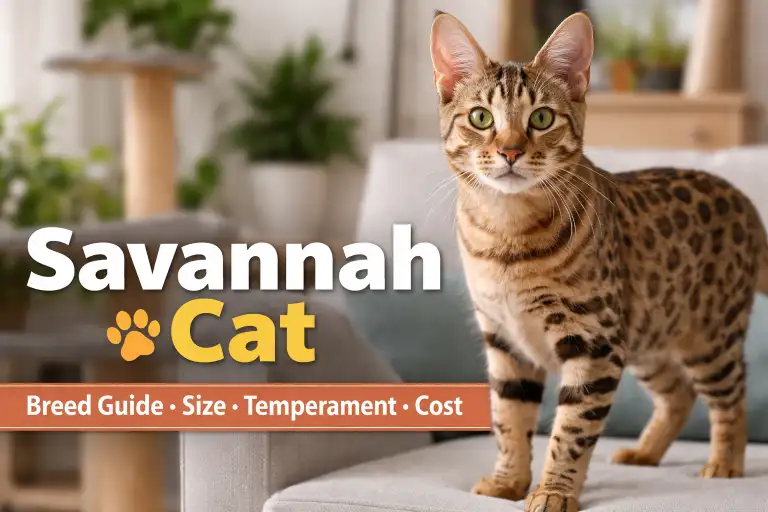
The Savannah cat is unlike almost any other domestic cat you’ll encounter. Created by crossing a domestic cat with the African serval, this breed blends a striking wild appearance with varying degrees of domestic temperament—depending heavily on generation. Understanding what a Savannah cat truly is (and isn’t) is essential before falling in love with the look alone.
The breed began in the late 1980s when a serval was successfully bred with a domestic cat, producing the first-generation (F1) Savannah. Breeders were drawn to the serval’s tall frame, spotted coat, and alert intelligence, but the long-term goal was not to create a wild pet. Instead, the aim was to gradually develop a cat that retained the exotic look while becoming more predictable, manageable, and suitable for life in a home. Over time, selective breeding led to later generations that behave much more like domestic cats, though still with noticeably higher energy and intelligence than average.
One of the most important things to understand about Savannah cats is that they are classified by generations, labeled F1 through F5 and beyond. The “F” stands for filial, indicating how many generations removed the cat is from its serval ancestor. This isn’t just a technical detail—it directly affects size, behavior, care requirements, legality, and cost.
Savannah cats are recognized by The International Cat Association (TICA), but recognition comes with strict breeding standards and does not mean the breed is universally legal. In some regions, early-generation Savannahs are restricted or outright banned, which makes generation knowledge critical before purchase.
Another common misconception is that Savannah cats are aggressive because of their wild ancestry. In reality, aggression is not a defining trait of the breed. What Savannahs are, however, is intensely alert, curious, and driven. They notice everything, learn quickly, and become bored faster than most cats. When people struggle with Savannah cats, it’s usually because they underestimated the breed’s needs—not because the cat is inherently difficult.
To give a clear snapshot of how generations differ, here’s a simple overview:
Savannah Cat Generations at a Glance
| Generation | Serval Ancestry | Size Expectation | Temperament Difficulty | Ownership Experience Needed |
|---|---|---|---|---|
| F1 | ~50% | Very large, very tall | Very demanding | Expert owners only |
| F2 | ~25% | Large | High | Advanced owners |
| F3 | ~12% | Medium to large | Moderate–high | Confident owners |
| F4 | ~6% | Medium | Moderate | Experienced owners |
| F5+ | Minimal | Medium | Lower | More adaptable households |
What truly makes the Savannah breed unique isn’t just the serval lineage—it’s how much variation exists within the breed itself. An F1 Savannah can feel more like living with a semi-exotic animal, while an F5 Savannah may resemble a very athletic, highly intelligent domestic cat. Treating them as the same breed without understanding these differences is one of the biggest mistakes new owners make.
At its core, the Savannah cat is best described as a breed for people who want interaction, engagement, and challenge—not a passive, low-maintenance pet.
Savannah Cat Appearance, Size, and Physical Traits
At first glance, the Savannah cat looks more like a small wild cat than a typical house cat. Its tall body, long legs, and spotted coat give it a bold, exotic look that many people find impressive. This wild appearance is one of the main reasons people are drawn to the breed.
Savannah cats are known for their height more than their weight. They are one of the tallest cat breeds in the world. Because of their long legs and lean body, they often look much bigger than they actually are.
Most Savannah cats weigh between 12 and 25 pounds, depending on their generation. Early-generation cats (like F1 and F2) are usually larger and taller, while later generations are closer in size to large domestic cats. Males are usually bigger than females.
Here is a quick overview of their physical size and traits:
Savannah Cat Size and Physical Traits
| Trait | Typical Description |
|---|---|
| Height | 14–17 inches or more |
| Weight | 12–25+ pounds |
| Body Type | Tall, slim, and athletic |
| Legs | Long and strong |
| Tail | Medium length, slightly thick |
| Overall Look | Wild and exotic |
The Savannah cat has a short coat that feels smooth and soft. The coat is not thick, which means shedding is usually low to moderate. Most Savannah cats have spotted patterns, similar to a cheetah or serval. These spots can be black, brown, or dark gray.
Their ears are large and stand upright on top of the head. Many Savannah cats have small light-colored marks on the back of their ears, called ocelli. These are a leftover trait from their wild ancestors. Their eyes are medium-sized and slightly hooded, giving them a focused and alert expression.
Even though they look wild, Savannah cats move with smooth and graceful steps. They can jump very high and often enjoy climbing to the highest point in a room. This body design helps explain why they need more space and activity than many other cat breeds.
Savannah Cat Temperament, Personality, and Behavior
Savannah cats are best known for their strong personality and high intelligence. They are not quiet or lazy cats. Instead, they are curious, active, and always aware of what is happening around them. Many owners say living with a Savannah cat feels more like living with a small dog than a typical cat.
These cats form strong bonds with their people. They often choose one or two favorite humans and stay close to them. While Savannah cats can be loving, most are not true lap cats. They prefer to sit next to you, follow you around, or watch what you are doing rather than sleep on your lap for long hours.
Savannah cats are very smart. They learn fast and can open doors, cabinets, and even figure out puzzle toys. Because of this, they need daily mental activity. If they get bored, they may knock things over, scratch furniture, or try to escape outside.
Here is a simple look at their personality traits:
Savannah Cat Personality Traits
| Trait | What It Means |
|---|---|
| Intelligence | Very high, learns quickly |
| Energy Level | Very high |
| Affection | Loyal but not clingy |
| Independence | Medium |
| Vocal Sounds | Chirps, trills, soft meows |
| Boredom Risk | Very high if not stimulated |
Savannah cats can be vocal, but they do not meow like normal cats all the time. Instead, they make chirping or trilling sounds. These sounds are often used to get attention or communicate with their owner.
With children, Savannah cats usually do well if the kids are calm and respectful. They enjoy play but may not like rough handling. In homes with other cats, they do best with confident cats that are not easily scared. Timid cats may feel stressed around them.
Savannah cats often get along well with dogs, especially friendly dogs that are used to cats. Because Savannahs have a strong prey drive, smaller pets like birds or hamsters should be kept safely away.
One common mistake people make is thinking Savannah cats are aggressive. This is not true. Most behavior problems come from boredom, lack of space, or not enough interaction. When their needs are met, Savannah cats are confident, playful, and well-behaved.
Savannah Cat Care, Activity Level, and Training Needs
Savannah cats need more care and attention than many other cat breeds. They are very active, very smart, and get bored easily. This means they are not a good fit for people who want a calm or low-energy pet.
Savannah cats need daily exercise. Short playtime once a day is not enough. They enjoy running, jumping, climbing, and chasing toys. Many Savannah cats can jump very high and love tall cat trees, shelves, or window perches. Without enough activity, they may become destructive or restless.
Mental exercise is just as important as physical exercise. Savannah cats like puzzle toys, interactive games, and learning new tricks. Many owners teach them to play fetch, walk on a leash, or respond to simple commands. Because they are so smart, they often enjoy training and see it as a game.
Here is a simple overview of their care needs:
Savannah Cat Care Requirements
| Care Area | Level Needed |
|---|---|
| Daily Exercise | High |
| Mental Stimulation | Very high |
| Space to Move | High |
| Training | Easy with patience |
| Grooming | Low |
| Indoor Enrichment | Very important |
Savannah cats respond best to gentle and positive training. Yelling or punishment does not work and can damage trust. Reward-based training using treats or praise works much better. Starting training at a young age helps a lot.
Grooming is simple. Savannah cats have short coats and do not need frequent brushing. Brushing once a week is usually enough. They shed less than many other breeds. Nail trimming, ear cleaning, and dental care should still be done regularly.
Most Savannah cats do best as indoor pets. This keeps them safe and protects wildlife. Some owners use leash training or outdoor cat enclosures so their cats can enjoy fresh air safely. Letting them roam freely outside is risky because of their value, curiosity, and escape skills.
Savannah cats do best in homes where people have time to play, train, and interact with them every day. Without this, they can become frustrated or unhappy.
Savannah Cat Cost, Health, Pros & Cons, and Is This Breed Right for You?
Owning a Savannah cat can be exciting, but it also comes with high costs and big responsibilities. This is not a cheap or low-effort breed, and knowing this early helps avoid problems later.
Savannah cat prices depend mostly on generation. Early generations cost much more because they are harder to breed and closer to their wild ancestor. Later generations are more affordable but still cost more than most regular cats.
Savannah Cat Cost Breakdown
| Expense Type | Typical Cost Range |
|---|---|
| Kitten Price | $1,500 to $20,000+ |
| Vet Visits (Yearly) | $300 to $800 |
| Food & Enrichment | Higher than average |
| Insurance | Often expensive or limited |
Savannah cats usually live 12 to 20 years when well cared for. Most are healthy, but because they are a hybrid breed, it is important to work with a vet who understands Savannah cats. Some may have sensitive stomachs or heart concerns, so regular checkups matter.
Before choosing this breed, it helps to clearly see the good and the hard parts.
Savannah Cat Pros & Cons
| Pros | Cons |
|---|---|
| Very intelligent | Needs lots of time and attention |
| Loyal and interactive | Not good for beginners |
| Exotic, wild appearance | Very expensive |
| Trainable and playful | Can get bored and destructive |
| Low grooming needs | Not legal everywhere |
Savannah cats are a good choice for people who:
- Want a very active and interactive pet
- Have time to play and train daily
- Enjoy smart, curious animals
- Have enough space at home
They are not a good choice for people who:
- Want a quiet or lazy cat
- Are first-time pet owners
- Have very small living spaces
- Cannot spend much time with their pet
In the right home, a Savannah cat can be loyal, fun, and deeply bonded to its owner. In the wrong home, it can become stressed and unhappy.
For official breed standards, registration details, and generation guidelines, you can also explore the Savannah cat profile from The International Cat Association (TICA).

Ata Ur Rehman is the founder of Pet Age in Human Years Calculator, an educational platform that provides age conversion charts and lifespan guides for dogs, cats, birds, and other companion animals. His work focuses on helping pet owners understand how animal ages translate into human years using commonly accepted age conversion formulas and published lifespan averages.
The website compiles breed and species lifespan data from kennel clubs, breed organizations, and general animal lifespan studies to present simple and easy-to-understand guides for pet owners worldwide.
This website was created to centralize animal age conversion charts into one easy reference platform for pet owners.