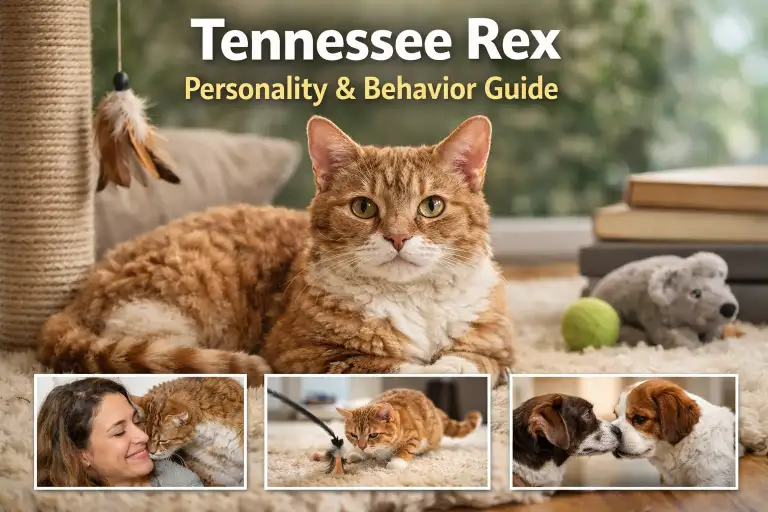
The Tennessee Rex is often described as affectionate, curious, and socially aware — but like all cats, personality exists on a spectrum. While breed tendencies can give us clues, each Tennessee Rex develops a temperament shaped by genetics, early handling, environment, and individual sensitivity.
For those wondering, “What are Tennessee Rex cats like?” — the short answer is this: they tend to balance closeness with independence. They are often people-oriented without being overly demanding, playful without being relentlessly hyperactive, and expressive without being excessively loud.
Below is a quick snapshot of typical temperament tendencies.
| Trait | Typical Tendency | What It Looks Like in Daily Life |
|---|---|---|
| Affection Level | Moderate to High | Seeks proximity, may follow favorite person from room to room |
| Energy Level | Moderate | Enjoys daily play but also appreciates quiet downtime |
| Sociability | People-oriented | Observes guests with curiosity rather than hiding immediately |
| Vocalization | Soft to moderate | Uses trills, chirps, or gentle meows to communicate |
| Independence | Balanced | Comfortable resting alone but checks in regularly |
| Adaptability | Generally adaptable | Adjusts well when routine feels predictable |
It’s important to understand that these are tendencies, not guarantees. Within the same litter, you may see one Tennessee Rex that prefers lap time and another that expresses affection by simply staying nearby. Both are affectionate — just in different ways.
Many Tennessee Rex cats display what behaviorists would call “proximity bonding.” Instead of constantly climbing into laps, they may choose to sit beside you, sleep near your feet, or quietly observe your activities. This style of affection is often misunderstood as aloofness, but in reality, it reflects a secure attachment pattern. They want to be near you — just on their terms.
Energy levels are typically moderate. As kittens, they can be spirited and curious explorers. As adults, they often settle into a rhythm of interactive play sessions followed by calm observation. They are not usually described as high-intensity or chaotic, but they do enjoy mental stimulation and environmental novelty.
In terms of emotional sensitivity, Tennessee Rex cats often appear attuned to household tone. In calm homes, they relax quickly. In loud or unpredictable environments, they may become observant before engaging. This isn’t fearfulness — it’s social assessment, a very normal feline behavior.
Independence also plays a healthy role in their temperament. Unlike some highly clingy personalities, Tennessee Rex cats generally tolerate short periods alone, especially if their environment provides enrichment and security. A cat who naps comfortably while you’re away but greets you at the door is not detached — they’re balanced.
One of the most important things to remember is that breed description should never override individual observation. A well-socialized Tennessee Rex raised in a stable environment will likely express confidence and sociability. A cat raised with limited early exposure may show more caution. Neither is “wrong” — both reflect developmental experience.
At their core, Tennessee Rex cats often combine:
- Gentle affection
- Curious intelligence
- Moderate playfulness
- Social awareness
- Emotional balance
Understanding this baseline helps set realistic expectations. Rather than asking whether a Tennessee Rex is “friendly enough,” a better question is: How does this individual cat choose to show connection?
That perspective builds trust — both for the owner and for the cat.
How Tennessee Rex Cats Communicate & Express Behavior
Cats do not use words the way humans do. Instead, they speak with their body, their eyes, their tail, and their voice. A Tennessee Rex may look calm on the outside, but small signals tell you exactly how they feel.
Learning these signals helps you understand what your cat is trying to say.
Body Language Quick Guide
| Signal | What It Usually Means | When to Look Closer |
|---|---|---|
| Tail straight up | Happy and friendly | Often seen when greeting you |
| Slow blinking | Trust and comfort | A relaxed body confirms it |
| Gentle tail sway | Focused or curious | Common during play |
| Fast tail flick | Annoyed or overstimulated | May need a short break |
| Ears slightly back | Alert or unsure | Flattened ears mean stronger fear |
| Showing belly | Feeling safe | Not always asking for a belly rub |
A tail held high when your Tennessee Rex walks toward you is like a smile. It usually means they are glad to see you. Slow blinking is another sign of trust. Many owners call this a “cat kiss.”
If the tail starts flicking quickly from side to side, your cat may be getting irritated. This often happens when petting goes on too long. It does not mean your cat is aggressive. It simply means, “That’s enough for now.”
Stress vs Comfort Signals
| Comfort Signals | Mild Stress Signals |
|---|---|
| Loose, relaxed body | Body becomes stiff |
| Purring softly | Grooming more than usual |
| Kneading paws | Avoiding eye contact |
| Calm sleeping posture | Hiding suddenly |
A relaxed Tennessee Rex will stretch out, curl loosely, or nap in open spaces. A mildly stressed cat may move away quietly or start grooming more than usual.
Stress does not always mean something is wrong. Cats react to changes like new guests, loud noises, or moved furniture. Most of the time, once the environment feels safe again, their body language returns to normal.
Vocal Communication
Tennessee Rex cats are often soft talkers.
You may hear:
- Gentle trills when they greet you
- Short meows when they want attention
- Soft chirps during play
- Louder calls if they feel confused or separated
Some cats are naturally quiet. Others enjoy “talking” back and forth. Neither is better. It is simply personality.
Subtle Signals Owners Miss
Sometimes the smallest signs matter most.
- Whiskers pushed forward can mean excitement
- A quick head turn away can mean “I need space”
- A low crouch with focused eyes often means play mode
- Slow walking with a lifted tail tip often means curiosity
Many misunderstandings happen when humans miss these early signals. When you respond early — by pausing petting or giving space — you build trust.
Understanding communication is not about controlling your cat. It is about listening in their language.
Social Behavior with Humans & Other Pets
The Tennessee Rex is often described as people-focused. But that does not mean every cat acts the same way. Some are very outgoing. Others are calm and selective. What matters most is how they build trust.
Most Tennessee Rex cats enjoy being near their humans. They may follow you from room to room. They may sit beside you while you work. Some like lap time. Others prefer sitting close without being held. Both styles show connection.
Social Compatibility Overview
| Situation | Typical Response | What Helps Most |
|---|---|---|
| With Adults | Forms strong bond | Calm daily routine |
| With Children | Gentle but observant | Respectful handling |
| With Other Cats | Often tolerant | Slow introduction |
| With Dogs | Can adjust well | Dog must be calm |
| With Guests | Curious but cautious | Safe retreat space |
When it comes to bonding, many Tennessee Rex cats form a strong link with one main person. This does not mean they ignore others. It simply means they may choose one person as their “safe base.” They may sleep closer to that person or greet them first.
With children, this breed usually does well if the child is gentle. Quick grabbing or loud behavior can make any cat step back. Teaching children to pet softly and give space builds a healthy relationship.
With other cats, Tennessee Rex cats often do fine if introductions are slow. Cats are territorial by nature. They need time to share space. Giving each cat their own sleeping area, food bowl, and high perch reduces stress.
Living with dogs is also possible. The key factor is the dog’s personality. A calm dog that respects space makes things easier. A loud or chasing dog can cause stress. Slow introductions and supervision are important.
It is also normal for Tennessee Rex cats to use vertical space. Climbing shelves or cat trees is not dominance. It is security. High spaces allow them to observe safely.
If your Tennessee Rex sometimes chooses to sit alone, that does not mean they do not love you. Cats need quiet time. Healthy social behavior includes both closeness and independence.
Understanding their social style helps you avoid labels like “clingy” or “aloof.” Most of the time, they are simply responding to what feels safe in the moment.
Playfulness, Energy Level & Natural Instincts
Tennessee Rex cats usually have a moderate energy level. This means they enjoy daily play, but they are not wild or out of control. They like activity, but they also enjoy quiet rest time.
As kittens, they are very curious. They may chase moving objects, jump on new surfaces, and explore every corner of the house. This is normal learning behavior. Kittens use play to practice hunting skills.
As adults, their energy becomes more balanced. They still enjoy play, but it may be shorter and more focused.
Play & Instinct Profile
| Behavior | What It Means |
|---|---|
| Pouncing on toys | Practicing hunting skills |
| Hiding behind furniture | Ambush play style |
| Carrying small toys | Mimicking prey behavior |
| Sudden evening zoomies | Natural active time (cats are most active at dawn and dusk) |
| Scratching surfaces | Stretching muscles and marking space |
| Climbing high places | Looking for safety and observation points |
Cats are natural hunters. Even indoor Tennessee Rex cats will show stalking behavior. You may see them lower their body, wiggle slightly, and then jump. This is not aggression. It is instinct.
Night activity is also normal. Cats are crepuscular, which means they are most active in early morning and evening. If your cat runs around at night sometimes, this is part of their natural rhythm.
Scratching is another natural behavior. It helps them stretch, remove old nail layers, and leave scent marks. It is not bad behavior. It is communication and body care.
Climbing and perching are also important. High spaces make cats feel secure. When your Tennessee Rex sits on a shelf or cat tree, they are not trying to be “in charge.” They simply feel safe watching from above.
Some owners confuse play biting with aggression. During play, bites are usually softer and happen during high excitement. Real aggression comes with stiff body posture, flattened ears, and strong tail flicking. Knowing the difference helps prevent misunderstandings.
Providing regular play sessions helps your Tennessee Rex stay mentally happy. Play builds confidence and reduces boredom.
Behavior Changes Across Life Stages & When to Observe Closely
A Tennessee Rex does not stay the same forever. Just like people, cats change as they grow. Their energy, habits, and social style can shift over time. Most changes are normal and part of growing older.
Understanding these stages helps you avoid worry when behavior evolves slowly.
Life Stage Behavior Overview
| Life Stage | Common Behavior Focus |
|---|---|
| Kitten | High energy, strong curiosity, constant play |
| Adolescent | Testing limits, more independence, playful bursts |
| Adult | Balanced energy, stable personality, clear routine |
| Senior | Slower movement, more sleep, seeks comfort |
As kittens, Tennessee Rex cats are very active. They explore everything. They may climb often, chase fast-moving objects, and show endless curiosity. This is how they learn about the world.
During adolescence, they may become more independent. You might notice short periods where they seem less cuddly. This does not mean they stopped loving you. It is part of maturity and confidence building.
In adulthood, personality usually becomes steady. You can clearly see if your cat prefers lap time, quiet closeness, or playful attention. Adult Tennessee Rex cats often follow a daily routine and feel secure when life is predictable.
In senior years, energy slows down. Your cat may sleep more and choose softer, warmer places. They may become more selective about interaction. Many senior cats seek comfort and quiet over intense play.
Small behavior changes over time are normal. What deserves attention is a sudden or strong change, such as:
- Hiding much more than usual
- Stopping play completely
- Sudden loud or unusual vocal sounds
- Avoiding contact after normally being social
Gradual changes are usually part of aging. Sudden changes are worth observing more closely and discussing with a professional if they continue.
Watching patterns over time is more helpful than reacting to one single moment.
For more in-depth information about understanding feline behavior and communication, visit the American Association of Feline Practitioners’ Cat Friendly Homes resource center.

Ata Ur Rehman is the founder of Pet Age in Human Years Calculator, an educational platform that provides age conversion charts and lifespan guides for dogs, cats, birds, and other companion animals. His work focuses on helping pet owners understand how animal ages translate into human years using commonly accepted age conversion formulas and published lifespan averages.
The website compiles breed and species lifespan data from kennel clubs, breed organizations, and general animal lifespan studies to present simple and easy-to-understand guides for pet owners worldwide.
This website was created to centralize animal age conversion charts into one easy reference platform for pet owners.