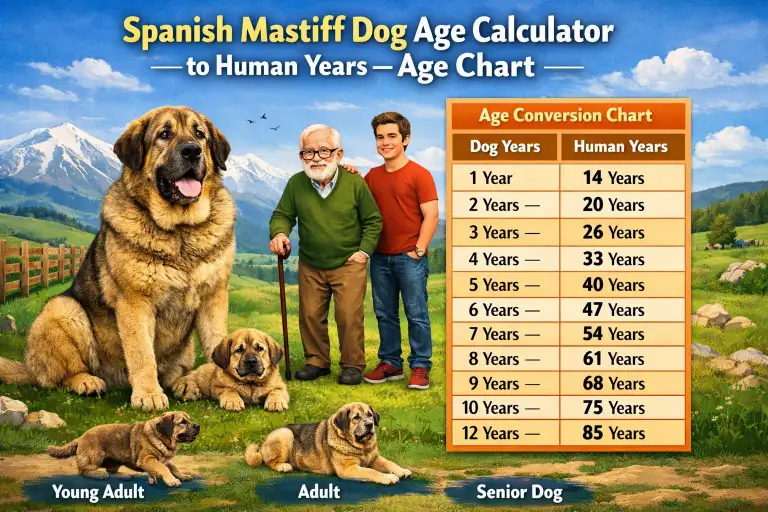
Understanding your Spanish Mastiff’s age in human years is essential for proper care, diet, exercise, and health monitoring. Unlike the old “one dog year equals seven human years” rule, giant breeds like the Spanish Mastiff have unique growth patterns and lifespans that make this formula inaccurate.
This is where a Spanish Mastiff age calculator comes in. By entering your dog’s current age, the calculator provides an approximate human-age equivalent that reflects the breed’s slower maturation, longer puppy stage, and earlier onset of senior years compared to smaller dogs.
The calculator considers key factors such as:
- Your dog’s exact age in years and months
- The Spanish Mastiff’s giant-breed size category
- Breed-specific life stage adjustments (puppy, adult, senior)
Using this tool gives you a more accurate understanding of your dog’s developmental stage and helps you plan for exercise routines, veterinary checkups, and lifestyle changes at the right time. Even if you don’t use the calculator, understanding the logic behind it is helpful for gauging how your Spanish Mastiff is aging relative to humans.
Inputs Used in the Spanish Mastiff Age Calculator
| Input Factor | Description |
|---|---|
| Dog age | Enter in years and months to capture precise growth stage |
| Breed size | Spanish Mastiff categorized as a giant breed for lifespan calculation |
| Life stage weighting | Adjusts human-age equivalence for puppy, adult, and senior phases |
This simple table shows the factors that determine the age conversion. Knowing how these inputs work can make the results from the calculator more understandable and trustworthy.
Spanish Mastiff Age Chart (Dog Years to Human Years)
Many dog owners want to know exactly how old their Spanish Mastiff is in human years. The old “1 dog year = 7 human years” rule is not accurate, especially for giant breeds like the Spanish Mastiff. These dogs grow quickly as puppies but age faster once they reach adulthood.
The table below shows the approximate human age equivalent for each year of a Spanish Mastiff’s life. It also shows the life stage, so you can understand whether your dog is a puppy, adult, or senior.
Spanish Mastiff Age to Human Years
| Spanish Mastiff Age (Years) | Human Age Equivalent | Life Stage | What This Age Looks Like |
|---|---|---|---|
| 0.5 | 5 | Puppy | Tiny, growing fast, learning basic skills |
| 1 | 15 | Puppy | More coordinated, playful, still learning |
| 2 | 24 | Adolescent | Large, stronger, exploring boundaries |
| 3 | 30 | Young Adult | Mature body, high energy, social skills developing |
| 4 | 36 | Adult | Fully grown, stable behavior |
| 5 | 42 | Adult | Adult energy, possible first minor health checks |
| 6 | 48 | Adult | Physical peak, very active |
| 7 | 53 | Adult | Slight slowdown, watch joints |
| 8 | 58 | Senior | Early aging signs, slower recovery |
| 9 | 63 | Senior | Possible stiffness, start monitoring diet and activity |
| 10 | 68 | Senior | Senior dog, may need joint supplements and more rest |
| 11 | 73 | Senior | Slower movement, more rest, health checkups important |
| 12 | 78 | Senior | Typical lifespan approaching end, careful care needed |
| 13 | 83 | Senior | Very senior, extra support, limited activity |
| 14 | 88 | Senior | Advanced age, monitor health closely |
This table gives you a quick reference for how your Spanish Mastiff is aging compared to humans. It can help you plan exercise, nutrition, and vet visits at the right time.
Why Spanish Mastiffs Age Differently Than Other Dogs
Spanish Mastiffs are giant dogs, and giant breeds do not age the same way as small or medium dogs. They grow very fast as puppies, reach full size later, and show signs of aging sooner in later years. This is why the old rule “1 dog year = 7 human years” does not work for them.
Smaller dogs may live 12–16 years, but giant dogs like Spanish Mastiffs usually live 10–12 years on average. Their bodies mature quickly but also wear down faster in later life.
Some important reasons for this difference are:
- Body size: Bigger dogs have more weight on their bones and joints.
- Growth rate: Spanish Mastiffs grow faster as puppies.
- Life span: Giant breeds naturally live shorter lives than small breeds.
- Genetics: Breed-specific traits affect how fast they age.
Aging Comparison by Dog Size
| Dog Size | Average Lifespan | Early Growth Phase | Aging Pattern |
|---|---|---|---|
| Small (1–10 kg) | 12–16 years | 6–12 months | Slow, steady aging |
| Medium (11–25 kg) | 10–14 years | 8–14 months | Moderate aging speed |
| Large (26–45 kg) | 9–12 years | 10–16 months | Faster aging in later years |
| Giant (46+ kg) | 8–12 years | 12–24 months | Rapid aging after adult maturity |
This table shows why Spanish Mastiffs, as a giant breed, age faster in later years compared to smaller dogs. Knowing this helps owners plan health care, nutrition, and exercise for each stage of life.
Spanish Mastiff Life Stages Explained (Puppy to Senior)
Spanish Mastiffs grow differently than smaller dogs. Their life can be divided into four main stages: puppy, adolescent, adult, and senior. Understanding each stage helps you care for your dog properly.
Puppy (0–2 years)
- Rapid growth, learning basic skills, playful and curious
- Still developing joints, so exercise should be gentle
Adolescent (2–3 years)
- Body becomes stronger, behavior matures slowly
- High energy, needs training and socialization
Adult (3–7 years)
- Fully grown, peak physical condition
- Stable behavior, regular exercise and balanced diet are important
Senior (7+ years)
- Slower movement, early signs of joint stiffness
- Need softer food, shorter walks, and more rest
- Regular vet visits are crucial
Spanish Mastiff Life Stages
| Life Stage | Age Range | Physical Changes | Behavioral Changes | Owner Focus |
|---|---|---|---|---|
| Puppy | 0–2 years | Rapid growth, soft bones | Curious, playful, learning skills | Gentle exercise, basic training |
| Adolescent | 2–3 years | Stronger muscles, growing joints | High energy, testing limits | Consistent training, socialization |
| Adult | 3–7 years | Full size, peak health | Calm, predictable | Regular diet, exercise, vet checks |
| Senior | 7+ years | Slower, joint stiffness | Less active, needs more rest | Soft food, gentle walks, health monitoring |
This table makes it easy to see what to expect at each stage and how to adjust care for your Spanish Mastiff as it grows.
Spanish Mastiff Lifespan, Aging Signs, and Care Tips
Spanish Mastiffs are giant dogs, so they live shorter lives than smaller breeds. On average, a Spanish Mastiff lives 10–12 years, but proper care can help them stay healthy and comfortable for as long as possible.
As your dog gets older, you may notice physical and behavioral changes. Paying attention to these signs helps you catch problems early and provide the right care.
Common Aging Signs:
- Slower movement or stiffness in joints
- Less energy and shorter play sessions
- Changes in appetite or weight
- Grey hair around the muzzle
- Changes in vision or hearing
Aging Signs and Care Tips for Spanish Mastiffs
| Aging Sign | Typical Age Appears | Normal vs Concerning | Care Tips |
|---|---|---|---|
| Slower movement | 7–8 years | Normal if mild stiffness | Short walks, soft bedding, joint supplements |
| Reduced energy | 7–9 years | Concerning if sudden drop | Adjust exercise, monitor health |
| Changes in appetite | 8–10 years | Concerning if rapid loss or gain | Consult vet, balanced diet |
| Grey hair on muzzle | 8–10 years | Normal | No action needed |
| Vision/hearing changes | 9+ years | Concerning if sudden or severe | Vet checkup |
These tips help you support your Spanish Mastiff through each stage of senior life. Regular vet visits, proper diet, and adjusted exercise keep your dog comfortable and active for as long as possible.
Outbound Link Sentence (to add at the end of the article)
For more detailed guidance on caring for giant breeds, you can visit the American Kennel Club’s page on Mastiff Care and Lifespan.

Ata Ur Rehman is the founder of Pet Age in Human Years Calculator, an educational platform that provides age conversion charts and lifespan guides for dogs, cats, birds, and other companion animals. His work focuses on helping pet owners understand how animal ages translate into human years using commonly accepted age conversion formulas and published lifespan averages.
The website compiles breed and species lifespan data from kennel clubs, breed organizations, and general animal lifespan studies to present simple and easy-to-understand guides for pet owners worldwide.
This website was created to centralize animal age conversion charts into one easy reference platform for pet owners.