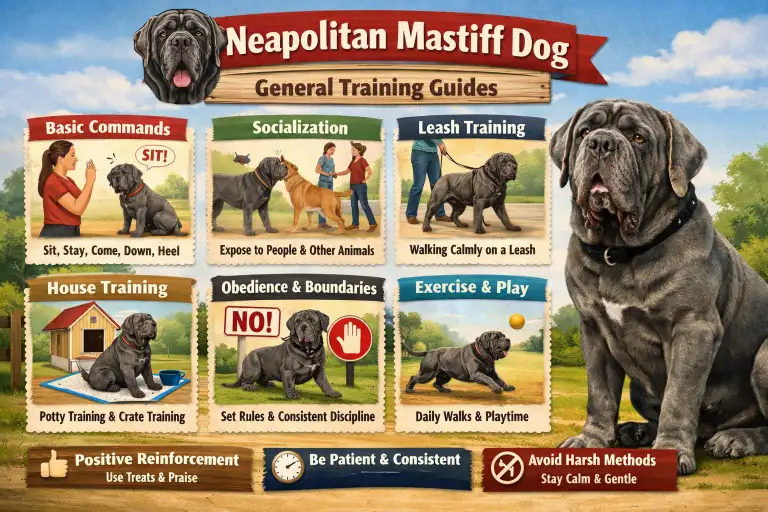
Training a Neapolitan Mastiff is not about chasing perfect obedience or flashy commands. It’s about building control, trust, and emotional stability in one of the most powerful guardian breeds in the world. This guide is designed to help you raise a Neapolitan Mastiff that is calm in daily life, manageable in public, and safe around people—without relying on force, intimidation, or outdated “alpha” methods.
Unlike many working or sporting breeds, the Neapolitan Mastiff is slow to mature, naturally protective, and highly sensitive to pressure. These dogs were developed to guard property and family, not to perform repetitive tasks on command. That means training success looks different here: a well-trained Neapolitan Mastiff is steady, responsive, and thoughtful—not robotic or hyper-obedient.
- First-time Neapolitan Mastiff owners who want realistic guidance
- Puppy owners trying to set the right foundation early
- Adult or rescue owners dealing with size, strength, or behavior concerns
- Anyone searching for safe, breed-appropriate training methods
If you approach training with patience, structure, and respect for the breed’s instincts, Neapolitan Mastiffs can become exceptionally reliable companions. If you rush, overcorrect, or skip foundational work, small issues can quickly become serious problems due to their size and guarding nature.
Before going further, it’s important to be honest about what living and training with this breed actually involves.
Is the Neapolitan Mastiff Right for You? A Reality Check
| Area | What Many Owners Expect | Reality With a Neapolitan Mastiff |
|---|---|---|
| Trainability | Quick obedience like common breeds | Slower learning, but deep retention |
| Temperament | Gentle giant with everyone | Calm with family, suspicious of strangers |
| Energy level | Lazy and low-maintenance | Low energy, but needs structured mental work |
| Maturity | Adult behavior by 1 year | Emotional maturity can take 2–3 years |
| Handling | Easy to manage with size | Requires early control and consistency |
If you’re looking for a dog that thrives on constant commands, frequent corrections, or intense repetition, this is not the right breed. If you’re willing to invest time into relationship-based training, early structure, and thoughtful socialization, the Neapolitan Mastiff can be one of the most loyal and steady dogs you’ll ever own.
Understanding Neapolitan Mastiff Temperament and Behavior
To train a Neapolitan Mastiff well, you must first understand how this breed thinks. Many training problems happen because owners expect this dog to behave like a Labrador, German Shepherd, or Border Collie. That expectation leads to frustration on both sides.
Neapolitan Mastiffs were bred to guard, not to obey constant commands. They are calm, watchful, and serious dogs. They do not rush to please strangers, and they do not enjoy being pushed, shouted at, or rushed through training steps.
This breed is also slow to mature. A Neapolitan Mastiff may look like an adult by one year of age, but mentally and emotionally, they often act like puppies until two or even three years old. Training must match that pace.
Here are the key temperament traits you need to understand before training.
Neapolitan Mastiff Temperament Traits Explained
| Trait | What You See at Home | What It Means for Training |
|---|---|---|
| Guardian instinct | Watches doors, windows, and visitors | Socialization must be calm and controlled |
| Independence | Doesn’t respond instantly to commands | Needs patience, not repeated shouting |
| Sensitivity | Shuts down with harsh correction | Responds best to calm tone and rewards |
| Loyalty to family | Very bonded to owners | Training works best when trust is strong |
| Slow maturity | Puppy behavior lasts longer | Progress is steady, not fast |
Many owners think their Neapolitan Mastiff is being stubborn. In most cases, the dog is not refusing. The dog is thinking. This breed often pauses before acting, especially in new or stressful situations. That pause is normal and should not be punished.
Fear also plays a big role in behavior. A Neapolitan Mastiff that feels unsafe may:
- Freeze and refuse to move
- Bark deeply at strangers
- Step between you and other people
- Avoid new places
These are not signs of a “bad dog.” They are signs of a dog that needs confidence-building, not force.
Because of their size and strength, small behavior issues matter more with this breed. Pulling on the leash, guarding spaces, or ignoring recall can become dangerous if not handled early and correctly.
The good news is this: when trained with calm leadership, clear rules, and consistency, Neapolitan Mastiffs become very stable dogs. They may not be fast learners, but they remember lessons deeply once learned.
How to Train a Neapolitan Mastiff: Step-by-Step Method
Training a Neapolitan Mastiff works best when it is slow, calm, and consistent. This breed does not learn well with pressure or fast drills. Short sessions, clear rules, and good timing matter more than strict control.
Start training as early as possible, but keep your expectations realistic. A Neapolitan Mastiff learns deeply, not quickly. The goal is steady progress, not speed.
First, focus on relationship and trust. Your dog must feel safe with you before real learning happens. Speak in a calm voice, move with confidence, and avoid yelling or jerking the leash. This breed shuts down when training feels rough or confusing.
Training sessions should be:
- Short (5 to 10 minutes for puppies, 10 to 15 minutes for adults)
- Calm and quiet
- Done once or twice a day
- Ended on a good note
Below is a simple training plan based on age. This helps you avoid doing too much too soon.
Neapolitan Mastiff Training Plan by Age
| Age Stage | Main Training Focus | Session Length | How Often |
|---|---|---|---|
| 8–16 weeks | Name, focus, calm handling | 3–5 minutes | 2–3 times daily |
| 4–12 months | Leash walking, sit, stay | 5–10 minutes | 1–2 times daily |
| 12–24 months | Control, manners, confidence | 10–15 minutes | Daily |
| Adult rescue | Trust, basics, calm behavior | 10–15 minutes | Daily |
Next, choose the right rewards. Neapolitan Mastiffs are not high-energy dogs, so toys do not always work. Many respond better to food, praise, or simply space and calm attention.
Effective Rewards for Neapolitan Mastiffs
| Reward Type | Works Best When | When It May Fail |
|---|---|---|
| Soft food treats | Learning new skills | Overused or given late |
| Calm praise | After correct behavior | Too loud or excited |
| Gentle touch | When dog is relaxed | If dog is nervous |
| Space and rest | After hard thinking | If used too early |
Timing is very important. Reward the moment your dog does the right thing. If you wait too long, your dog may not understand what it did correctly.
Core skills to teach first include:
- Calm leash walking
- Sitting and staying without stress
- Focus on you when distracted
- Coming when called in safe areas
- Calm behavior around people
Socialization must be done carefully. Do not force your Neapolitan Mastiff to meet many strangers. Instead, let the dog watch from a distance and reward calm behavior. This builds confidence without fear.
Many owners make the mistake of pushing too fast. If your dog seems tired, confused, or stressed, stop the session. Progress will come faster when the dog feels safe and understood.
Common Neapolitan Mastiff Training Problems and Solutions
Many Neapolitan Mastiff owners worry that something is “wrong” when training feels hard. In most cases, the problem is not the dog. It is a mismatch between the dog’s nature and the training method.
This breed is calm, slow-thinking, and protective. When problems appear, they usually come from fear, confusion, or lack of early structure.
Below are the most common training problems owners face, along with simple and safe solutions.
Common Neapolitan Mastiff Training Problems and What Actually Works
| Problem | Why It Happens | What Helps | What Makes It Worse |
|---|---|---|---|
| Pulling on the leash | Dog is strong and not taught leash skills early | Short walks, calm pace, reward loose leash | Yanking, choke chains, long walks |
| “Stubborn” behavior | Dog is thinking or unsure | Clear cues, patience, fewer repeats | Shouting commands, rushing |
| Overprotective behavior | Strong guarding instinct | Controlled social exposure, calm leadership | Forcing greetings, praising barking |
| Fear of strangers | Poor or rushed socialization | Distance, rewards for calm watching | Dragging dog to people |
| Ignoring recall | Low motivation or fear | Practice in safe spaces, high-value rewards | Calling only to punish or leash |
One of the biggest mistakes owners make is reacting with force when the dog hesitates. Neapolitan Mastiffs do not respond well to pressure. Harsh corrections can create fear, which often turns into guarding or shutdown behavior later.
Another common mistake is doing too much too fast. Long walks, busy places, and constant commands can overwhelm this breed. Simple routines and calm practice work better.
If a behavior is getting worse instead of better after several weeks of steady training, that is a sign to pause and reassess. Continuing the same approach will not fix the problem.
When to Seek Professional Help for Neapolitan Mastiff Training
Some training issues can be handled at home with time and patience. Others should not be handled alone, especially with a dog as large and powerful as a Neapolitan Mastiff.
Getting help is not a failure. In many cases, it is the safest and smartest choice.
You should look for professional help if you see:
- Growling or snapping at family members
- Lunging or trying to bite strangers
- Strong guarding of food, toys, or spaces
- Fear that does not improve after weeks of calm training
- Loss of control due to size or strength
These signs can get worse if ignored. Waiting too long often makes training harder, not easier.
Use the table below to understand when home training is okay and when expert help is needed.
DIY Training vs Professional Help for Neapolitan Mastiffs
| Behavior | Safe to Handle at Home? | Professional Help Needed? | Urgency Level |
|---|---|---|---|
| Mild leash pulling | Yes | No | Low |
| Slow learning of commands | Yes | No | Low |
| Barking at visitors | Sometimes | Yes, if intense | Medium |
| Fear-based reactions | Rarely | Yes | High |
| Aggression toward people or dogs | No | Yes | Immediate |
If you need help, choose the right type of professional. Look for:
- A trainer experienced with giant or guardian breeds
- Positive, calm methods (no force or intimidation)
- Clear safety plans for large dogs
- Willingness to train the owner, not just the dog
Avoid trainers who promise fast results, use dominance language, or rely on pain or fear. These methods often make Neapolitan Mastiff behavior worse over time.
Early help can prevent serious problems later. With the right guidance, many dogs show big improvement in a short period.
For deeper, science-based guidance on humane and effective dog training methods, you can also review the American Veterinary Society of Animal Behavior (AVSAB) position on dog trainin which supports reward-based, low-risk approaches for all breeds:

Ata Ur Rehman is the founder of Pet Age in Human Years Calculator, an educational platform that provides age conversion charts and lifespan guides for dogs, cats, birds, and other companion animals. His work focuses on helping pet owners understand how animal ages translate into human years using commonly accepted age conversion formulas and published lifespan averages.
The website compiles breed and species lifespan data from kennel clubs, breed organizations, and general animal lifespan studies to present simple and easy-to-understand guides for pet owners worldwide.
This website was created to centralize animal age conversion charts into one easy reference platform for pet owners.