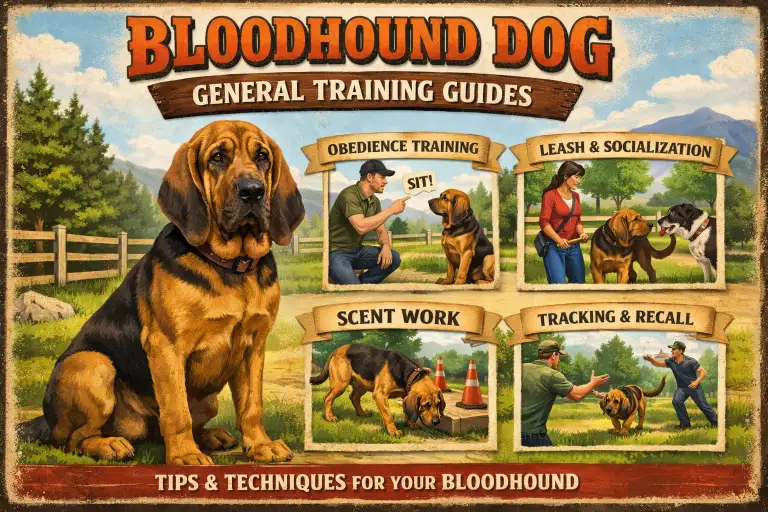
Training a Bloodhound is not about forcing obedience or repeating commands louder. It’s about understanding how a powerful scent-driven mind learns, makes decisions, and prioritizes the world around it. This guide is designed to help Bloodhound owners build reliable, real-world training skills that work with the breed’s instincts rather than against them.
Whether you’re raising a Bloodhound puppy, adopting an adult rescue, or struggling with recall and leash pulling, this guide focuses on practical, science-backed training methods that are realistic for everyday homes. Bloodhounds are intelligent, sensitive, and independent dogs, but they require a different approach than highly biddable breeds.
This article serves as a general Bloodhound training guide, covering foundational obedience, behavior understanding, and common challenges owners face. It is written for beginners who need clear direction, while still offering value to experienced owners who want more reliable results.
Is This Guide Right for Your Bloodhound?
| Situation | Is this guide helpful? | Why it applies |
|---|---|---|
| Bloodhound puppy (8–16 weeks) | Yes | Builds correct habits before scent fixation becomes strong |
| Adolescent Bloodhound | Yes | Addresses selective listening and impulse control issues |
| Adult Bloodhound | Yes | Focuses on motivation-based retraining and reliability |
| First-time Bloodhound owner | Yes | Explains breed-specific behavior in simple terms |
| Experienced dog owner new to Bloodhounds | Yes | Highlights why standard training methods often fail |
| Severe aggression or fear issues | Limited | May require professional, in-person behavior support |
By the end of this guide, you should understand why Bloodhounds behave the way they do, how to structure training sessions for success, and what realistic progress actually looks like with this breed.
Why Bloodhound Training Is Different (And Why It Matters)
Bloodhounds are not hard to train because they are “bad listeners.” They are different because their brain is built to follow scent first. Once a Bloodhound smells something interesting, the rest of the world fades away. This is why many owners feel their dog ignores them on walks or outside.
Training matters because a full-grown Bloodhound is large, strong, and very determined. Without training, common problems include pulling hard on the leash, running off after a scent, and ignoring recall. These are not small issues. They can be dangerous for the dog and stressful for the owner.
Bloodhounds also mature slowly. What looks like stubborn behavior is often a mix of strong instinct and delayed impulse control. Training helps teach the dog when to follow their nose and when to check back with you instead.
Early and consistent training keeps problems from becoming habits. A Bloodhound that learns basic rules early is safer, calmer, and easier to live with as an adult. Training is not about control. It is about communication and safety.
How Bloodhound Traits Affect Training
| Bloodhound trait | How it affects training | Why training matters |
|---|---|---|
| Extremely strong sense of smell | Dog loses focus quickly outdoors | Training builds check-in habits and safer recall |
| Independent thinking | Dog may ignore commands | Training teaches cooperation, not force |
| Large body and strength | Pulling becomes hard to manage | Leash training prevents injuries |
| High stamina | Dog does not tire easily | Mental training helps reduce problem behavior |
| Slow maturity | Takes longer to learn impulse control | Patience prevents frustration and mistakes |
Without training, these traits work against the owner. With the right training, they become strengths instead of problems.
Understanding Bloodhound Behavior and Learning Style
Bloodhounds learn in a different way than many other dogs. They are not trying to be stubborn or disobedient. Their brain is designed to follow smells. When a scent is strong, it feels more important than your voice, a toy, or even food.
This breed also thinks independently. That means a Bloodhound often decides, “Is this worth doing?” before responding. This does not mean they cannot learn. It means training must feel rewarding and clear to the dog.
Bloodhounds learn best with positive reinforcement. This means rewarding the behavior you want instead of punishing mistakes. Harsh corrections often confuse Bloodhounds and can cause fear or shutdown. Calm guidance and good rewards work much better.
Timing matters. Rewards must come right after the dog does the correct thing. If the reward is late, the dog may not understand what it is being praised for. Short, focused sessions work better than long training lessons.
What Works for Bloodhounds and What Does Not
| Training approach | Works or fails | Why it matters |
|---|---|---|
| Food rewards with strong smell | Works | Bloodhounds are highly food-motivated |
| Calm, happy voice | Works | Builds trust and focus |
| Short training sessions | Works | Prevents mental overload |
| Repeating commands many times | Fails | Teaches the dog to ignore you |
| Physical corrections | Fails | Can cause fear or stubborn resistance |
| Training only indoors | Fails | Dogs do not generalize skills well |
Understanding how your Bloodhound thinks makes training easier and less stressful. When you work with the dog’s natural instincts, progress comes faster and lasts longer.
Step-by-Step Bloodhound Training Basics
Bloodhound training works best when it is simple, short, and repeated often. Long lessons usually fail. These dogs learn better with clear steps and good rewards.
Start training in a quiet place. Once your Bloodhound understands the skill, slowly move to harder places like the yard or sidewalk. Expect outdoor training to take more time. Smells are very distracting for this breed.
Focus first on skills that keep your dog safe and calm. These include recall, leash walking, focus on the owner, and impulse control. Fancy tricks can wait.
Training sessions should always end on a good note. Stop before your dog gets bored or frustrated.
Bloodhound Training Session Blueprint
| Training part | What to do |
|---|---|
| Session length | 5–10 minutes |
| Sessions per day | 2–3 short sessions |
| Best location | Quiet area at first |
| Rewards | Smelly treats or favorite food |
| Owner behavior | Calm, patient, consistent |
| When to stop | When the dog is still engaged |
Short sessions help your Bloodhound stay focused and willing to learn.
Training Focus by Age
| Age stage | Main training goals |
|---|---|
| Puppy (8–16 weeks) | Name response, recall basics, leash comfort |
| Young dog (4–12 months) | Focus with distractions, loose leash walking |
| Adult Bloodhound | Reliable recall, impulse control, real-world practice |
Do not rush progress. Bloodhounds mature slowly. A skill that takes one week for another breed may take several weeks for a Bloodhound. This is normal.
Training should feel like a team effort. You are guiding your dog, not fighting against instincts.
Common Bloodhound Training Problems and Real-World Fixes
Even with the best training, Bloodhounds can develop common problems. Knowing what causes them and how to fix them makes life easier for both you and your dog.
Ignoring recall is the top challenge. A Bloodhound may not return when called if a smell is more interesting. Leash pulling is another frequent issue. Bloodhounds are strong and persistent, so without proper leash training, walks can be exhausting. Selective listening and distraction problems happen often, especially in busy homes or outdoors.
Training must adjust to the situation. Puppies, adult dogs, and multi-pet households all need slightly different approaches. Consistency and patience are key.
Common Bloodhound Training Problems & Fixes
| Problem | Likely cause | What owners usually do wrong | What actually works |
|---|---|---|---|
| Ignoring recall | Strong scent drive | Repeating name loudly, chasing | Reward-based recall with short distances, gradually increasing |
| Pulling on leash | High energy + scent interest | Pulling back, yelling | Loose-leash training, stop-and-go method |
| Selective hearing | Boredom or distraction | Ignoring small successes | Focus games and short, fun sessions |
| Frustration or stubbornness | Confusing commands | Giving up or punishment | Patience, positive reinforcement, clear cues |
| Getting overly excited | Overstimulation | Overreacting | Calm greetings, structured play before training |
When Training Isn’t Enough
| Behavior sign | Possible issue | Who to contact |
|---|---|---|
| Aggression toward people or dogs | Fear, anxiety, or poor socialization | Professional trainer or veterinary behaviorist |
| Chronic anxiety or shutdown | Past trauma or sensitivity | Veterinary behaviorist |
| Unsafe off-leash running | Strong prey drive or lack of recall | Certified trainer for advanced recall |
Understanding these problems early prevents frustration and keeps your Bloodhound safe. Many issues are not about “bad behavior” but natural instincts that need guidance.
For breed-specific background and temperament context, you can also review the Bloodhound breed profile from the American Kennel Club (AKC), which helps explain many of the training challenges discussed in this guide.

Ata Ur Rehman is the founder of Pet Age in Human Years Calculator, an educational platform that provides age conversion charts and lifespan guides for dogs, cats, birds, and other companion animals. His work focuses on helping pet owners understand how animal ages translate into human years using commonly accepted age conversion formulas and published lifespan averages.
The website compiles breed and species lifespan data from kennel clubs, breed organizations, and general animal lifespan studies to present simple and easy-to-understand guides for pet owners worldwide.
This website was created to centralize animal age conversion charts into one easy reference platform for pet owners.