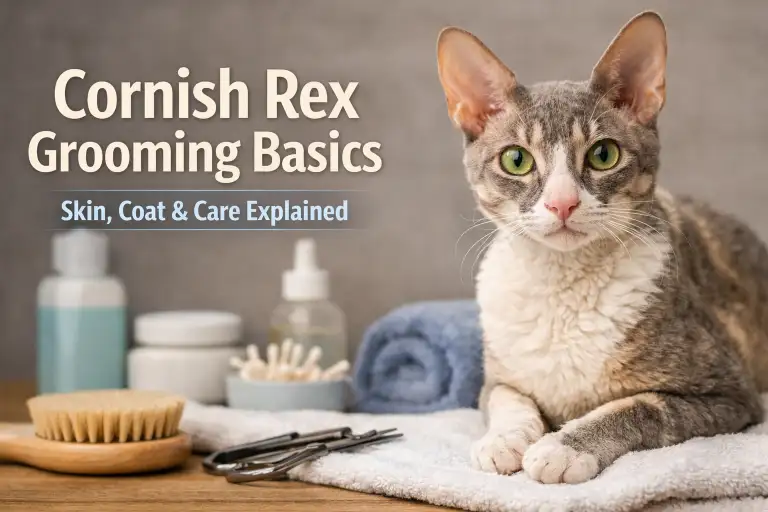
Cornish Rex grooming is different from grooming most other cats, even though their coat is short. Many owners assume short-haired cats need very little care, but that idea does not apply to this breed. Cornish Rex cats have a unique coat and skin structure that changes how grooming should be done.
Unlike typical cats, the Cornish Rex has a single-layer coat made entirely of soft, wavy hairs. They do not have guard hairs, which normally help protect the skin and absorb oils. Because of this, the skin is more exposed and natural oils are more noticeable. This is why some Cornish Rex cats feel slightly greasy to the touch, especially around the neck, belly, and tail base.
Grooming for a Cornish Rex is less about removing loose fur and more about protecting the skin. Over-grooming can easily irritate their sensitive skin, while under-grooming can allow oil buildup, ear wax accumulation, and hygiene issues. The goal is balance, not frequent handling.
Most Cornish Rex cats are kept indoors, which also affects grooming needs. Indoor environments can increase oil buildup but reduce dirt exposure. Temperature sensitivity is another factor. With less fur for insulation, Cornish Rex cats can feel cold easily, so grooming routines should always be gentle and kept short to avoid stress or discomfort.
The table below gives a quick overview of the Cornish Rex coat and skin features and how they affect grooming decisions:
| Feature | What It Means for Grooming |
|---|---|
| Single curly coat | Grooming focuses on skin care, not fur removal |
| No guard hairs | Skin is more exposed and easily irritated |
| Visible natural oils | Occasional bathing may be needed |
| Short hair length | Brushing is minimal and infrequent |
| Mostly indoor lifestyle | Grooming frequency varies by home environment |
Understanding these basics helps prevent the most common mistakes owners make, such as brushing too often, bathing too frequently, or assuming grooming is unnecessary. Once you understand how the Cornish Rex coat and skin work, every grooming step becomes easier, safer, and far less stressful for your cat.
Brushing and Skin Care for Cornish Rex Cats
Brushing a Cornish Rex cat is very different from brushing most other cats. Their coat is short, soft, and made of fine curls that sit close to the skin. Because of this, brushing is not needed often and should always be gentle.
Many owners think brushing helps remove loose hair, but Cornish Rex cats do not shed in the same way as other breeds. Brushing too much can rub the skin and cause redness or irritation. For most Cornish Rex cats, light brushing once in a while is enough, and some cats may not need brushing at all.
When you do brush, focus on comfort instead of results. Use slow movements and very light pressure. If your cat flinches, pulls away, or twitches their skin, it means the skin is getting overstimulated. In that case, stop brushing and try again another day.
Skin care is more important than coat care for this breed. Cornish Rex skin produces natural oils that protect the skin. These oils can make the coat feel oily, but that is not always a problem. Trying to remove all the oil can damage the skin barrier and lead to dryness or irritation.
The table below shows safe brushing habits and common mistakes to avoid:
| Do | Don’t |
|---|---|
| Use very light pressure | Scrub or brush hard |
| Brush only when needed | Brush daily out of habit |
| Watch your cat’s reaction | Ignore skin twitching or flinching |
| Stop if the skin looks red | Push through discomfort |
If you notice redness, dryness, or sensitivity after brushing, give your cat a break from grooming and allow the skin to recover. Grooming should never cause pain or stress.
Bathing Cornish Rex Cats: When, Why, and How Often
Many people are surprised to learn that some Cornish Rex cats may need baths. Most cats clean themselves well, but the Cornish Rex coat works differently. Because they have less fur to absorb oil, natural skin oils can build up and make the skin feel greasy.
Bathing is not about making your cat smell good or look shiny. The goal is to gently remove extra oil when it becomes noticeable. If your Cornish Rex does not feel oily and looks clean, a bath is usually not needed.
How often a Cornish Rex needs a bath depends on the cat and the home. Some cats need one every few weeks, while others need them less often. Bathing too often can dry out the skin and cause itching or flakes. It is always better to bathe less and only increase if needed.
Signs your Cornish Rex may benefit from a bath include a greasy feel, dark buildup around the neck or belly, or a strong skin odor. Signs you are bathing too much include dry skin, redness, or your cat becoming very stressed during grooming.
The table below gives a general idea of bathing frequency for most Cornish Rex cats:
| Situation | Typical Bathing Frequency |
|---|---|
| Normal indoor cat | Every few weeks or as needed |
| Skin feels greasy | Bathe once, then reassess |
| Very clean home | Less frequent bathing |
| Dry or irritated skin | Stop bathing and allow skin to heal |
Always keep baths short and calm. Warm water, gentle handling, and a quiet space help reduce stress. If your cat becomes very upset, it is okay to stop and try again another time.
Ear Cleaning, Nail Trimming, and Dental Care Basics
Cornish Rex grooming is not only about the coat and skin. Basic care for the ears, nails, and teeth is also important for keeping your cat healthy and comfortable.
Cornish Rex cats often have more visible ear wax than other cats. This happens because there is less fur around the ears to trap debris. Checking the ears once a week helps catch buildup early. If the ears look clean and pale pink, no cleaning is needed. If you see dark wax near the opening, gentle cleaning may help. Never push anything deep into the ear.
Nail trimming is important even for indoor Cornish Rex cats. Long nails can catch on fabric, scratch skin during play, or break painfully. Most cats need their nails trimmed every few weeks. Keep sessions short and calm. If your cat struggles, it is better to trim one or two nails and stop than to force the process.
Dental care is often overlooked, but it is part of basic grooming. Healthy teeth support overall health. At home, beginners should focus on gentle habits, such as getting the cat used to mouth handling. Do not force brushing if your cat resists strongly. Professional dental care should always be handled by a veterinarian.
The table below gives a simple overview of how often these grooming tasks are usually needed:
| Grooming Task | General Frequency |
|---|---|
| Ear inspection | Weekly |
| Ear cleaning | Only when buildup is seen |
| Nail trimming | Every few weeks |
| Dental care | Regular light care |
If you notice strong ear odor, bleeding gums, broken nails, or signs of pain, stop home grooming and contact a veterinarian.
Grooming Routine, Safety, and Common Mistakes
A good Cornish Rex grooming routine is simple and gentle. You do not need to groom every day. Short, calm sessions work better than long or frequent ones. Always choose a quiet time when your cat is relaxed, such as after eating or resting.
Watch your cat’s body language during grooming. Small signs like tail flicking, skin twitching, ears turning sideways, or sudden movement mean your cat is getting uncomfortable. When you see these signs, it is best to pause or stop. Forcing grooming can make future sessions harder and more stressful.
Many grooming problems happen because owners try to do too much. Over-bathing, brushing too often, or cleaning ears too deeply can harm sensitive Cornish Rex skin. Another common mistake is pushing through stress instead of stopping. Grooming should never feel like a struggle for you or your cat.
The table below shows common stress signals and what to do if you notice them:
| Stress Signal | What It Means | What to Do |
|---|---|---|
| Tail flicking | Rising discomfort | Slow down or stop |
| Ears turned sideways | Stress building | Reduce handling |
| Skin twitching | Overstimulation | End the session |
| Sudden pulling away | Fear or pain | Stop and try later |
If grooming feels difficult no matter how gentle you are, a professional groomer or veterinarian can help. This is especially important if your cat has skin issues, painful nails, or strong fear during handling.
For additional veterinary-backed guidance on safe grooming and skin care for cats, you can refer to the American Veterinary Medical Association, which provides trusted information on feline hygiene, handling, and overall cat care: https://www.avma.org/resources-tools/pet-owners/petcare/cat-care-basics

Ata Ur Rehman is the founder of Pet Age in Human Years Calculator, an educational platform that provides age conversion charts and lifespan guides for dogs, cats, birds, and other companion animals. His work focuses on helping pet owners understand how animal ages translate into human years using commonly accepted age conversion formulas and published lifespan averages.
The website compiles breed and species lifespan data from kennel clubs, breed organizations, and general animal lifespan studies to present simple and easy-to-understand guides for pet owners worldwide.
This website was created to centralize animal age conversion charts into one easy reference platform for pet owners.