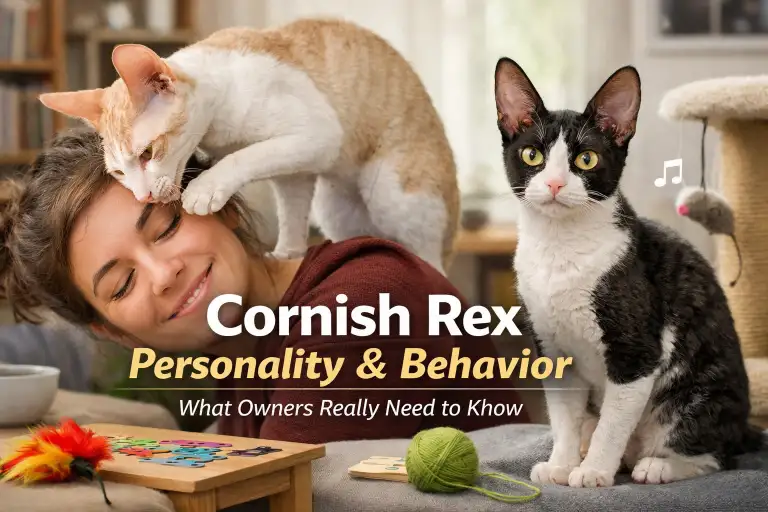
The Cornish Rex personality is often described as cat-like but turned up a few notches—not because these cats are demanding or difficult, but because they are unusually social, responsive, and emotionally present compared to the average domestic cat. Many owners notice early on that living with a Cornish Rex feels less like coexisting with a quiet observer and more like sharing space with an engaged companion.
At their core, Cornish Rex cats tend to be people-oriented. They are curious about what their humans are doing, where they are going, and how they are feeling. This doesn’t mean every Cornish Rex is identical. Personality varies widely between individuals, shaped by early experiences, environment, and the cat’s own temperament. However, as a group, they show a consistent pattern of seeking interaction rather than avoiding it.
One important thing to understand is that Cornish Rex cats don’t express affection in just one way. Some are enthusiastic lap cats who curl up tightly against their owners, while others prefer constant proximity—following from room to room, sitting nearby, or supervising daily activities. Both styles reflect attachment, not neediness. For this breed, closeness is often their default comfort state.
Their sensitivity is another defining trait. Cornish Rex cats are typically very aware of human tone, mood, and routine. They often respond quickly to changes in energy in the household, becoming more animated during active moments and more settled when things are calm. This emotional attunement can make them feel almost intuitive, but it can also lead owners to misinterpret normal social behavior as “clingy” or excessive.
What’s essential to keep in mind is that the Cornish Rex personality is not about dependence—it’s about engagement. These cats are wired to participate in their environment. When owners understand this, many behaviors that initially seem intense or puzzling start to make sense as expressions of curiosity, bonding, and trust rather than problems that need correcting.
Understanding this foundation sets the stage for interpreting everything else about Cornish Rex behavior—from their energy levels to their vocal habits—in a more accurate and reassuring way.
Why Cornish Rex Cats Behave the Way They Do
Many Cornish Rex behaviors make much more sense once you understand where they come from. These cats are not acting this way to get attention or cause trouble. Their behavior is shaped by a mix of genetics, early life, and daily environment.
Cornish Rex cats were bred from a natural genetic change. That change did more than affect their coat. It also influenced how their brains respond to people and surroundings. As a result, many Cornish Rex cats are more alert, more social, and more responsive than the average cat.
Early experiences matter too. Cornish Rex kittens that grow up with gentle handling, talking, and play usually become adults that enjoy human company. This does not mean cats without this background are “bad.” It simply means each cat learns what feels safe and rewarding.
The home environment plays a big role as well. Cornish Rex cats notice movement, sounds, and routines very easily. When their environment is interesting and predictable, their behavior often feels calm and balanced. When it changes suddenly or feels boring, they may become more vocal, more active, or more attached to their owners. This is communication, not misbehavior.
Human response is another key factor. Cornish Rex cats learn quickly. When following you, talking to you, or joining your activities leads to interaction, those behaviors are reinforced. Over time, this creates a strong feedback loop where the cat becomes even more engaged with their person.
It is important to understand that personality and behavior grow together. A Cornish Rex cat does not wake up one day deciding to be “clingy” or “hyper.” Their behavior develops naturally based on how safe, connected, and stimulated they feel in their daily life.
Seeing behavior as a result of wiring and experience—not intention—helps owners feel calmer and more confident.
Social, Affectionate, and Attention-Seeking Behavior Explained
Cornish Rex cats are known for being very social. They enjoy being around people and often want to be part of whatever is happening. This does not mean they are spoiled or demanding. It simply means they are a breed that bonds closely with humans.
Many Cornish Rex cats like to follow their owners from room to room. Some sit on laps. Others sit nearby, watching quietly. Both behaviors show affection. Cats express love in different ways, and Cornish Rex cats usually prefer closeness over distance.
These cats often look for attention through simple actions. They may touch you with a paw, make soft sounds, or sit where you can see them easily. This is how they start interaction. It is their way of saying, “I’m here” or “I want to connect.”
Below is a simple table to help understand common behaviors and what they usually mean:
| Behavior | What Owners Often Think | What It Really Means |
|---|---|---|
| Following you everywhere | Clingy behavior | Strong social bond |
| Sitting very close | Wants attention | Feels safe near you |
| Vocal greetings | Being demanding | Saying hello or checking in |
| Seeking warmth and contact | Too needy | Comfort and trust |
Some owners worry that this level of affection means something is wrong. In most cases, it is completely normal for this breed. Cornish Rex cats are people-focused by nature. They enjoy shared space, shared routines, and shared time.
It is also common for these cats to react to human moods. When you are calm, they often relax. When you are active, they may become playful or excited. This sensitivity makes them feel emotionally connected, which many owners find very rewarding.
Understanding this social behavior helps owners stop labeling normal actions as problems and start seeing them as signs of trust.
Playfulness, Energy Levels, and Natural Instincts
Cornish Rex cats are known for having a lot of energy. Many owners notice that these cats keep playing long after other cats slow down. This is normal for the breed and does not mean the cat is out of control or poorly behaved.
Play is very important for Cornish Rex cats. It helps them use their energy, stay focused, and feel happy. Running, jumping, chasing, and climbing are all natural behaviors. These actions come from their hunting instincts, even though they live indoors.
Some play behaviors can look confusing at first. A cat may suddenly run fast across the room or jump onto furniture. This is often called “zoomies.” It is a normal way for cats to release extra energy.
The table below helps explain common play behaviors and what they usually mean:
| Behavior | What It Looks Like | What Is Really Happening |
|---|---|---|
| Zoomies | Wild running | Energy release |
| Chasing feet or toys | Aggressive play | Practice hunting skills |
| Jumping and climbing | Restlessness | Need for movement |
| Repeating the same game | Obsession | Mental focus and fun |
Cornish Rex cats often enjoy playing with people. They like games that involve movement and interaction. This is part of how they bond. Play is not just exercise for them. It is also a way to connect and communicate.
Because they stay playful as they grow older, some people think Cornish Rex cats never calm down. In reality, their energy becomes more focused with age, but the love for play usually stays.
Understanding play behavior helps owners feel more relaxed and prevents normal actions from being misunderstood.
Commonly Misunderstood Cornish Rex Behaviors
Many Cornish Rex behaviors are normal, but they are often misunderstood. This happens because these cats act differently from what people expect a “typical” cat to be like. When owners do not understand the reason behind a behavior, it can cause worry.
One common misunderstanding is thinking a Cornish Rex is too needy. In most cases, the cat is simply social. Wanting to be near people, watching daily activities, or asking for interaction are signs of trust, not problems.
Another common worry is vocal behavior. Cornish Rex cats often make sounds to communicate. They may greet you, answer when spoken to, or talk during play. This is usually normal communication, not stress or fear.
Some owners also think their cat is too active. Running, climbing, and playing often are part of the Cornish Rex personality. These cats enjoy movement and mental challenges. High energy does not mean bad behavior.
The table below shows common myths and what they really mean:
| Common Belief | What Is Actually Happening |
|---|---|
| My cat is clingy | My cat is strongly bonded |
| My cat is hyper | My cat needs engagement |
| My cat is loud | My cat is communicating |
| My cat follows me too much | My cat feels safe with me |
Another misunderstood behavior is following owners closely. This is not usually a sign of fear or anxiety. It is often a sign that the cat enjoys company and feels secure.
When behavior is looked at as communication instead of a problem, it becomes easier to understand the cat’s needs and personality.
For readers who want a deeper, science-based understanding of normal cat behavior and communication, International Cat Care offers clear, veterinarian-reviewed guidance on how cats think, interact, and express themselves in everyday life.https://icatcare.org/advice/understanding-cat-behaviour

Ata Ur Rehman is the founder of Pet Age in Human Years Calculator, an educational platform that provides age conversion charts and lifespan guides for dogs, cats, birds, and other companion animals. His work focuses on helping pet owners understand how animal ages translate into human years using commonly accepted age conversion formulas and published lifespan averages.
The website compiles breed and species lifespan data from kennel clubs, breed organizations, and general animal lifespan studies to present simple and easy-to-understand guides for pet owners worldwide.
This website was created to centralize animal age conversion charts into one easy reference platform for pet owners.