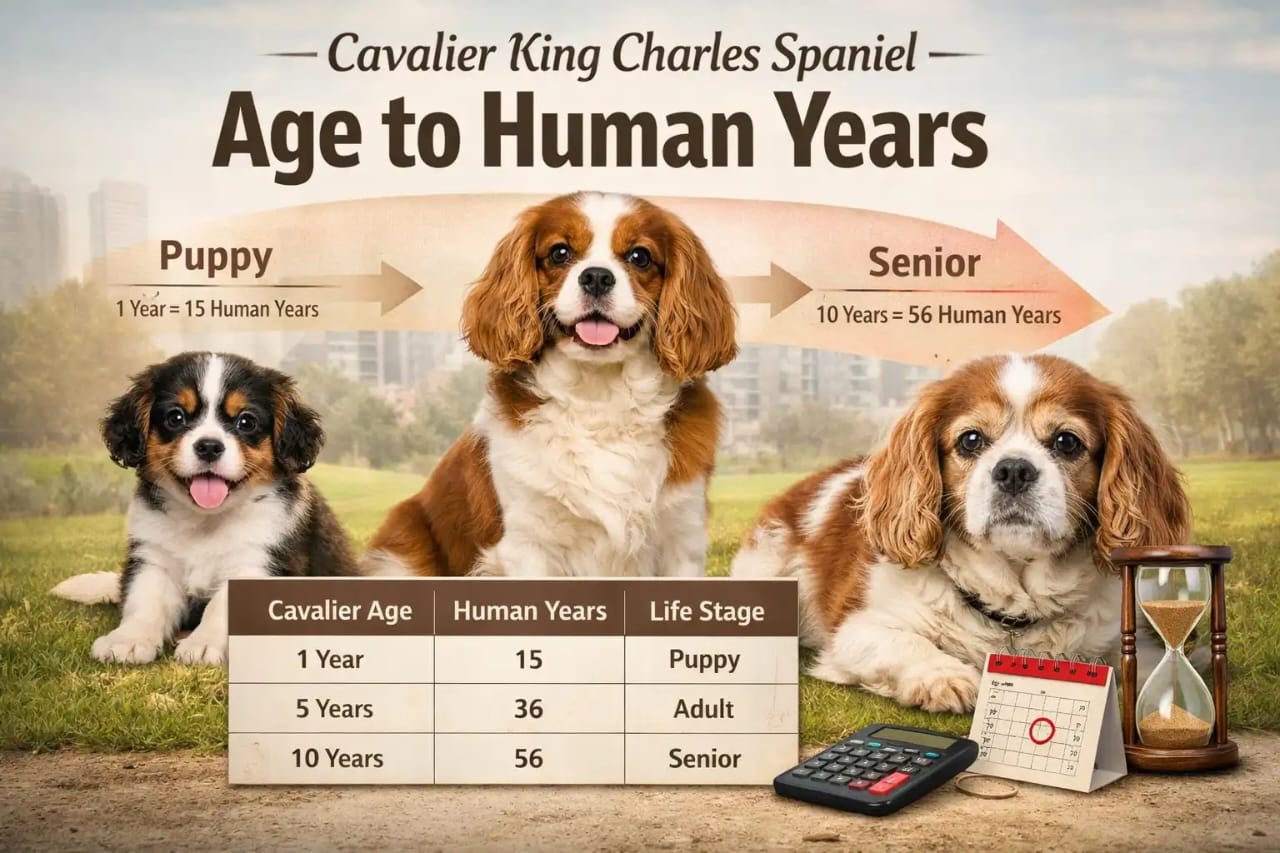
Cavalier King Charles Spaniels do not age at a simple 1-to-7 rate. Small breeds mature rapidly in their first two years and then age more gradually compared to larger dogs. Understanding this aging pattern helps you accurately compare your Cavalier’s age in human years using a reliable age chart.
Human years conversion is a method used to estimate how old a dog would be if it aged at a similar biological rate as humans. It accounts for rapid early development and slower aging in adulthood.
A Cavalier King Charles Spaniel ages rapidly in the first two years. A 1-year-old Cavalier equals about 15 human years, and a 2-year-old is roughly 24 in human years. After that, each additional year equals about 4 human years. Small breeds age faster early, then more gradually compared to larger dogs.
A simple way to understand it is by life stages: puppies grow quickly in the first year, adults reach a steady phase, and seniors start showing changes in health and activity. For example, a 2-year-old Cavalier is more like a 24-year-old human in maturity, not a 14-year-old.
Knowing how your Cavalier ages helps you plan for training, exercise, and health care at every stage. It also shows why small breeds like Cavaliers often live longer than bigger dogs.
Dog Years vs Human Years Explained
Many people believe that 1 dog year equals 7 human years, but this is a myth. Dogs do not age at a steady, linear rate. Small breeds like Cavalier King Charles Spaniels mature very quickly in the first two years and then age more slowly compared to larger dogs.
For Cavaliers, the first year equals about 15 human years, and the second year equals about 24 human years in total. After that, each additional year equals roughly 4 human years. This logarithmic aging pattern explains why the old “7-year rule” is inaccurate.
The Science Behind Cavalier Aging
Cavalier King Charles Spaniels grow and age in ways that science can explain. Small breeds like Cavaliers have fast early growth, then their aging slows compared to medium or large dogs. This is why a 1-year-old Cavalier may act like a 15-year-old human, while a 5-year-old is more like a 36-year-old human.
Scientists use modern models, like the 2019 dog epigenetic study, which looks at DNA changes as dogs grow older. These studies show that dog aging is logarithmic, not linear, meaning the first years count more toward “human age” than later years.
Understanding this helps owners care for their Cavaliers properly, from puppy training to senior health. It also corrects the old myth that every dog year equals seven human years.
Cavalier King Charles Spaniel Age in Human Years Chart
To know your Cavalier’s age in human years, you can use a simple conversion model. Small dogs like Cavaliers age faster in the first two years, then their aging slows.
Below is the complete Cavalier King Charles Spaniel age in human years chart showing each life stage:
| Cavalier Age (Years) | Human Age Equivalent | Life Stage |
|---|---|---|
| 0–1 | 0–15 | Puppy |
| 2 | 24 | Young Adult |
| 3 | 28 | Adult |
| 4 | 32 | Adult |
| 5 | 36 | Adult |
| 6 | 40 | Adult |
| 7 | 44 | Adult |
| 8 | 48 | Mature Adult |
| 9 | 52 | Senior |
| 10 | 56 | Senior |
| 11 | 60 | Senior |
| 12 | 64 | Senior |
| 13 | 68 | Senior |
| 14 | 72 | Senior |
| 15 | 76 | Senior |
This chart makes it easy to see how your Cavalier compares to a human at any age. For example, a 5-year-old Cavalier is roughly 36 human years, while a 10-year-old Cavalier is about 56 human years.
Using this Cavalier King Charles Spaniel age in human years chart can help you plan training, exercise, and health care according to your dog’s life stage.
Life Stages: Puppy, Adult, and Senior Cavaliers
Cavalier King Charles Spaniels go through three main life stages: puppy, adult, and senior. Each stage has its own changes in behavior, health, and energy.
Puppy (0–1 year)
- Rapid growth and learning.
- Very playful and curious.
- Needs gentle training, socialization, and short exercise sessions.
Adult (2–8 years)
Cavalier King Charles Spaniels are usually fully grown in size by 12 months of age. However, mental and emotional maturity continues developing until around 18–24 months.
- Energy levels are steady.
- Fully grown in size and personality.
- Requires regular exercise, mental stimulation, and consistent training.
Senior (9+ years)
- Slower movement, more rest needed.
- Possible changes in appetite, joints, or vision.
- Requires gentle walks, soft bedding, and regular vet check-ups.
Understanding these stages helps owners give the right care, diet, and attention. Watching for signs of aging, like slower walking or weight changes, ensures your Cavalier stays healthy and happy.
Helping Your Cavalier Age Healthily
Keeping your Cavalier healthy at every age is important. Small changes in diet, exercise, and care can make a big difference in their life.
Nutrition and weight management
- Feed age-appropriate food: puppy, adult, or senior formulas.
- Avoid overfeeding to prevent weight gain and joint problems.
Exercise and mental activity
- Puppies: short play sessions and socialization.
- Adults: daily walks, playtime, and simple training games.
- Seniors: gentle walks, soft toys, and short mental exercises.
Vet care and screenings
- Regular check-ups for teeth, eyes, and heart.
- Early detection of common Cavalier health issues like heart disease and joint problems.
Lifestyle tips for longevity
- Spaying or neutering may help extend life expectancy.
- Keep a routine for meals, exercise, and rest.
- Provide cozy bedding and calm spaces for older dogs.
Following these tips helps your Cavalier stay happy, active, and healthy for many years.
Frequently Asked Questions
How long do Cavalier King Charles Spaniels live?
Cavalier King Charles Spaniels typically live between 12 and 15 years. Lifespan depends on genetics, diet, exercise, and early detection of common health conditions.
Is 10 years old considered old for a Cavalier?
Yes. A 10-year-old Cavalier is considered a senior and equals roughly 56 human years. At this stage, regular vet care and gentle exercise become especially important.
Do small dogs age slower than large dogs?
Small breeds like Cavaliers age quickly in their first two years but tend to age more slowly and live longer overall compared to large dog breeds.
For more detailed guidance on Cavalier King Charles Spaniel care and health, you can visit the American Kennel Club’s breed page: https://www.akc.org/dog-breeds/cavalier-king-charles-spaniel/.

Ata Ur Rehman is the founder of Pet Age in Human Years Calculator, an educational platform that provides age conversion charts and lifespan guides for dogs, cats, birds, and other companion animals. His work focuses on helping pet owners understand how animal ages translate into human years using commonly accepted age conversion formulas and published lifespan averages.
The website compiles breed and species lifespan data from kennel clubs, breed organizations, and general animal lifespan studies to present simple and easy-to-understand guides for pet owners worldwide.
This website was created to centralize animal age conversion charts into one easy reference platform for pet owners.