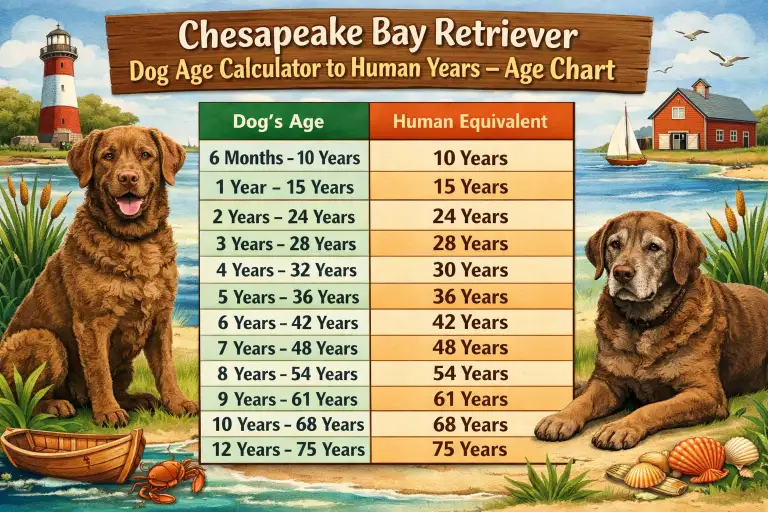
Many people ask, “How old is my Chesapeake Bay Retriever in human years?”
This age calculator helps you convert your dog’s age into a human age estimate that makes sense for this large, athletic working breed.
Chesapeake Bay Retrievers do not age the same way humans do. They grow very fast in the first two years, then aging slows down. After middle age, large dogs like Chesapeakes start aging faster again.
This calculator is based on:
- Large-breed dog aging patterns
- Modern veterinary aging research
- Real lifespan data for Chesapeake Bay Retrievers
Example:
A 5-year-old Chesapeake Bay Retriever is roughly equal to a 36–40-year-old human, not 35 like the old “7-year rule” suggests.
Chesapeake Bay Retriever Age Chart (Dog Years to Human Years)
Use this table to quickly see how your Chesapeake Bay Retriever’s age compares to human years. This chart is made specifically for large breeds, not small dogs.
| Dog Age (Years) | Human Age Equivalent | Life Stage |
|---|---|---|
| 1 | 15 | Puppy |
| 2 | 24 | Young Adult |
| 3 | 28 | Adult |
| 4 | 32 | Adult |
| 5 | 36–40 | Adult |
| 6 | 42–45 | Adult |
| 7 | 47–50 | Mature |
| 8 | 51–55 | Senior |
| 9 | 56–60 | Senior |
| 10 | 61–65 | Senior |
| 11 | 66–70 | Senior |
| 12 | 71–75 | Senior |
Important notes:
- Chesapeakes usually live 10–13 years
- Large dogs age faster after about 7–8 years
- Lifestyle, weight, and health can change aging speed
How Chesapeake Bay Retrievers Age Compared to Humans
Dogs and humans do not age in a straight line. That is why the “1 dog year = 7 human years” rule is wrong.
Here is what really happens:
- Puppies age extremely fast in the first year
- Adult dogs age slowly for a few years
- Large dogs age faster again as seniors
Chesapeake Bay Retrievers are:
- Large and muscular
- Bred for hard physical work
- Faster to mature than humans
- Shorter-lived than small dogs
Modern studies show dog aging follows a curved pattern, not a straight one. Early years count more, middle years slow down, and senior years speed up again.
Size matters a lot:
- Small dogs age slower later in life
- Large dogs like Chesapeakes show aging signs earlier
- Joint, heart, and mobility changes appear sooner in large breeds
Chesapeake Bay Retriever Life Stages Explained
Chesapeake Bay Retrievers go through clear life stages. Each stage comes with different needs and behaviors.
| Dog Age | Life Stage | What You’ll Notice |
|---|---|---|
| 0–1 | Puppy | Fast growth, high energy, learning basics |
| 1–2 | Adolescent | Strong body growth, testing limits |
| 3–6 | Adult | Peak strength, steady behavior |
| 7–8 | Mature | Slight slowdown, more rest |
| 9+ | Senior | Gray hair, stiffness, lower energy |
Many Chesapeakes are considered senior dogs around 8 years old.
Common senior changes:
- Slower movement
- Joint stiffness
- Weight gain
- Less patience
- More sleeping
Helping Your Chesapeake Bay Retriever Age Healthily
Good care can improve both lifespan and quality of life, especially for large breeds like Chesapeakes.
| Life Stage | Main Focus | Helpful Tips |
|---|---|---|
| Puppy | Growth | Balanced food, joint-safe exercise |
| Adult | Fitness | Regular activity, weight control |
| Mature | Prevention | Vet checks, joint support |
| Senior | Comfort | Softer beds, gentle walks |
Key tips:
- Keep your dog lean to protect joints
- Adjust exercise as your dog ages
- Visit the vet at least once a year, twice for seniors
- Watch for pain, limping, or behavior changes
- Mental games help aging brains stay sharp
Large dogs hide pain well, so small changes matter.
For more breed-specific health and lifespan information, you can also visit the American Kennel Club’s Chesapeake Bay Retriever breed profile, which provides official insights into the breed’s history, traits, and longevity:
https://www.akc.org/dog-breeds/chesapeake-bay-retriever/

Ata Ur Rehman is the founder of Pet Age in Human Years Calculator, an educational platform that provides age conversion charts and lifespan guides for dogs, cats, birds, and other companion animals. His work focuses on helping pet owners understand how animal ages translate into human years using commonly accepted age conversion formulas and published lifespan averages.
The website compiles breed and species lifespan data from kennel clubs, breed organizations, and general animal lifespan studies to present simple and easy-to-understand guides for pet owners worldwide.
This website was created to centralize animal age conversion charts into one easy reference platform for pet owners.