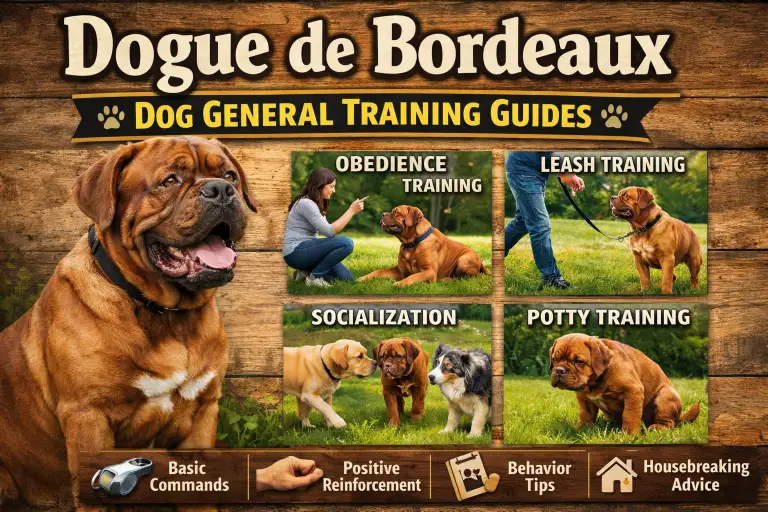
Training a Dogue de Bordeaux is not about teaching tricks or chasing perfect obedience—it’s about building control, trust, and calm behavior in a very large, powerful, and emotionally sensitive dog. This breed is intelligent and loyal, but it is also strong-willed, slow to mature, and physically capable of overwhelming an unprepared owner. That combination makes early, structured training essential, not optional.
This guide is designed for real-life owners, not professional trainers. It applies whether you are raising a Dogue de Bordeaux puppy from 8 weeks old, working with an adolescent dog testing boundaries, or retraining an adult dog with little or inconsistent training. The focus is on practical, everyday skills that matter in normal households—walking politely on leash, responding reliably to cues, staying calm around people and other animals, and handling the world without fear or overreaction.
Unlike generic dog training advice, Dogue de Bordeaux training must account for three realities:
their size and strength, their naturally protective temperament, and their tendency to shut down or resist when handled harshly. Methods that rely on force, intimidation, or constant repetition often fail with this breed and can actively create behavior problems.
The goal of training is not to suppress the dog’s personality, but to channel it safely. A well-trained Dogue de Bordeaux should be calm in the home, manageable in public, confident without being reactive, and responsive even when distracted. Everything in this guide is built around achieving that outcome in a realistic, humane, and repeatablew
Understanding the Dogue de Bordeaux Temperament and Learning Style
Before you train a Dogue de Bordeaux, you must understand how this dog thinks and learns. Many training problems with this breed happen not because the dog is “bad,” but because owners use the wrong approach.
The Dogue de Bordeaux is calm, loyal, and very attached to its family. At the same time, it can be stubborn, slow to mature, and naturally protective. This means training works best when it is clear, fair, and consistent, not loud or forceful.
This breed does not respond well to pressure or punishment. If pushed too hard, many Dogue de Bordeaux dogs either shut down and stop trying, or push back and ignore the owner. Training should be calm, confident, and reward-based, with clear rules that never change.
They are also late bloomers. Many owners expect fast results like they see with smaller or more eager-to-please breeds. With Dogue de Bordeaux dogs, progress is steady but slow. Patience matters more than intensity.
Below is a simple table to help you quickly understand how common breed traits affect training and what you should do as an owner.
Dogue de Bordeaux Training Traits at a Glance
| Breed Trait | What This Means | How to Train Effectively |
|---|---|---|
| Calm and laid-back | May seem lazy or unmotivated | Use short sessions and high-value rewards |
| Strong-willed | Will test limits if rules change | Be consistent every day |
| Very loyal to family | Bonds deeply with owners | Build trust before demanding obedience |
| Protective by nature | May guard people or space | Focus on early socialization and calm exposure |
| Slow to mature | Behaves puppy-like longer | Adjust expectations and avoid rushing |
| Sensitive to pressure | Shuts down with harsh handling | Use praise, food, and calm guidance |
Understanding this learning style will save you time and frustration. When training matches the dog’s temperament, results come faster and last longer.
Step-by-Step Dogue de Bordeaux Training for Puppies and Adults
Training a Dogue de Bordeaux works best when it is simple, calm, and consistent. This breed does not need long lessons or harsh control. It needs clear rules, short sessions, and daily practice.
Training should start as soon as the dog comes home. Puppies and adult dogs can both learn well, but the pace and focus must match their age.
The table below shows what to train at each life stage so owners know what to expect and do next.
| Age or Stage | Main Training Focus | What Owners Should Expect |
|---|---|---|
| 8–16 weeks (puppy) | Name response, potty training, gentle leash use, handling | Short attention span, fast learning |
| 4–6 months | Sit, down, stay, calm greetings | Testing limits, needs patience |
| 6–18 months (teen) | Leash manners, recall, impulse control | Stubborn phase, slow progress |
| Adult dog | Reinforce basics, calm behavior in public | Steady improvement with routine |
Daily training should be short and frequent, not long and tiring. This breed can get bored or frustrated if pushed too much.
Use the table below as a daily guide.
| Training Item | Recommendation |
|---|---|
| Session length | 5–10 minutes |
| Sessions per day | 2–3 short sessions |
| Best rewards | Soft treats, praise, calm touch |
| Best time to train | Before meals or walks |
| When to stop | When the dog loses focus or stress shows |
Common Dogue de Bordeaux Training Problems and How to Fix Them
Many Dogue de Bordeaux training problems come from confusion, weak rules, or moving too fast. This breed is strong and confident, so small mistakes can turn into big habits if they are not fixed early.
The good news is that most problems are very fixable when owners stay calm and consistent.
The table below shows the most common training issues, why they happen, and what owners should do.
| Problem | Why It Happens | What to Do |
|---|---|---|
| Pulling on the leash | Dog learns it can move you with strength | Use short walks, reward loose leash, stop when pulling |
| Ignoring commands | Too many repeats or distractions too soon | Ask once, reward fast responses, train in quiet places |
| Jumping on people | Dog wants attention and excitement | Ignore jumping, reward calm sitting |
| Guarding people or space | Natural protectiveness without guidance | Increase calm social exposure, reward relaxed behavior |
| Stubborn shutdown | Training is too long or too strict | Shorten sessions, use better rewards |
| Rough play | Dog does not know limits | End play when it gets too rough, restart calmly |
One common owner mistake is talking too much. Repeating commands over and over teaches the dog that listening is optional. Say the cue once, wait, and reward when the dog responds.
Another mistake is training only at home. Dogs must slowly learn to behave in new places. Start inside, then move to the yard, then quiet outdoor areas.
If a problem gets worse instead of better after a few weeks of steady work, stop pushing forward and adjust the plan. For this breed, pushing harder often makes problems worse.
When to Get Professional Help with Dogue de Bordeaux Training
Some training problems should not be handled alone. Because the Dogue de Bordeaux is large and powerful, waiting too long can make problems harder and unsafe to fix later.
If basic training is not working after steady effort, or if behavior gets worse, it is time to ask for help. Getting help early does not mean you failed. It means you are protecting your dog and everyone around you.
The table below shows clear warning signs and what to do next.
| Warning Sign | Why It Matters | What to Do |
|---|---|---|
| Growling or snapping at people | Can turn into serious bites | Contact a professional trainer or behavior expert |
| Strong guarding of food or space | Can become dangerous quickly | Stop DIY fixes and get expert guidance |
| Fear reactions that get worse | Fear can lead to aggression | Seek help early, not later |
| No progress after weeks of training | Wrong method or timing | Get a trainer to adjust the plan |
| Owner feels unsafe or overwhelmed | Safety comes first | Get professional support immediately |
Choose a trainer who has experience with large or mastiff-type breeds and who uses calm, reward-based methods. Avoid trainers who rely on fear, pain, or force. These methods often make Dogue de Bordeaux dogs more defensive or shut down.
For more guidance on safe, reward-based dog training methods, you can also review this resource from the ASPCA: https://www.aspca.org/pet-care/dog-care/dog-training

Ata Ur Rehman is the founder of Pet Age in Human Years Calculator, an educational platform that provides age conversion charts and lifespan guides for dogs, cats, birds, and other companion animals. His work focuses on helping pet owners understand how animal ages translate into human years using commonly accepted age conversion formulas and published lifespan averages.
The website compiles breed and species lifespan data from kennel clubs, breed organizations, and general animal lifespan studies to present simple and easy-to-understand guides for pet owners worldwide.
This website was created to centralize animal age conversion charts into one easy reference platform for pet owners.