Many owners assume that one dog year equals seven human years, but this rule doesn’t accurately reflect how Samoyeds age. Dogs mature much faster than humans in their early years and then age more gradually as adults. This uneven pace is why a simple one-to-seven conversion can be misleading, especially for a breed like the Samoyed.
A Samoyed typically reaches physical and sexual maturity within the first year, something that takes humans more than a decade. That rapid early development means a one-year-old Samoyed is closer to a human teenager than a seven-year-old child. After this early growth phase, the aging process slows down, and each additional year adds fewer “human years” than people expect.
Samoyeds also don’t age the same way as all dogs. As a medium-to-large spitz breed, they mature a bit more slowly than small dogs but generally age more evenly and live longer than giant breeds. Their thick coat, strong genetics, and historically active working role all influence how their bodies develop and age over time.
Understanding these differences is important because age affects everything from nutrition and exercise to veterinary care. When you know how Samoyed aging compares to human aging, age calculators and charts become far more useful, helping you make better decisions at every stage of your dog’s life.
The Science Behind Samoyed Aging and Lifespan
Samoyeds do not age in a straight line like humans. Their bodies grow fast in the first year, then slow down as they reach adulthood. This is why scientists say dog aging follows a curve, not a simple count of years. Early life equals big changes, while later years bring slower, gradual aging.
One major reason Samoyeds age the way they do is body size. Smaller dogs usually live longer and age more slowly. Very large dogs age faster and often have shorter lives. Samoyeds fall in the middle, which gives them a balanced aging pattern compared to many other breeds.
Research also shows that dogs age faster at the DNA level when they are young. A major 2019 study on dog DNA (called an epigenetic methylation study) found that dogs age very quickly early in life and then slow down as adults. This supports why the old “7-year rule” does not work and why breed size matters.
Samoyeds are known for having a fairly long lifespan for their size. Good genetics, proper care, and an active lifestyle can all help them age more slowly and stay healthy longer.
Here is how Samoyeds compare to other dog size groups:
Dog Size Groups and Average Lifespan
| Dog Size Group | Average Lifespan | Where Samoyeds Fit |
|---|---|---|
| Small breeds | 12–16 years | No |
| Medium breeds | 10–14 years | Yes |
| Large breeds | 8–12 years | Partly |
| Giant breeds | 6–10 years | No |
This table helps explain why Samoyeds usually live longer than very large dogs but not as long as tiny breeds. It also shows why Samoyed age calculators must be breed-aware to be accurate.
Samoyed Age Calculator and Dog-to-Human Age Chart
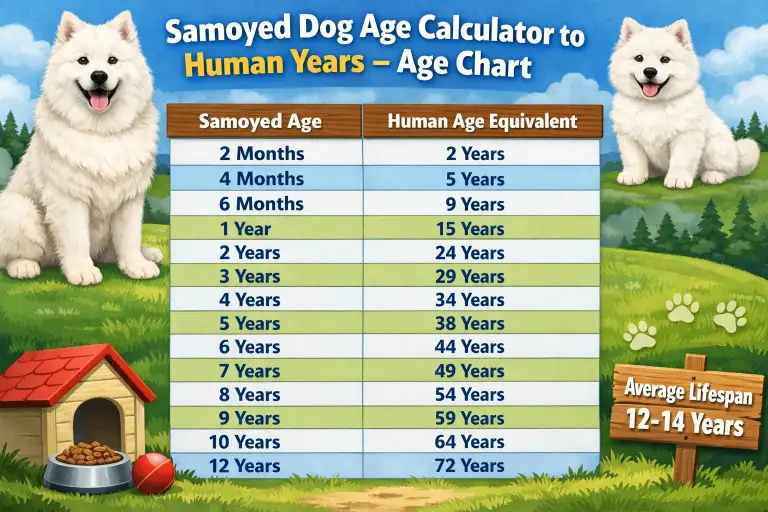
A Samoyed age calculator helps turn your dog’s age into human years in a more accurate way. Instead of using the old 7-year rule, this method looks at how fast Samoyeds grow early in life and how their aging slows as adults.
In simple terms, Samoyeds age very fast in the first two years. After that, each new year adds fewer human years. This is why a young Samoyed may seem to “grow up overnight,” while an older Samoyed ages more slowly.
Below is a clear and easy Samoyed age chart. You can quickly find your dog’s age and see what it means in human years.
Samoyed Age to Human Age Chart1 | 15
| Samoyed Age (Years) | Human Age (Approx.) |
|---|---|
| 2 | 24 |
| 3 | 28 |
| 4 | 32 |
| 5 | 36 |
| 6 | 40 |
| 7 | 44 |
| 8 | 48 |
| 9 | 52 |
| 10 | 56 |
| 11 | 60 |
| 12 | 64 |
For example, a 5-year-old Samoyed is about the same age as a 36-year-old human. A 10-year-old Samoyed is closer to a human in their mid-50s. This helps owners understand why energy levels, exercise needs, and health care change over time.
This chart is meant to give a close estimate, not an exact number. Things like genetics, diet, exercise, and vet care can all affect how quickly a Samoyed ages.
Samoyed Life Stages: Puppy, Adult, and Senior Years
Samoyeds go through clear life stages, and each stage comes with different needs and behaviors. Knowing your dog’s life stage helps you understand their energy level, health changes, and daily care.
Samoyed puppies grow very fast in their first year. They learn, play, and explore nonstop. This is the time when training, social skills, and healthy growth matter the most. Puppies need gentle exercise and good food to protect their growing joints.
Adult Samoyeds are usually full of energy but more balanced. They are strong, playful, and easier to manage than puppies. Most Samoyeds stay in this adult stage for several years. This is when they enjoy regular walks, playtime, and steady routines.
Senior Samoyeds slow down over time. They may sleep more, move slower, or need extra care for joints and teeth. Some seniors still act playful, but their bodies need more support. Regular vet visits become very important at this stage.
The table below shows the common life stages for Samoyeds and what owners often notice.
Samoyed Life Stages and What to Expect
| Life Stage | Age Range | Common Changes |
|---|---|---|
| Puppy | 0–12 months | Fast growth, high energy, learning |
| Young Adult | 1–4 years | Strong, active, full maturity |
| Mature Adult | 5–8 years | Calm behavior, stable health |
| Senior | 9+ years | Slower movement, aging signs |
Every Samoyed is different, but this table gives a helpful guide for most dogs.
How to Help Your Samoyed Age Healthily
Helping your Samoyed age well starts with simple daily care. Small choices made over time can make a big difference in how long your dog stays active and comfortable.
Food plays a big role in healthy aging. Samoyeds should stay at a healthy weight because extra weight puts stress on joints and the heart. As dogs get older, they may need fewer calories but better-quality protein to keep muscles strong.
Exercise is still important at every age. Puppies need short play sessions. Adult Samoyeds enjoy walks, games, and mental activities. Senior Samoyeds benefit from gentle walks and light play that keeps joints moving without causing pain.
Regular vet visits help catch problems early. As Samoyeds age, vets often check teeth, joints, heart health, and blood work. Early care can slow many age-related issues.
Comfort also matters more with age. Soft bedding, easy access to food and water, and warm sleeping areas help senior Samoyeds feel safe and relaxed.
The table below shows simple care tips based on age.
Age-Based Care Tips for Samoyeds
| Age Range | Care Focus |
|---|---|
| Puppy | Safe growth, training, joint protection |
| Adult | Balanced diet, exercise, weight control |
| Senior | Joint support, vet checks, comfort care |
These steps can help your Samoyed stay happy and healthy through all stages of life.
For more science-backed details on how dogs age at the DNA level, you can explore the research shared by the American Kennel Club, which explains why dog years don’t follow a simple formula:
https://www.akc.org/expert-advice/health/how-to-calculate-dog-years-to-human-years/

Ata Ur Rehman is the founder of Pet Age in Human Years Calculator, an educational platform that provides age conversion charts and lifespan guides for dogs, cats, birds, and other companion animals. His work focuses on helping pet owners understand how animal ages translate into human years using commonly accepted age conversion formulas and published lifespan averages.
The website compiles breed and species lifespan data from kennel clubs, breed organizations, and general animal lifespan studies to present simple and easy-to-understand guides for pet owners worldwide.
This website was created to centralize animal age conversion charts into one easy reference platform for pet owners.