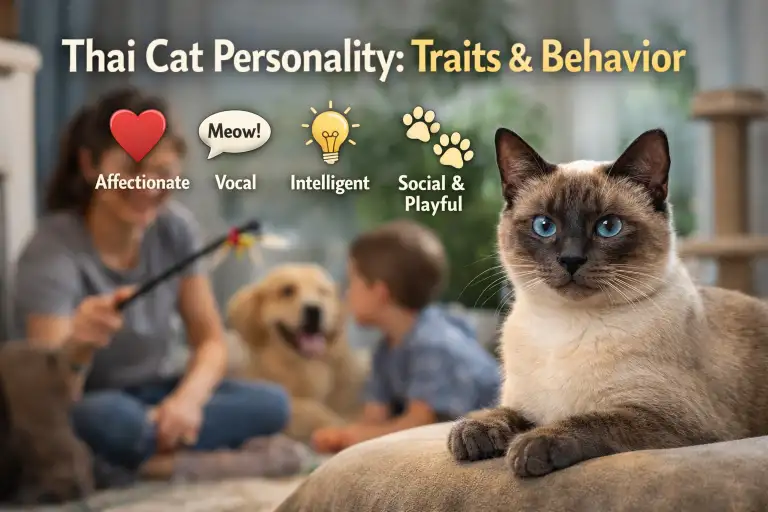
The Thai cat personality is often described as intelligent, affectionate, and deeply people-oriented — but those words only scratch the surface. Living with a Thai cat feels less like owning a pet and more like sharing space with an observant, emotionally tuned-in companion who is always paying attention.
Unlike more aloof breeds, Thai cats tend to be socially engaged. They notice your routines, respond to your tone of voice, and often position themselves nearby simply to stay connected. However, this does not mean every Thai cat behaves the same way. Personality exists on a spectrum, even within a breed known for strong social traits.
At their core, Thai cats combine four defining elements: emotional sensitivity, intelligence, communication, and selective independence.
Core Thai Cat Personality Traits Overview
| Trait | How It Shows Up at Home | What It Actually Means |
|---|---|---|
| Affectionate | Follows you from room to room, sleeps nearby | Strong social bonding instinct |
| Vocal | Responds when spoken to, “talks” during routines | Communication-driven temperament |
| Intelligent | Observes patterns, opens cabinets, learns quickly | High environmental awareness |
| Emotionally Sensitive | Reacts to tone changes or tension | Attuned to human mood shifts |
| Curious | Investigates new objects immediately | Cognitive engagement and confidence |
Affection in Thai cats often looks like proximity rather than constant physical contact. Some are lap cats who seek full-body closeness. Others prefer sitting beside you, touching lightly with a paw or curling at your feet. Both are expressions of bonding. Owners sometimes misinterpret this attentiveness as clinginess, when in reality it reflects a breed wired for social awareness.
Intelligence is another hallmark of the Thai temperament. These cats quickly recognize feeding schedules, bedtime routines, and even subtle environmental changes. It’s common for them to anticipate your next move — waiting by the door before you leave or appearing in the kitchen minutes before dinner prep begins. This isn’t manipulation; it’s pattern recognition.
Emotionally, Thai cats are perceptive. Raised voices, sudden changes in schedule, or a shift in household energy can influence their behavior. A normally vocal cat may grow quieter during tension, or a typically independent individual may seek extra closeness. This sensitivity is not fragility — it is responsiveness.
At the same time, Thai cats retain a level of independence. They are capable of entertaining themselves, observing from elevated perches, or retreating to a favorite resting spot when overstimulated. Their independence is balanced by a preference to remain socially connected.
It’s also important to understand that genetics provide a framework, but early life experiences shape how personality develops. Kittens exposed to gentle handling, stable environments, and varied experiences often grow into confident, expressive adults. Those raised with less stimulation may appear more reserved. Even so, the breed’s baseline sociability usually remains present.
In everyday life, a Thai cat often acts like a conversational partner — not because they demand constant attention, but because interaction energizes them. They thrive when acknowledged, spoken to, and included in the rhythm of daily activity.
Understanding Thai cat personality begins with recognizing this blend of warmth, alertness, and awareness. They are not simply affectionate or vocal. They are engaged observers who choose to participate in your world.
Thai Cat Behavior & Communication: Body Language and Vocal Signals
Thai cats are known for being expressive. They do not stay silent about their needs, feelings, or interests. If you live with one, you quickly learn that they communicate in many ways — not just with sound, but with their eyes, tail, posture, and small movements.
Understanding these signals helps you respond correctly and prevents misunderstandings.
Why Thai Cats Are So Vocal
Thai cats often “talk” to their humans. This does not mean they are noisy all the time. It means they use their voice as part of social bonding.
You may hear:
- Soft trills when greeting you
- Clear meows during mealtime
- Repeated calls when they want attention
- Quiet murmurs while walking near you
- A silent open-mouth meow when making eye contact
Most of the time, vocal sounds are social, not a problem. Thai cats often expect a response. When you talk back, they may answer again. It becomes a simple back-and-forth conversation.
If a normally vocal Thai suddenly becomes very quiet, that is when attention is needed. But regular talking is part of their personality.
Body Language: What Your Thai Cat Is Saying Without Words
Thai cats also communicate clearly through posture and movement.
Watch for:
- Upright tail with a soft curve at the tip — friendly greeting
- Slow blinking — trust and comfort
- Ears facing forward — relaxed interest
- Slight head bump — affection and scent marking
- Sitting near you without touching — social closeness
They also show excitement and alertness through:
- Wide eyes when curious
- Quick tail flicks when focused
- Still body posture when watching something closely
Small details matter. For example, whiskers pushed slightly forward often mean interest. Ears turning sideways may show mild uncertainty. These signals are subtle but helpful.
Thai Cat Communication Quick Guide
| Behavior | Likely Meaning | When to Pay Attention |
|---|---|---|
| Upright tail with curve | Friendly greeting | When approaching trusted people |
| Slow blink | Feeling safe | During calm eye contact |
| Loud repeated meow | Request or interaction | Near feeding or play time |
| Silent meow | Social connection | Direct eye contact moment |
| Sudden stillness | Alert focus | Watch ears and tail for more clues |
Comfort Signals vs Early Stress Signals
Thai cats are sensitive. They show comfort and stress differently.
Comfort signs:
- Kneading on soft surfaces
- Gentle purring
- Tail wrapped around body
- Relaxed grooming
Early stress signs:
- Fast tail flicking
- Flattened ears
- Sudden hiding
- Wide eyes with stiff posture
Most stress in Thai cats comes from sudden change — new people, loud noise, schedule shifts, or tension in the home. They do not usually react with aggression first. More often, they observe quietly or seek closeness.
What Owners Often Miss
Many owners focus only on loud meows or big movements. But Thai cats also use quiet communication:
- Pausing before jumping into your lap
- Sitting and staring gently before vocalizing
- Following you silently from room to room
- Light paw touch to get attention
These small behaviors show intention and awareness.
When you respond calmly and consistently, your Thai cat feels understood. This builds trust over time.
Social Behavior: Attachment to Humans, Other Pets & Family Life
Thai cats are very social. They do not like to feel ignored. They enjoy being part of daily life. Many owners say their Thai cat acts more like a small roommate than a pet.
But social does not always mean clingy. It means they like connection.
Attachment to Humans
Thai cats often form strong bonds with their people. Some bond closely with one main person. Others connect with the whole family.
You may notice:
- Following you from room to room
- Sitting nearby while you work
- Waiting at the door when you come home
- Sleeping near your head or feet
This behavior is sometimes called “shadow cat” behavior. It is not neediness. It is social attachment.
Some Thai cats love sitting on laps. Others prefer sitting beside you. Both are normal. Each cat shows love in its own way.
Can Thai Cats Stay Alone?
Thai cats can stay alone during work hours if:
- They have toys or climbing spaces
- They get daily interaction
- They have a stable routine
They may greet you with extra talking when you return. This is usually excitement, not distress.
If left alone too long without stimulation, they may become bored. Bored behavior can include more vocalizing or getting into cabinets.
Thai Cats with Children
Thai cats usually do well with calm, respectful children.
They do best when:
- Children move gently
- Handling is soft and not forced
- The cat has a quiet place to rest
Because Thai cats are sensitive, very loud or rough play may make them step away rather than react aggressively.
Thai Cats with Other Cats and Dogs
Thai cats often adjust well to other pets when introductions are slow and calm.
They may:
- Watch from a distance at first
- Approach slowly
- Set clear boundaries with body language
They usually prefer animals that are not overly rough or loud.
Here is a quick overview:
| Situation | Typical Thai Cat Response | What Helps Most |
|---|---|---|
| Single owner home | Very close bond | Daily talking and play |
| Family with children | Loyal but sensitive | Calm handling |
| Multi-cat home | Social but selective | Slow introduction |
| Home with dog | Careful observer at first | Gentle dog personality |
| Alone during workday | May vocalize on return | Enrichment toys |
Territorial Behavior
Like all cats, Thai cats are territorial. This means they feel safe when their space feels predictable.
They may:
- Rub their face on furniture
- Sleep in the same favorite spots
- Watch doors and windows
These behaviors are normal. They help the cat feel secure.
Thai cats are social, but they still need personal space. A high perch, a quiet corner, or a soft bed helps them relax when they want alone time.
Play, Hunting Instincts & Daily Activity Patterns
Thai cats are smart and active. Even though they love people, they are still hunters at heart. Play is not just fun for them. It is practice for natural hunting skills.
Understanding this helps you see why they move and act the way they do.
Natural Hunting Instincts
Thai cats like to stalk before they pounce. You may see them:
- Crouch low to the ground
- Wiggle their back before jumping
- Focus very hard on moving objects
- Freeze and watch before attacking a toy
This behavior is normal. It shows focus and control.
Toys that move like prey — such as feather wands or small rolling objects — often keep their attention longer than simple toys.
Energy Levels
Thai cats usually have short bursts of energy. They are often most active:
- Early morning
- Evening hours
This pattern is called crepuscular behavior. It means they are naturally active at dawn and dusk.
During these times, they may:
- Run quickly through the house
- Jump onto high places
- Invite you to play
- Become more talkative
This is normal and healthy.
Mental Stimulation
Thai cats are intelligent. They do not just need physical activity. They also need mental activity.
They enjoy:
- Puzzle toys
- Learning routines
- Watching birds through windows
- Climbing cat trees
- Exploring new objects safely
Without enough stimulation, boredom can appear.
Signs of boredom may include:
- Opening cabinets
- Knocking small objects down
- Extra vocalizing
- Following you more than usual
These are not bad behaviors. They often mean the cat needs more engagement.
Climbing and High Spaces
Thai cats like to observe from above. High places make them feel safe and in control.
They may choose:
- The top of a bookshelf
- A tall cat tree
- The back of a couch
Vertical space helps reduce stress and supports natural behavior.
Play vs Real Aggression
Sometimes fast movements or small bites during play can worry owners. It is helpful to know the difference.
Play usually includes:
- Loose body
- Pauses during movement
- No growling
- Light, controlled biting
Real aggression usually includes:
- Stiff body
- Flattened ears
- Growling or hissing
- No pause in attack
Most of the time, Thai cats are playful, not aggressive. They enjoy interaction and quick games.
Play keeps them healthy, confident, and balanced.
Stress Signals, Behavior Changes & Commonly Misunderstood Traits
Thai cats are sensitive and aware. Because they notice small changes in their home, they may react faster than other cats when something feels different. This does not mean they are fragile. It means they are observant.
Learning the difference between normal behavior and stress helps owners feel more confident.
Common Stress Triggers
Thai cats like routine. Sudden changes can make them uneasy.
Common triggers include:
- Moving furniture
- New people or pets
- Loud noises
- Travel or house moves
- Changes in feeding times
- Tension in the home
Most Thai cats respond by watching quietly, hiding for a short time, or staying close to their favorite person.
Comfort Signals vs Stress Signals
Here is a simple guide to help you tell the difference.
| Comfort Signals | Stress Signals |
|---|---|
| Slow blinking | Wide eyes with stiff body |
| Kneading | Sudden hiding |
| Gentle purring | Fast tail flicking |
| Relaxed grooming | Overgrooming one area |
| Tail wrapped softly | Ears flattened back |
Comfort behaviors show the cat feels safe. Stress behaviors show the cat is unsure or overwhelmed.
Mild stress often passes once the environment feels stable again.
Behavior Changes Across Life Stages
Thai cat personality can shift slightly as they grow.
Kittens:
- Very curious
- Very playful
- Learning social skills
Young adults:
- High energy
- Strong bonding behavior
- More confident communication
Adult cats:
- Stable routine
- Balanced activity
- Clear preferences
Senior cats:
- Slightly lower energy
- More quiet companionship
- Still socially attached
Personality usually stays consistent. Energy levels may change, but the social nature often remains.
Commonly Misunderstood Thai Cat Behaviors
Some traits are easy to misread.
“Clingy”
Often just strong bonding behavior.
“Too vocal”
Usually normal communication for this breed.
“Demanding”
Often means mentally active and seeking engagement.
“Dramatic”
Often emotional awareness, not overreaction.
Thai cats are expressive. They do not hide their thoughts. When owners understand this, the behavior makes more sense.
When to Seek Professional Advice
Most behavior changes are small and temporary. However, it is important to consult a veterinarian if you notice:
- Sudden aggression
- Complete withdrawal
- Major appetite changes
- Sudden litter box problems
- Sharp personality shifts
These changes can sometimes signal a health issue rather than a personality issue.
Understanding stress and normal behavior helps build trust. Thai cats do best in calm, predictable homes where their communication is noticed and respected.
For readers who would like to explore the official breed history and recognition details, you can learn more about the Thai cat through The International Cat Association (TICA).

Ata Ur Rehman is the founder of Pet Age in Human Years Calculator, an educational platform that provides age conversion charts and lifespan guides for dogs, cats, birds, and other companion animals. His work focuses on helping pet owners understand how animal ages translate into human years using commonly accepted age conversion formulas and published lifespan averages.
The website compiles breed and species lifespan data from kennel clubs, breed organizations, and general animal lifespan studies to present simple and easy-to-understand guides for pet owners worldwide.
This website was created to centralize animal age conversion charts into one easy reference platform for pet owners.