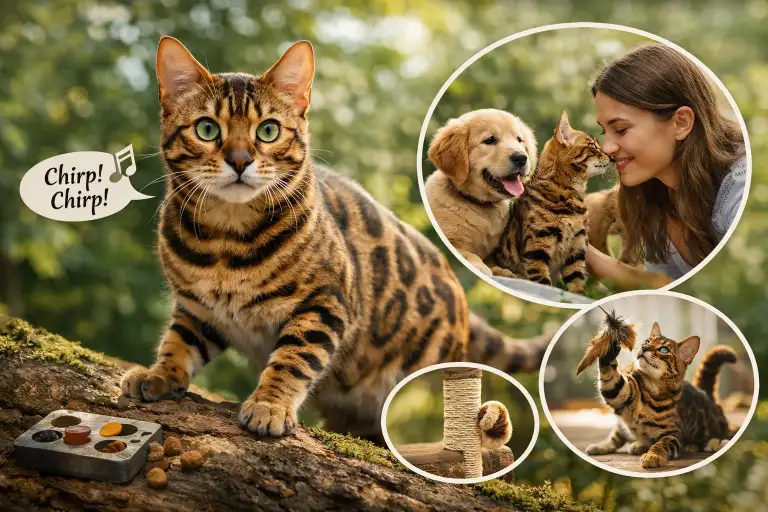
Bengal Cat Personality & Behavior: Traits, Communication, and Social Style
Bengal cats are known for their striking appearance, high energy, and unique intelligence, but there’s much more to their personality than meets the eye. Understanding a Bengal’s personality helps owners provide the right environment, mental stimulation, and social interaction.
Recommended Dog Care Products
Based on your dog’s age, these products may help with comfort, health, grooming, and daily care.

Purina Pro Plan Veterinary Supplements
Daily probiotics for dogs to support digestive and gut health.
View on Amazon ↗
Earth Rated Poop Bags for Dogs
Leak-proof, extra thick waste bag refill rolls with lavender scent.
View on Amazon ↗
Greenies Pill Pockets for Dogs
Large dog treats for capsule medication, peanut butter flavor.
View on Amazon ↗
HONEY CARE All-Absorb Dog Wrap
Small male dog wraps, 50 count, useful for daily care support.
View on Amazon ↗
Seresto Flea & Tick Collar
Flea and tick treatment and prevention for dogs over 18 lbs.
View on Amazon ↗
Milk-Bone MaroSnacks
Small dog treats with real bone marrow in a 40 oz canister.
View on Amazon ↗
Vital Essentials Dog Treats
Freeze dried beef liver dog treats, grain free and single ingredient.
View on Amazon ↗
Stain & Odor Eliminator
Enzyme cleaner for pet stains, carpet messes, and strong odors.
View on Amazon ↗
Pur Luv Chicken Jerky Treats
Dog treats made with real chicken breast, high protein and chew-friendly.
View on Amazon ↗
Milk-Bone Flavor Snacks
Mini crunchy dog biscuits in a 36 oz canister for small rewards.
View on Amazon ↗As an Amazon Associate, we may earn from qualifying purchases.
Bengals are often misunderstood as “wild” or overly demanding, but these traits are a reflection of their curiosity, alertness, and intelligence. Each Bengal is an individual, and their behavior is influenced by both genetics and early socialization. Observing your Bengal closely will reveal a range of personality traits that are completely normal for this breed.
Key Personality Traits at a Glance
| Trait | Typical Expression | What It Means for Owners |
|---|---|---|
| Intelligence | Solves puzzles, explores novel objects | Needs regular mental stimulation |
| Curiosity | Investigates new spaces, watches activity | Enjoys interactive play and enrichment |
| Energy | High activity bursts, playful for hours | Requires daily play and exercise |
| Confidence | Approaches new people, climbs, explores | Thrives in enriched, safe environments |
| Affection | Follows owners, seeks attention selectively | Bonds strongly, may prefer one-on-one interaction |
Bengals are both independent and social, showing affection in ways that may differ from other breeds. They often enjoy following their favorite person around the house or engaging in games that challenge their mind. Their personality is a mix of boldness, curiosity, and selective attachment, which makes them one of the most engaging and interactive domestic cats.
By recognizing these traits, owners can support their Bengal’s natural behaviors, provide adequate stimulation, and enjoy a stronger bond based on understanding rather than correction.
How Bengals Communicate
Bengal cats are very expressive. They use their body, tail, ears, eyes, and voice to tell you what they feel. Learning to read these signals helps you understand your cat better and avoid misreading normal behaviors as problems.
Bengals are also very vocal. They can chirp, trill, or meow to get attention or show excitement. Each sound has a meaning, and paying attention to tone and context is key.
| Signal | What It Looks Like | What It Means |
|---|---|---|
| Tail held high | Standing tall with tip slightly curved | Friendly, confident, greeting you |
| Ears forward | Pointed toward sounds | Curious or alert |
| Ears flattened | Pressed back | Annoyed, overstimulated, or cautious |
| Eyes wide, slow blink | Slow blinking while looking at you | Relaxed and trusting |
| Chirp or trill | Short, high-pitched sound | Wants attention, playful, or communicating |
| Meowing | Regular vocalization | Greeting, asking for interaction, or hunger |
Bengals use body language and sounds together. For example, a cat might trill while wagging its tail to invite you to play. Understanding these signals helps you respond appropriately, keeping your cat happy and confident.
Bengals may also show subtle cues, like a quick ear flick or a soft tail twitch, to communicate feelings you might miss at first. Paying attention to these small details makes bonding with your Bengal much easier and more rewarding.
Social Behavior with Humans & Other Pets
Bengal cats are social and enjoy spending time with people they trust. They can bond closely with one person or enjoy the company of the whole family. Some Bengals like to follow their favorite human around the house to be part of everything you do.
When it comes to other pets, Bengals are usually confident and curious. They can play with other cats or dogs, but it is important to introduce them slowly and give each pet its own space at first. Bengals use playful gestures, chasing, and pouncing to interact, which can be misread as aggression if you don’t know their signals.
Recommended Dog Care Products
Based on your dog’s age, these products may help with comfort, health, grooming, and daily care.
Purina Pro Plan Veterinary Supplements
Daily probiotics for dogs to support digestive and gut health.
View on Amazon ↗
Earth Rated Poop Bags for Dogs
Leak-proof, extra thick waste bag refill rolls with lavender scent.
View on Amazon ↗
Greenies Pill Pockets for Dogs
Large dog treats for capsule medication, peanut butter flavor.
View on Amazon ↗
HONEY CARE All-Absorb Dog Wrap
Small male dog wraps, 50 count, useful for daily care support.
View on Amazon ↗
Seresto Flea & Tick Collar
Flea and tick treatment and prevention for dogs over 18 lbs.
View on Amazon ↗
Milk-Bone MaroSnacks
Small dog treats with real bone marrow in a 40 oz canister.
View on Amazon ↗
Vital Essentials Dog Treats
Freeze dried beef liver dog treats, grain free and single ingredient.
View on Amazon ↗
Stain & Odor Eliminator
Enzyme cleaner for pet stains, carpet messes, and strong odors.
View on Amazon ↗
Pur Luv Chicken Jerky Treats
Dog treats made with real chicken breast, high protein and chew-friendly.
View on Amazon ↗
Milk-Bone Flavor Snacks
Mini crunchy dog biscuits in a 36 oz canister for small rewards.
View on Amazon ↗As an Amazon Associate, we may earn from qualifying purchases.
| Context | Typical Bengal Behavior | What Owners Should Know |
|---|---|---|
| With humans | Follows, nudges, seeks attention | Loves interaction, may want your company often |
| With other cats | Playful, curious, confident | Monitor play intensity to avoid misunderstandings |
| With dogs | Curious, sometimes cautious | Early socialization helps friendships form |
| Family environment | Active, engages in activities | Needs interaction and stimulation to stay happy |
Bengals are both independent and social, meaning they enjoy attention but also value their alone time. Watching how your Bengal interacts with people and pets can help you understand their needs, prevent stress, and strengthen your bond.
Play, Hunting, and Natural Instincts
Bengal cats are very active and love to play. Play is not just for fun—it helps them use their hunting instincts and stay healthy. Bengals enjoy chasing toys, climbing, jumping, and exploring new spaces. These activities keep them mentally and physically stimulated.
Bengals also like problem-solving games. Puzzle toys, interactive feeders, and hidden treats give them a challenge and prevent boredom. Without enough play or stimulation, they may become restless or look for ways to entertain themselves.
| Activity | Instinct Targeted | Benefit for Bengal |
|---|---|---|
| Wand toy chasing | Hunting | Exercise and fun |
| Puzzle feeder | Problem solving | Mental stimulation and slower eating |
| Climbing shelves | Exploration | Confidence and energy release |
| Interactive play | Social hunting | Strengthens bond with owner |
| Water play | Curiosity and novelty | Enrichment and engagement |
Bengals are also most active during dawn and dusk, which is natural for their hunting instincts. Understanding their need to explore and play helps you create a safe and stimulating environment that matches their energy level.
Misunderstood Behaviors and Life Stage Changes
Bengal cats are often misunderstood because of their energy and intelligence. Many owners think they are “too vocal,” “hyperactive,” or “destructive,” but these behaviors are normal for this breed when they need stimulation or attention.
Bengals also change their behavior as they grow. Kittens are very curious and playful, adolescents test boundaries and have lots of energy, adults are more confident and predictable, and seniors may become calmer and enjoy more quiet time.
| Life Stage | Typical Behavior | What Owners Should Know |
|---|---|---|
| Kitten | Biting, climbing, exploring | Normal curiosity; needs safe play |
| Adolescent | High energy, boundary testing | Provide mental and physical stimulation |
| Adult | Confident, selective play | Energy stabilizes; enjoys routines |
| Senior | Less active, more attached | Adjust play and interaction to comfort |
Some common behaviors are misread as problems. For example, a Bengal that meows a lot is often just trying to communicate or get attention. Climbing or scratching furniture can be a sign they need vertical space or scratching posts.
Understanding these behaviors and observing patterns rather than reacting helps owners provide a happy environment for their Bengal. Respecting their instincts, energy, and social needs ensures Bengals thrive at every life stage.
For expert guidance on Bengal cats, their personality, and care, readers can explore the Bengal cat profile from The International Cat Association, a trusted authority on feline breeds.
Recommended Dog Care Products
Based on your dog’s age, these products may help with comfort, health, grooming, and daily care.
Purina Pro Plan Veterinary Supplements
Daily probiotics for dogs to support digestive and gut health.
View on Amazon ↗
Earth Rated Poop Bags for Dogs
Leak-proof, extra thick waste bag refill rolls with lavender scent.
View on Amazon ↗
Greenies Pill Pockets for Dogs
Large dog treats for capsule medication, peanut butter flavor.
View on Amazon ↗
HONEY CARE All-Absorb Dog Wrap
Small male dog wraps, 50 count, useful for daily care support.
View on Amazon ↗
Seresto Flea & Tick Collar
Flea and tick treatment and prevention for dogs over 18 lbs.
View on Amazon ↗
Milk-Bone MaroSnacks
Small dog treats with real bone marrow in a 40 oz canister.
View on Amazon ↗
Vital Essentials Dog Treats
Freeze dried beef liver dog treats, grain free and single ingredient.
View on Amazon ↗
Stain & Odor Eliminator
Enzyme cleaner for pet stains, carpet messes, and strong odors.
View on Amazon ↗
Pur Luv Chicken Jerky Treats
Dog treats made with real chicken breast, high protein and chew-friendly.
View on Amazon ↗
Milk-Bone Flavor Snacks
Mini crunchy dog biscuits in a 36 oz canister for small rewards.
View on Amazon ↗As an Amazon Associate, we may earn from qualifying purchases.

Ata Ur Rehman is the founder of Pet Age in Human Years Calculator, an educational platform that provides age conversion charts and lifespan guides for dogs, cats, birds, and other companion animals. His work focuses on helping pet owners understand how animal ages translate into human years using commonly accepted age conversion formulas and published lifespan averages.
The website compiles breed and species lifespan data from kennel clubs, breed organizations, and general animal lifespan studies to present simple and easy-to-understand guides for pet owners worldwide.
This website was created to centralize animal age conversion charts into one easy reference platform for pet owners.