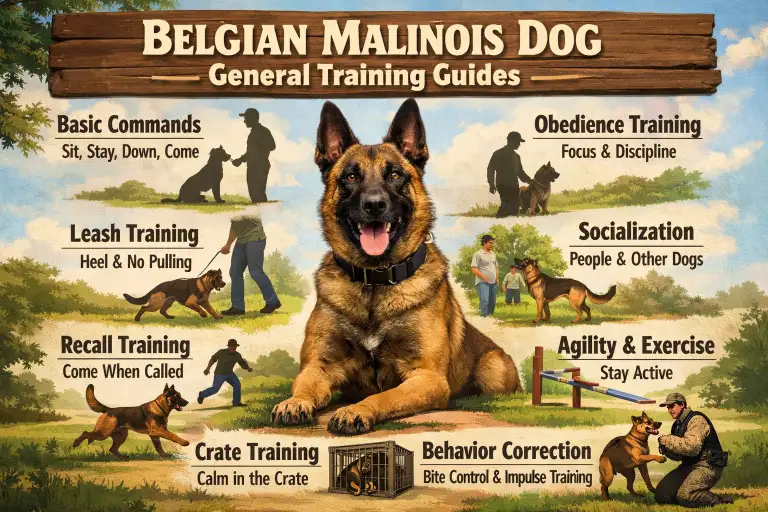
Belgian Malinois training is not about teaching a few commands and hoping for the best. This breed was developed for intense, purposeful work, and that reality shapes everything about how they learn, behave, and live in a home environment. A Belgian Malinois can become one of the most responsive, focused dogs you’ll ever work with—or one of the most difficult—depending on how training is approached.
This guide is designed to help you train a Belgian Malinois the right way, whether you’re raising a puppy, adopting an adolescent, or trying to bring structure to an adult dog that’s already showing problem behaviors. It focuses on practical, realistic training strategies that work in everyday homes, not just in police or sport settings.
You’ll learn why this breed requires more structure than most dogs, how their behavior is shaped by drive and arousal, and how to build obedience, impulse control, and focus without creating frustration or conflict. The goal is not to suppress your Malinois’s intensity—but to channel it safely and productively.
If you’re looking for shortcuts, dominance-based methods, or a “low-effort” training plan, this breed is not a good match. But if you’re willing to train consistently, understand how your dog thinks, and build skills step by step, a Belgian Malinois can thrive as a highly controlled, deeply bonded companion.
Why Belgian Malinois Training Is Different
Belgian Malinois are not typical pet dogs. They were bred to work all day, make fast decisions, and respond instantly to their handler. Because of this, training matters more for this breed than for most others.
Without proper training, a Malinois does not simply become “untrained.” They often become overwhelmed, frustrated, and unsafe. This can show up as constant biting, jumping, barking, escaping the yard, or reacting strongly to people and dogs.
Many owners make the mistake of treating a Malinois like a Labrador or German Shepherd. That usually leads to problems because Malinois have higher drive, higher energy, and lower tolerance for boredom.
The table below helps show why this breed needs a different training approach.
| Belgian Malinois | Typical Pet Dog |
|---|---|
| Very high drive and intensity | Moderate energy |
| Needs daily mental work | Mostly needs physical exercise |
| Learns fast, good or bad | Learns at a slower pace |
| Gets frustrated without structure | Can handle more downtime |
| Behavior problems escalate quickly | Behavior problems develop slowly |
Training a Belgian Malinois early and consistently is not optional. It is how you keep the dog safe, focused, and able to live calmly in a home.
Understanding Belgian Malinois Behavior and Learning
Belgian Malinois are extremely smart, but intelligence alone does not make training easy. What makes this breed challenging is how fast they react and how intense their emotions can be.
Many behaviors owners call “bad” are actually signs of unmet needs. Nipping, pacing, barking, or ignoring commands usually mean the dog is overstimulated, under-trained, or confused.
Malinois also learn patterns very quickly. If a dog learns that jumping, barking, or biting gets attention, that behavior can become strong in just a few days.
The table below explains common behaviors and what they usually mean.
| Behavior You See | What It Usually Means | What Owners Often Think |
|---|---|---|
| Nipping hands or clothes | Over-arousal or lack of impulse control | The dog is aggressive |
| Ignoring commands outside | Too much distraction, not stubbornness | The dog is being dominant |
| Pacing or whining | Mental stress or boredom | The dog needs more running |
| Fixating on people or dogs | High drive without control | The dog wants to attack |
Punishment and yelling often make these problems worse. This breed responds best to clear rules, calm handling, and rewards given at the right time.
Step-by-Step Belgian Malinois Training Method
Training a Belgian Malinois works best when it is short, structured, and daily. Long sessions usually create frustration, not progress.
The main goals of training are focus, impulse control, and calm obedience. Fancy tricks are not important at the start.
Use the table below as a simple daily structure.
| Training Type | Session Length | How Often | Main Goal |
|---|---|---|---|
| Basic obedience | 5–10 minutes | 2–3 times a day | Focus and listening |
| Impulse control | 3–5 minutes | Daily | Calm behavior |
| Mental games | 10–15 minutes | Daily | Reduce boredom |
| Physical exercise | 30–60 minutes | Daily | Release energy safely |
Training should start in quiet areas and slowly move to harder places like parks or streets. Puppies need even shorter sessions, while adult dogs may need more structure and consistency.
Rewards should be things your dog truly wants, such as food, toys, or play. Timing matters. The reward must come right after the correct behavior.
Do not rush progress. A calm, controlled Malinois is far more valuable than a fast but out-of-control dog.
Common Belgian Malinois Training Problems and When to Get Help
Even with good training, many Belgian Malinois owners face challenges. The key is to fix problems early before they grow.
The table below shows common issues and safer first steps.
| Problem | Common Owner Mistake | Better First Step |
|---|---|---|
| Biting or nipping | Yelling or grabbing the dog | Pause play and reward calm |
| Pulling on leash | Using stronger corrections | Train focus before walking |
| Ignoring commands | Repeating commands loudly | Lower distractions and rebuild |
| Overexcitement | Too much rough play | Add calm training breaks |
Some behaviors should not be handled alone. Seek professional help if your dog shows repeated aggression, fear-based biting, or extreme reactivity, especially in puppies under one year old.
A qualified trainer or behavior professional can help prevent long-term damage and reduce the risk of rehoming.
For readers who want deeper, science-based insight into modern dog training methods, you can explore the American Veterinary Society of Animal Behavior (AVSAB) guidelines, which explain why reward-based training is safest and most effective for high-drive breeds like the Belgian Malinois:
https://avsab.org/resources/position-statements/

Ata Ur Rehman is the founder of Pet Age in Human Years Calculator, an educational platform that provides age conversion charts and lifespan guides for dogs, cats, birds, and other companion animals. His work focuses on helping pet owners understand how animal ages translate into human years using commonly accepted age conversion formulas and published lifespan averages.
The website compiles breed and species lifespan data from kennel clubs, breed organizations, and general animal lifespan studies to present simple and easy-to-understand guides for pet owners worldwide.
This website was created to centralize animal age conversion charts into one easy reference platform for pet owners.