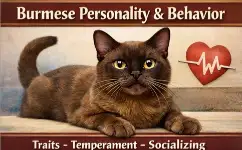
Burmese Cat Personality and Behavior Traits Explained
The Burmese cat is known for having a warm, people-focused personality. Many owners describe this breed as loving, social, and emotionally aware. Burmese cats are not the type to stay distant or ignore what is happening around them. They like to be involved in daily life and often prefer staying close to their humans.
Recommended Dog Care Products
Based on your dog’s age, these products may help with comfort, health, grooming, and daily care.

Purina Pro Plan Veterinary Supplements
Daily probiotics for dogs to support digestive and gut health.
View on Amazon ↗
Earth Rated Poop Bags for Dogs
Leak-proof, extra thick waste bag refill rolls with lavender scent.
View on Amazon ↗
Greenies Pill Pockets for Dogs
Large dog treats for capsule medication, peanut butter flavor.
View on Amazon ↗
HONEY CARE All-Absorb Dog Wrap
Small male dog wraps, 50 count, useful for daily care support.
View on Amazon ↗
Seresto Flea & Tick Collar
Flea and tick treatment and prevention for dogs over 18 lbs.
View on Amazon ↗
Milk-Bone MaroSnacks
Small dog treats with real bone marrow in a 40 oz canister.
View on Amazon ↗
Vital Essentials Dog Treats
Freeze dried beef liver dog treats, grain free and single ingredient.
View on Amazon ↗
Stain & Odor Eliminator
Enzyme cleaner for pet stains, carpet messes, and strong odors.
View on Amazon ↗
Pur Luv Chicken Jerky Treats
Dog treats made with real chicken breast, high protein and chew-friendly.
View on Amazon ↗
Milk-Bone Flavor Snacks
Mini crunchy dog biscuits in a 36 oz canister for small rewards.
View on Amazon ↗As an Amazon Associate, we may earn from qualifying purchases.
Unlike the common idea that cats are always independent, Burmese cats enjoy connection. This does not mean they need constant handling, but they do like presence. A Burmese may sit near you, follow you from room to room, or quietly watch what you are doing. This is their way of feeling secure and connected.
Burmese cats also tend to be playful well into adulthood. They often keep a kitten-like curiosity and enjoy games, movement, and interaction. This playful nature is usually balanced with affection, making them both fun and comforting companions.
It is important to remember that every Burmese cat is still an individual. Some may be more vocal, some more relaxed, and some more energetic. The breed gives a general personality pattern, but each cat expresses it in their own way.
Key Burmese Personality Traits at a Glance
| Trait | What You May See at Home | What It Does Not Mean |
|---|---|---|
| Affectionate | Sitting close, gentle touch | Needy or spoiled |
| Social | Following people, watching activity | No personal boundaries |
| Playful | Enjoys games even as an adult | Hyper or out of control |
| Curious | Explores rooms and objects | Getting into trouble |
What Shapes Burmese Cat Behavior
A Burmese cat’s behavior is shaped by both genetics and environment. The breed is naturally social, but how this shows up depends a lot on early life experiences and daily routines. A kitten raised with gentle handling and regular human contact often grows into a confident and trusting adult.
Daily environment plays a big role. Burmese cats usually respond strongly to routine. Feeding times, play times, and quiet times help them feel safe. Sudden changes, like long absences or loud environments, may make them seek reassurance more often.
Human response also matters. Burmese cats are sensitive to attention and tone. Calm interaction, predictable behavior, and patience often lead to a relaxed and confident cat. Ignoring or misunderstanding their signals can lead to confusion, not bad behavior.
It is helpful to think of Burmese cats as emotionally responsive rather than demanding. Their behavior often reflects what is happening around them.
Genetics vs Environment in Burmese Behavior
Recommended Dog Care Products
Based on your dog’s age, these products may help with comfort, health, grooming, and daily care.
Purina Pro Plan Veterinary Supplements
Daily probiotics for dogs to support digestive and gut health.
View on Amazon ↗
Earth Rated Poop Bags for Dogs
Leak-proof, extra thick waste bag refill rolls with lavender scent.
View on Amazon ↗
Greenies Pill Pockets for Dogs
Large dog treats for capsule medication, peanut butter flavor.
View on Amazon ↗
HONEY CARE All-Absorb Dog Wrap
Small male dog wraps, 50 count, useful for daily care support.
View on Amazon ↗
Seresto Flea & Tick Collar
Flea and tick treatment and prevention for dogs over 18 lbs.
View on Amazon ↗
Milk-Bone MaroSnacks
Small dog treats with real bone marrow in a 40 oz canister.
View on Amazon ↗
Vital Essentials Dog Treats
Freeze dried beef liver dog treats, grain free and single ingredient.
View on Amazon ↗
Stain & Odor Eliminator
Enzyme cleaner for pet stains, carpet messes, and strong odors.
View on Amazon ↗
Pur Luv Chicken Jerky Treats
Dog treats made with real chicken breast, high protein and chew-friendly.
View on Amazon ↗
Milk-Bone Flavor Snacks
Mini crunchy dog biscuits in a 36 oz canister for small rewards.
View on Amazon ↗As an Amazon Associate, we may earn from qualifying purchases.
| Influence | How It Affects Behavior | What Owners Often Notice |
|---|---|---|
| Genetics | Social and people-oriented nature | Likes being nearby |
| Early social life | Confidence and trust | Comfortable with handling |
| Daily routine | Emotional stability | Calm and predictable behavior |
| Home atmosphere | Sense of safety | Seeks comfort when unsure |
How Burmese Cats Communicate
Burmese cats communicate clearly, but often in gentle ways. They use body language, eye contact, and position in the room more than dramatic signals. A Burmese may sit close, make soft eye contact, or gently touch with a paw to communicate comfort or interest.
Vocal sounds are common but usually not harsh. Many Burmese cats make soft, conversational noises. These sounds often mean they are greeting you, asking for attention, or responding to your voice.
Understanding these signals helps avoid confusion. A cat sitting near you is often choosing closeness, not asking for something. A soft meow may simply be part of social interaction, not a demand.
Burmese cats often prefer quiet communication over extreme signals. Paying attention to small changes in posture or sound helps owners understand their needs better.
Burmese Body Language and Vocal Signals
| Signal | Common Meaning | Often Misread As |
|---|---|---|
| Sitting close | Comfort and trust | Clinginess |
| Soft eye contact | Relaxation | Staring |
| Gentle meow | Social greeting | Complaining |
| Following quietly | Bonding | Separation fear |
Social Behavior With Humans and Other Pets
Burmese cats usually form strong bonds with people. They often enjoy sharing space more than being held all the time. Sitting on the couch nearby or sleeping in the same room is common behavior.
With families, Burmese cats often adapt well to different people, including children, when treated gently. They may choose favorite people but still enjoy group activity and household routines.
With other pets, Burmese cats are often open and curious. They may enjoy companionship, especially with other friendly cats or calm dogs. Their social nature means they often watch, learn, and adjust rather than act aggressively.
Social behavior in Burmese cats is best understood as cooperative. They like shared space, shared time, and predictable relationships.
Burmese Social Behavior in Daily Life
Recommended Dog Care Products
Based on your dog’s age, these products may help with comfort, health, grooming, and daily care.
Purina Pro Plan Veterinary Supplements
Daily probiotics for dogs to support digestive and gut health.
View on Amazon ↗
Earth Rated Poop Bags for Dogs
Leak-proof, extra thick waste bag refill rolls with lavender scent.
View on Amazon ↗
Greenies Pill Pockets for Dogs
Large dog treats for capsule medication, peanut butter flavor.
View on Amazon ↗
HONEY CARE All-Absorb Dog Wrap
Small male dog wraps, 50 count, useful for daily care support.
View on Amazon ↗
Seresto Flea & Tick Collar
Flea and tick treatment and prevention for dogs over 18 lbs.
View on Amazon ↗
Milk-Bone MaroSnacks
Small dog treats with real bone marrow in a 40 oz canister.
View on Amazon ↗
Vital Essentials Dog Treats
Freeze dried beef liver dog treats, grain free and single ingredient.
View on Amazon ↗
Stain & Odor Eliminator
Enzyme cleaner for pet stains, carpet messes, and strong odors.
View on Amazon ↗
Pur Luv Chicken Jerky Treats
Dog treats made with real chicken breast, high protein and chew-friendly.
View on Amazon ↗
Milk-Bone Flavor Snacks
Mini crunchy dog biscuits in a 36 oz canister for small rewards.
View on Amazon ↗As an Amazon Associate, we may earn from qualifying purchases.
| Situation | Typical Response | Normal Meaning |
|---|---|---|
| Owner working | Lying nearby | Feeling secure |
| Guests visiting | Observing quietly | Curiosity |
| Other cats | Gentle interaction | Social interest |
| Being alone | Waiting calmly | Trust in routine |
Commonly Misunderstood Burmese Behaviors
Many Burmese behaviors are misunderstood because they go against common cat stereotypes. Following a person from room to room is often seen as being too dependent, but in Burmese cats, it usually means bonding.
Vocal behavior is another area of confusion. Burmese cats may talk more than some breeds, but this is usually social communication, not constant asking or stress.
Playfulness is sometimes mistaken for restlessness. In reality, Burmese cats enjoy interaction and mental activity. This behavior often stays with them as they grow older.
Understanding these behaviors helps owners feel more confident and relaxed. Most Burmese behaviors are signs of comfort, trust, and social connection.
Myth vs Reality in Burmese Cat Behavior
| Owner Concern | Reality | Reassuring Explanation |
|---|---|---|
| “My cat is clingy” | Strong bonding | Normal for the breed |
| “My cat talks a lot” | Social communication | Part of connection |
| “My cat follows me” | Emotional awareness | Feeling safe with you |
| “My cat plays too much” | Healthy engagement | Natural energy level |
For further general reading on understanding cat behavior from a trusted animal welfare source, you can visit:
https://www.aspca.org/pet-care/cat-care/cat-behavior

Ata Ur Rehman is the founder of Pet Age in Human Years Calculator, an educational platform that provides age conversion charts and lifespan guides for dogs, cats, birds, and other companion animals. His work focuses on helping pet owners understand how animal ages translate into human years using commonly accepted age conversion formulas and published lifespan averages.
The website compiles breed and species lifespan data from kennel clubs, breed organizations, and general animal lifespan studies to present simple and easy-to-understand guides for pet owners worldwide.
This website was created to centralize animal age conversion charts into one easy reference platform for pet owners.