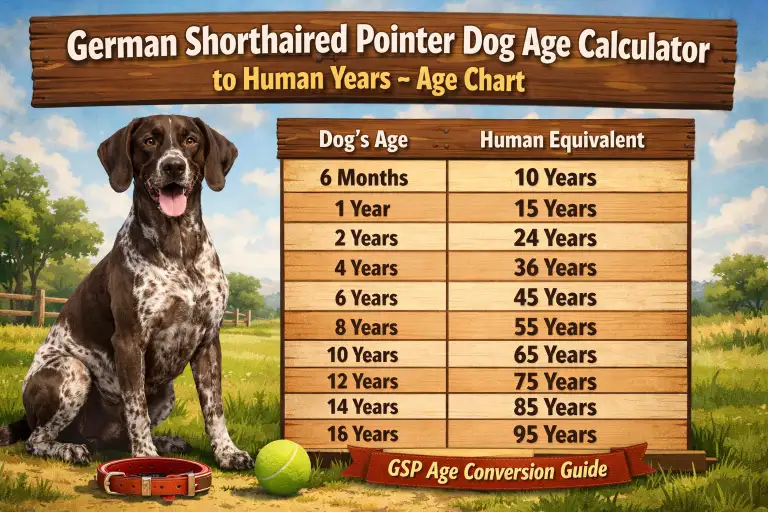
The German Shorthaired Pointer age calculator helps you understand how old your dog is in human years. Dogs do not age the same way humans do, and this is especially true for active, medium-large breeds like the German Shorthaired Pointer.
Many people still believe that 1 dog year equals 7 human years. This rule is outdated and incorrect. German Shorthaired Pointers grow very fast in their early years and then age more slowly as adults. A breed-specific calculator gives a much more realistic result.
This guide uses modern aging research, dog size data, and life-stage changes to estimate your German Shorthaired Pointer’s human-equivalent age. It gives you a clearer picture of your dog’s physical and mental maturity, not just a number.
How this age calculator works (simple explanation)
| Dog Age Phase | What Happens |
|---|---|
| First 2 years | Very fast physical and mental growth |
| Adult years | Slower, steady aging |
| Senior years | Aging speeds up again |
German Shorthaired Pointer Age Chart (Dog Years to Human Years)
This age chart shows how German Shorthaired Pointer years compare to human years. It is based on breed size, growth speed, and modern aging studies.
German Shorthaired Pointers are medium-large sporting dogs. They usually mature faster than humans in the first years, but slower later in life.
German Shorthaired Pointer dog years to human years chart
| Dog Age (Years) | Human Age Equivalent |
|---|---|
| 1 | 15 |
| 2 | 24 |
| 3 | 28 |
| 4 | 32 |
| 5 | 36 |
| 6 | 40 |
| 7 | 44 |
| 8 | 48 |
| 9 | 52 |
| 10 | 56 |
| 11 | 60 |
| 12 | 64 |
| 13 | 68 |
| 14 | 72 |
| 15 | 76 |
Example:
A 5-year-old German Shorthaired Pointer is roughly the same as a 36-year-old human.
A 10-year-old German Shorthaired Pointer is similar to a 56-year-old human.
How German Shorthaired Pointers Age Compared to Humans
German Shorthaired Pointers do not age in a straight line like humans. Their bodies change very quickly when they are young and more slowly during adult years.
The old “7-year rule” does not work because:
- Puppies grow faster than human babies
- Dogs reach adulthood much earlier
- Aging speed changes over time
Modern research shows that dog aging follows a curved pattern. Early years count more, later years count less. This idea comes from biological aging studies that look at DNA changes over time.
Size also matters. German Shorthaired Pointers live longer than giant breeds but shorter than small dogs. Their high activity level keeps them fit, but it also means joints and muscles need more care as they age.
Simple comparison:
- A 1-year-old German Shorthaired Pointer is like a human teenager
- A 5-year-old German Shorthaired Pointer is like a middle-aged adult
- A 10-year-old German Shorthaired Pointer is like an older adult
German Shorthaired Pointer Life Stages by Age
Understanding life stages helps you know what your dog needs at each age. Behavior, energy, and health needs change over time.
German Shorthaired Pointer life stages
| Life Stage | Age Range | What to Expect |
|---|---|---|
| Puppy | 0–1 year | Fast growth, high energy, learning basics |
| Adolescent | 1–2 years | Strong body, testing limits, needs training |
| Adult | 3–7 years | Peak fitness, stable behavior |
| Senior | 8+ years | Slower movement, more rest, health monitoring |
Signs your German Shorthaired Pointer may be entering senior years include:
- Less stamina on long walks
- Stiffness after rest
- More sleeping
- Gray hair around the face
Knowing these stages helps you adjust food, exercise, and vet care at the right time.
How to Help a German Shorthaired Pointer Age Healthily
Good care can improve both lifespan and quality of life. Aging is natural, but how your dog ages depends a lot on daily care.
Key areas that matter most are food, exercise, and vet visits.
Age-based care tips for German Shorthaired Pointers
| Age Group | Care Focus |
|---|---|
| Puppy | Balanced growth, training, joint protection |
| Adult | Weight control, regular exercise, dental care |
| Senior | Joint support, softer exercise, health checks |
Helpful tips:
- Keep your dog at a healthy weight
- Adjust exercise as your dog gets older
- Visit the vet at least once a year, twice for seniors
- Provide mental games to keep the brain active
- Make the home comfortable for older joints
Spaying or neutering, safe exercise, and good nutrition can all support longer and healthier aging.
For more detailed scientific insight into how dogs biologically age compared to humans, you can review the landmark canine aging research published by the National Institutes of Health (NIH) through the Dog Aging Project, which explains modern, evidence-based models of dog aging and lifespan studies.

Ata Ur Rehman is the founder of Pet Age in Human Years Calculator, an educational platform that provides age conversion charts and lifespan guides for dogs, cats, birds, and other companion animals. His work focuses on helping pet owners understand how animal ages translate into human years using commonly accepted age conversion formulas and published lifespan averages.
The website compiles breed and species lifespan data from kennel clubs, breed organizations, and general animal lifespan studies to present simple and easy-to-understand guides for pet owners worldwide.
This website was created to centralize animal age conversion charts into one easy reference platform for pet owners.