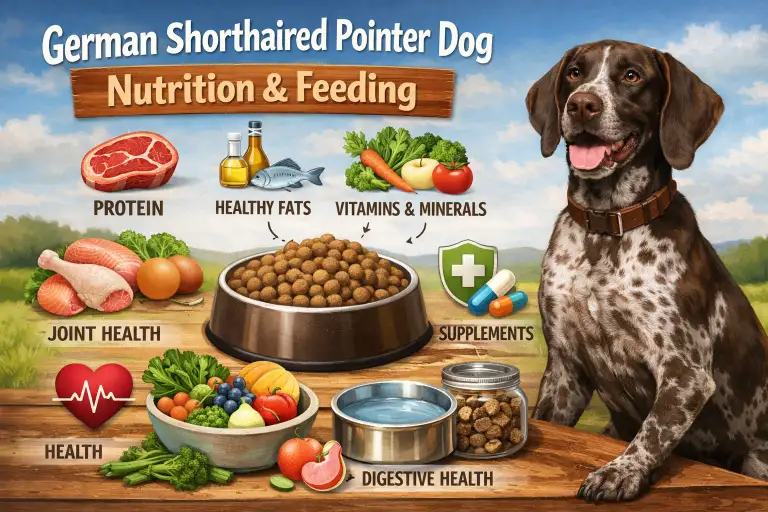
GGerman Shorthaired Pointers (GSPs) are athletic, high-drive dogs built for endurance. They burn fuel fast, recover hard, and stay best at a lean, tucked-up body shape (many healthy GSPs look “thin” to new owners).
A strong GSP diet should help with:
- Muscle building + daily recovery
- Sustained stamina for long runs, training, and hunting days
- Joint + bone support (especially during growth and heavy work)
- Skin + coat quality
- Steady energy without crashes or rebound hunger
What most adult GSPs thrive on
- Animal protein as the #1 ingredient (real meat-based formulas)
- Moderate-to-higher fat (they use fat well for endurance)
- Balanced carbs + fiber (steady fuel + healthy stool)
- Complete vitamins/minerals that meet AAFCO “complete and balanced”
One-table quick target guide (adult GSPs)
| Goal | What to look for on the label | Why it matters for GSPs |
|---|---|---|
| Strong muscle | Meat-first recipe; solid protein level | Supports lean mass + recovery |
| Long endurance | Moderate-to-higher fat | Fat is reliable “work fuel” |
| Joint resilience | Omega-3s (fish oil), quality protein | Helps inflammation + movement comfort |
| Skin/coat | Omega-3/6 balance + zinc/biotin support | Reduces dryness and dull coat |
| Steady energy | Balanced carbs + fiber | Prevents spikes/crashes and messy stools |
How Much to Feed a German Shorthaired Pointer
How much your GSP needs depends on weight, age, metabolism, and activity. A hunting or field dog can require dramatically more calories than a pet GSP.
Daily calories (general guide)
Use this as a starting point, then adjust using body condition (waist + ribs).
| GSP Weight | Low Activity (cal/day) | Moderate Activity (cal/day) | High / Working (cal/day) |
|---|---|---|---|
| 45 lb | 900–1,000 | 1,200–1,400 | 1,600–1,800 |
| 55 lb | 1,000–1,200 | 1,400–1,600 | 1,800–2,100 |
| 65 lb | 1,200–1,400 | 1,600–1,800 | 2,100–2,400 |
Turning calories into “cups”
Because kibble calories vary a lot, the most accurate method is:
- Find the food’s kcal per cup (on the bag or brand website).
- Use: cups/day = target calories ÷ kcal per cup
Example: if target is 1,600 kcal/day and your kibble is 400 kcal/cup, feed 4 cups/day, split into meals.
Body condition check (your best “calculator”)
- Ribs easy to feel but not sharp
- Clear waist from above
- Tuck-up from the side
If ribs show too much → increase calories 10–15%.
If the waist disappears → reduce calories 10–15% and tighten treats.
Best Food Types for German Shorthaired Pointers
There isn’t one perfect choice—there’s the best match for your dog’s digestion, your routine, and your budget. For many GSPs, a quality performance kibble is the easiest “base,” then you can add controlled toppers if needed.
| Food Type | Pros | Cons |
|---|---|---|
| Dry kibble | Convenient, affordable, usually complete | Quality varies; some are too carb-heavy |
| Fresh food | Highly palatable, often easy digestion | Higher cost; needs storage |
| Raw diet | High meat appeal | Safety + balance risks if not formulated correctly |
| Canned food | Moisture-rich, tasty | Expensive for a large active dog |
| Freeze-dried | Travel-friendly, light | Usually needs rehydration; can be pricey |
| Homemade | Full control of ingredients | Hard to balance nutrients without a vet plan |
Simple “best choice” checklist
- Meat/animal protein clearly listed first
- Labeled AAFCO complete and balanced for the right life stage
- Matches your dog’s activity (pet vs sport/working)
- Stool stays firm, coat looks good, energy stays steady
Safe and Unsafe Foods for GSPs
Treats and extras can be useful, but they should stay controlled. A great rule: treat calories ≤ 10% of the day.
| Safer options (small amounts) | Never feed |
|---|---|
| Cooked chicken (plain) | Chocolate |
| Plain rice | Grapes/raisins |
| Carrots | Onions/garlic |
| Eggs (cooked) | Xylitol (common in sugar-free gum/candy) |
| Pumpkin (plain) | Alcohol |
Tip: If your GSP has a sensitive stomach, keep “extras” boring and consistent (plain protein + simple carb), and avoid frequent switching of treats.
Special Diets and Common Feeding Problems in GSPs
GSPs commonly run into feeding issues tied to high activity, fast metabolism, and intensity (fast eating, stomach sensitivity, picky phases, seasonal workload changes).
| Situation / Problem | What often helps (practical fixes) |
|---|---|
| Puppy growth | Higher calories + quality protein; avoid “chubby puppy” overfeeding; consider large-breed puppy formulas |
| Senior years | Slightly fewer calories; keep protein high-quality; add omega-3s/joint support |
| Always hungry | Increase protein and/or fiber; split meals; reduce treat “empty calories” |
| Weight loss / too lean | Increase calories 10–20%; consider higher-fat performance food |
| Loose stool | Slow transition; simplify ingredients; steady feeding schedule |
| Picky eater | Set meal times (15–20 min); remove leftovers; cut random treats |
| Fast eating | Slow feeder bowl, puzzle feeder, or scatter feeding |
Switching foods (very important)
Change diets over 7–10 days:
- Days 1–3: 75% old / 25% new
- Days 4–6: 50% / 50%
- Days 7–10: 25% / 75% then 100% new
Fast switches commonly cause diarrhea even when the new food is excellent.
German Shorthaired Pointer Age Calculator
GSPs are a medium-to-large athletic breed, so a simple “7 dog years = 1 human year” shortcut is misleading. This calculator gives a useful estimate for life-stage planning (training intensity, diet tweaks, senior screening).
Simple estimate formula (easy to use)
- First year ≈ 15 human years
- Second year adds ≈ 9 human years (so age 2 ≈ 24)
- Each year after 2 adds ≈ 5 human years
So:
- If dog age ≤ 1: human ≈ 15 × (dog age in years) (rough for puppies)
- If dog age is 2+: human ≈ 24 + 5 × (dog age − 2)
| GSP Age (years) | Estimated Human Age |
|---|---|
| 0.5 | ~7–8 |
| 1 | ~15 |
| 2 | ~24 |
| 3 | ~29 |
| 5 | ~39 |
| 7 | ~49 |
| 9 | ~59 |
| 11 | ~69 |
| 13 | ~79 |
| 15 | ~89 |
How to use it
9+ years: prioritize digestibility, omega-3s, and keeping muscle while managing calories
Under 2 years: focus on growth-safe nutrition + controlled conditioning
5–8 years: maintain lean body condition, joint support, performance calories as needed
For official nutritional standards and feeding guidance, you can review the AAFCO Dog Food Nutrient Profiles, which explain the minimum nutrient requirements for complete and balanced dog diets: https://www.aafco.org/nutrition/animal-food-nutrient-profiles/

Ata Ur Rehman is the founder of Pet Age in Human Years Calculator, an educational platform that provides age conversion charts and lifespan guides for dogs, cats, birds, and other companion animals. His work focuses on helping pet owners understand how animal ages translate into human years using commonly accepted age conversion formulas and published lifespan averages.
The website compiles breed and species lifespan data from kennel clubs, breed organizations, and general animal lifespan studies to present simple and easy-to-understand guides for pet owners worldwide.
This website was created to centralize animal age conversion charts into one easy reference platform for pet owners.