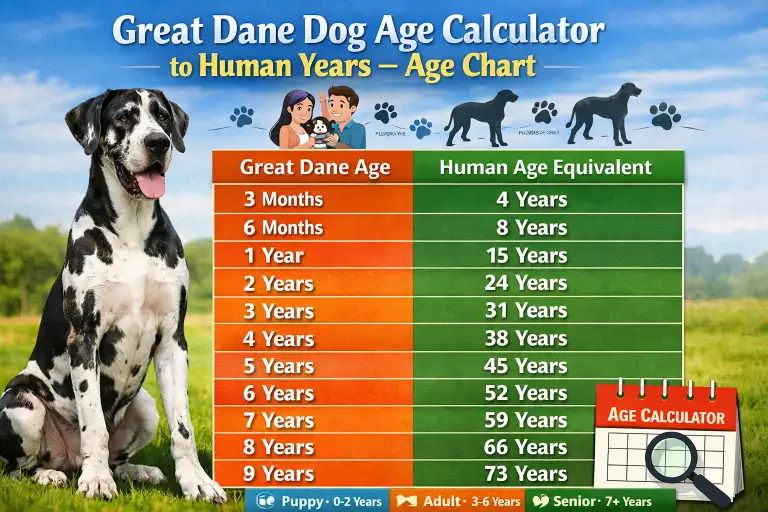
Great Danes do not age like humans — and they don’t even age like most other dogs. As a giant breed, Great Danes grow incredibly fast in their early months, reach physical maturity quickly, and then begin aging biologically much earlier than smaller dogs. This is why using a generic dog age calculator or the old “1 dog year equals 7 human years” rule gives misleading results for this breed.
In reality, a Great Dane’s first year of life represents far more human aging than seven years. Rapid bone growth, early hormonal changes, and accelerated cellular aging mean that by the time a Great Dane turns one, they are already comparable to a human teenager or young adult. After that early surge, the aging curve slows, but the overall lifespan remains shorter than that of medium and small breeds.
One of the biggest reasons Great Danes age differently is size. Larger bodies place greater strain on joints, organs, and the cardiovascular system over time. Giant breeds also have higher growth-factor activity early in life, which contributes to fast development but is associated with earlier onset of age-related decline later on. This is why Great Danes are often considered seniors as early as 5 to 6 years old, while a small dog might not reach senior status until 9 or 10.
Because of these biological differences, Great Dane age calculators must be breed-specific. A Labrador, Beagle, or Chihuahua of the same chronological age will not be at the same life stage as a Great Dane. Using a generalized dog age chart can underestimate how quickly Great Danes move through adulthood and delay important decisions about nutrition, exercise adjustments, and preventive veterinary care.
Why Great Dane Aging Is Different (Quick Comparison)
| Factor | Great Dane (Giant Breed) | Small / Medium Dogs |
|---|---|---|
| Average lifespan | Shorter (often 7–10 years) | Longer (12–16+ years) |
| Early growth speed | Extremely rapid | Moderate |
| Senior stage begins | Around 5–6 years | Around 8–10 years |
| Aging curve | Fast early, earlier decline | Slower, more gradual |
| Calculator accuracy | Needs breed-specific model | Generic models more reliable |
Understanding these differences is the foundation for accurately converting Great Dane years to human years.
The Science Behind Great Dane Aging
Great Danes age faster because their bodies grow and change at a speed that human bodies do not. In the first year of life, a Great Dane puppy can gain over 100 pounds. Bones grow quickly, organs work harder, and cells divide at a very fast rate. This early growth helps the dog become large and strong, but it also puts long-term stress on the body.
Scientists now know that dog aging does not happen in a straight line. Dogs age very fast when they are young and then slow down later. This idea comes from modern research that looks at changes inside a dog’s cells. One major study published in 2019 found that dogs follow a curved, or logarithmic, aging pattern. This means a Great Dane ages much faster in the early years than a human, even if later years seem to pass more slowly.
Size plays a huge role in this process. Giant breeds like Great Danes have higher growth hormone activity when they are young. This helps them grow fast, but it is also linked to shorter lifespans. Larger bodies also mean more pressure on joints, the heart, and other organs. Over time, this extra workload can lead to earlier aging compared to smaller dogs.
Because of this, two dogs that are both five years old may be at very different life stages. A five-year-old Great Dane is often closer to a middle-aged or senior human, while a five-year-old small dog may still be in early adulthood. This is why scientists and veterinarians agree that breed size must be included when converting dog years to human years.
Great Dane Aging Timeline Compared to Human Aging
| Great Dane Age | What’s Happening in the Body | Rough Human Age Range |
|---|---|---|
| 0–1 year | Rapid growth, bone and organ development | Childhood to late teens |
| 1–2 years | Reaches full size, growth slows | Early 20s |
| 3–4 years | Physical peak, early adult stage | Late 20s to mid-30s |
| 5–6 years | Aging signs may begin | Early 40s to 50s |
| 7–8 years | Clear senior changes in many dogs | Late 50s to 60s |
| 9+ years | Advanced senior stage | 70s and older |
This science-based understanding is what allows modern age calculators to be more accurate than old rules like “7 dog years equals 49 human years.”
Great Dane Age Calculator and Age Chart
answers the most common question owners ask: “How old is my Great Dane in human years?”
Because Great Danes age faster than most dogs, the calculator used here is based on giant-breed aging patterns, not the old 7-year rule.
The idea is simple. Great Danes age very fast in the first two years, then continue aging at a steady but shorter pace compared to smaller dogs. This means a young Great Dane can already be like a grown adult human, while an older Great Dane may be closer to a senior human.
Use the chart below to find your dog’s age. Look for your Great Dane’s real age on the left, then read across to see the human age equivalent.
Great Dane Age to Human Years Chart
| Great Dane Age (Years) | Human Age Equivalent | Life Stage |
|---|---|---|
| 0.5 | 10 | Child |
| 1 | 18 | Teenager |
| 2 | 25 | Young adult |
| 3 | 30 | Adult |
| 4 | 35 | Adult |
| 5 | 42 | Middle-aged |
| 6 | 49 | Mature adult |
| 7 | 56 | Early senior |
| 8 | 63 | Senior |
| 9 | 70 | Senior |
| 10 | 77 | Advanced senior |
For example, a 5-year-old Great Dane is often similar to a human in their early 40s. A 7-year-old Great Dane is usually already in the senior stage, even though many owners still think of them as “middle-aged.”
This chart gives a clear average, but real aging can change slightly based on factors like body weight, exercise, diet, and health care. That is why two Great Danes of the same age may not look or act exactly the same.
Great Dane Life Stages: Puppy, Adult, Senior
Great Danes move through life stages faster than many other dogs. Knowing which stage your dog is in helps you understand their behavior, energy level, and health needs. Even if two dogs are the same age in years, they may be in very different life stages depending on their size.
Great Dane puppies grow extremely fast. In just a few months, they change from small pups into very large dogs. During this time, their bones, muscles, and joints are still forming. Because of this fast growth, they need careful feeding and controlled exercise to avoid future joint problems.
Adult Great Danes may look fully grown by 18 to 24 months, but aging does not stop there. Many Great Danes reach their physical peak between 2 and 4 years of age. After this point, changes happen slowly and are often hard to notice at first. Energy may drop slightly, and recovery after exercise can take longer.
Senior years begin earlier in Great Danes than in smaller dogs. Many Great Danes are considered seniors around 5 to 6 years old. Signs of aging can include slower movement, stiff joints, more sleeping, and less interest in intense play. Some dogs may also show changes in hearing, vision, or thinking speed.
Great Dane Life Stages by Age
| Age Range | Life Stage | What Owners Commonly Notice | Main Health Focus |
|---|---|---|---|
| 0–1 year | Puppy | Very fast growth, high energy | Bone and joint development |
| 1–2 years | Young adult | Full size reached, playful | Muscle strength, training |
| 3–4 years | Adult | Physical peak | Weight control, fitness |
| 5–6 years | Mature adult | Slower movement begins | Joint and heart health |
| 7+ years | Senior | Stiffness, lower energy | Comfort, mobility, quality of life |
Understanding these life stages makes it easier to care for your Great Dane at every age.
How to Help Your Great Dane Age Healthier and Live Longer
Great Danes may have shorter lifespans than smaller dogs, but good care can greatly improve their comfort, mobility, and quality of life. Small daily choices make a big difference, especially as your dog moves into adult and senior years.
One of the most important factors is weight. Extra weight puts heavy stress on joints and the heart, which are already weak points for Great Danes. Keeping your dog lean helps them move easier and stay active longer. Food made for large or giant breeds is usually a better choice because it supports slower growth and joint health.
Exercise is also important, but it must match your dog’s age. Young Great Danes need controlled activity to protect growing bones. Adult dogs benefit from regular walks and light play. Older Great Danes do best with gentle exercise that keeps joints moving without causing pain.
Regular vet visits become more important as your Great Dane ages. Many health problems, like heart disease or joint issues, can be managed better when found early. Senior dogs may need more frequent checkups and comfort-focused care at home, such as soft bedding and help getting up or down.
Age-Based Care Guide for Great Danes
| Age Range | Care Focus | What Helps Most |
|---|---|---|
| Puppy (0–1) | Healthy growth | Proper nutrition, limited jumping |
| Young adult (1–2) | Strength building | Training, steady exercise |
| Adult (3–4) | Maintenance | Weight control, joint support |
| Mature adult (5–6) | Early aging care | Vet checks, lower-impact activity |
| Senior (7+) | Comfort and quality of life | Pain management, soft bedding, gentle walks |
Helping a Great Dane age well is about planning ahead. By understanding their age in human years, watching for early signs of aging, and adjusting care as needed, owners can give their dogs a happier and more comfortable life at every stage.
For more detailed breed health information and lifespan tips, visit the American Kennel Club’s Great Dane page: https://www.akc.org/dog-breeds/great-dane/

Ata Ur Rehman is the founder of Pet Age in Human Years Calculator, an educational platform that provides age conversion charts and lifespan guides for dogs, cats, birds, and other companion animals. His work focuses on helping pet owners understand how animal ages translate into human years using commonly accepted age conversion formulas and published lifespan averages.
The website compiles breed and species lifespan data from kennel clubs, breed organizations, and general animal lifespan studies to present simple and easy-to-understand guides for pet owners worldwide.
This website was created to centralize animal age conversion charts into one easy reference platform for pet owners.