Irish Setters do not age the same way humans do. People grow slowly over many years, but dogs grow very fast at the beginning of life and then slow down as they get older. This is why dog age cannot be converted using a simple rule.
In the first year, an Irish Setter puppy changes quickly. Bones grow, adult teeth come in, and the brain develops fast. By the time an Irish Setter is one year old, they are closer to a human teenager than a young child. After that, aging slows down during adult years, then speeds up again when senior years begin.
Another reason Irish Setters age differently is size. Irish Setters are a medium-large breed. Larger dogs usually age faster than small dogs and often have shorter lifespans. This means an Irish Setter will reach senior age earlier than a small breed like a Chihuahua, but later than giant breeds like Great Danes.
Breed traits also matter. Irish Setters are active, athletic, and high-energy dogs. This can help them stay fit longer, but it also means their joints, heart, and muscles work harder over time. How well an Irish Setter ages depends on weight, exercise, diet, and regular vet care.
Dog Aging vs Human Aging (Simple Comparison)
| Life Stage | Irish Setter Age | Human Age Comparison | What This Means |
|---|---|---|---|
| Puppy | 0–6 months | Early childhood | Fast growth and learning |
| Young dog | 6–12 months | Pre-teen to teen | Rapid body and brain changes |
| Young adult | 1–3 years | Early 20s | Full size, high energy |
| Adult | 4–7 years | 30s–40s | Stable health, mature behavior |
| Senior | 8+ years | 60s and older | Slower movement, aging signs |
This comparison helps explain why an Irish Setter can seem “old” at an age that doesn’t sound very high in dog years.
Understanding how Irish Setters age makes the age chart easier to understand and helps owners know what their dog needs at each stage of life.
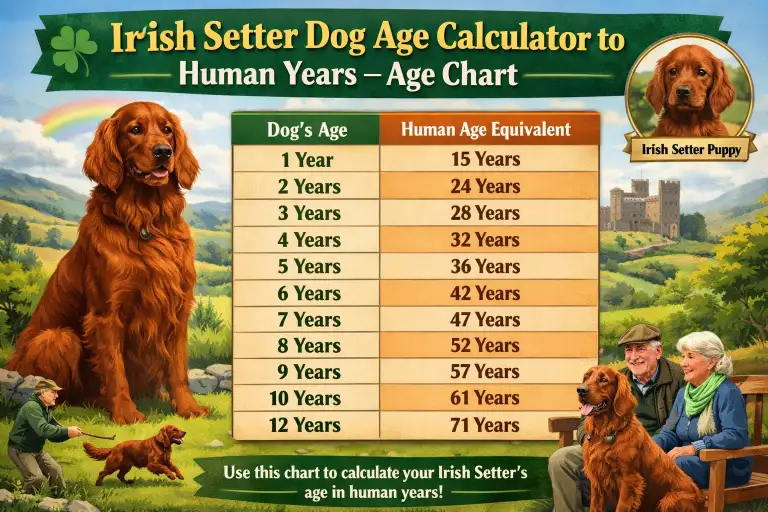
Irish Setter Age to Human Years Chart
This section gives you the full Irish Setter age to human years chart. It is made to be easy to read, quick to scan, and simple to understand. You can use it to find your dog’s human age in seconds.
Irish Setters age fast in the first two years. After that, each year adds fewer human years than people expect. This is why a chart is more helpful than guessing.
If your Irish Setter’s age falls between two numbers, use the closest age for a good estimate. Remember, this chart shows average aging. Health, diet, activity level, and genetics can make some dogs age a little faster or slower.
Irish Setter Age Conversion Chart
| Irish Setter Age (Dog Years) | Human Age Equivalent | Life Stage |
|---|---|---|
| 2 months | ~3 years | Puppy |
| 4 months | ~6 years | Puppy |
| 6 months | ~10 years | Puppy |
| 1 year | ~15 years | Young adult |
| 2 years | ~24 years | Young adult |
| 3 years | ~30 years | Adult |
| 4 years | ~38 years | Adult |
| 5 years | ~44 years | Adult |
| 6 years | ~50 years | Adult |
| 7 years | ~56 years | Adult |
| 8 years | ~61 years | Senior |
| 9 years | ~66 years | Senior |
| 10 years | ~70 years | Senior |
| 11 years | ~75 years | Senior |
| 12 years | ~79 years | Senior |
This table helps answer common questions like:
- How old is a 5-year-old Irish Setter in human years?
- When does an Irish Setter become a senior?
- Why does a 10-year-old Irish Setter feel much older than a 5-year-old one?
Looking at your dog’s age in human years can help you make better choices about food, exercise, and vet care.
Irish Setter Life Stages and What to Expect at Each Age
Irish Setters go through clear life stages. Each stage brings changes in energy, behavior, and health. Knowing what stage your dog is in helps you care for them better and notice problems early.
Puppies grow very fast. They learn how to walk, run, play, and follow rules. Irish Setter puppies are curious and full of energy. Training and social time are very important during this stage.
Adult Irish Setters are strong, active, and playful. This is when they have the most energy and need daily exercise. Most Irish Setters stay in this stage for several years.
Senior Irish Setters slow down. They may sleep more, move more carefully, and need extra comfort. Aging is normal, but changes should still be watched closely.
Irish Setter Life Stages Overview
| Life Stage | Age Range | Physical Changes | Behavior Changes |
|---|---|---|---|
| Puppy | 0–12 months | Fast growth, teething, weak coordination | Very playful, curious, short focus |
| Young adult | 1–3 years | Full height reached, muscle builds | High energy, better focus |
| Adult | 4–7 years | Stable body condition | Calm but still active |
| Senior | 8+ years | Slower movement, joint stiffness | Sleeps more, lower energy |
Common Signs of Aging in Irish Setters
| Sign | What You May Notice |
|---|---|
| Slower movement | Takes longer to stand or climb stairs |
| Weight changes | Gains or loses weight easily |
| Lower energy | Shorter walks, more rest |
| Joint stiffness | Limping or trouble jumping |
| Behavior changes | More quiet or confused |
These signs do not always mean illness, but they do mean your Irish Setter may need extra care and vet checkups.
How to Help Your Irish Setter Live Longer and Age Healthier
Helping your Irish Setter stay healthy at every age can make a big difference in how long they live and how happy they feel. Small changes in diet, exercise, and routine care can have a big impact.
Nutrition is very important. Puppies need high-protein food to grow strong. Adult Irish Setters need balanced meals to maintain weight and energy. Seniors benefit from food that supports joints and digestion.
Exercise keeps muscles, joints, and the heart healthy. Puppies and young adults need lots of playtime and walks. Older dogs may need shorter, gentler walks but should still stay active to avoid stiffness.
Regular vet visits are key. Your vet can check your dog’s weight, teeth, heart, and joints. Vaccinations, screenings, and preventive care help catch problems early.
Lifestyle matters too. Maintaining a healthy weight, avoiding overexertion, and providing mental stimulation help your Irish Setter age better. Spaying or neutering can also influence long-term health.
Age-Based Care Guide for Irish Setters
| Age Range | Nutrition Focus | Exercise Needs | Vet Care Tips |
|---|---|---|---|
| Puppy 0–12 months | High protein, growth-supporting food | Short play sessions, training walks | Vaccinations, deworming, check growth |
| Young adult 1–3 years | Balanced meals | Daily long walks, play, training | Annual vet check, dental care |
| Adult 4–7 years | Maintain weight, joint support | Regular walks, agility, play | Vet checkups, heart and joint screenings |
| Senior 8+ years | Senior formulas, joint supplements | Short gentle walks, low-impact play | More frequent vet visits, monitor mobility and weight |
Lifestyle Factors Affecting Lifespan
| Factor | Impact on Health |
|---|---|
| Weight management | Prevents joint stress and heart problems |
| Regular exercise | Keeps muscles and joints healthy |
| Mental stimulation | Reduces boredom and anxiety |
| Preventive care | Early detection of health issues |
| Environment | Safe, comfortable living space supports well-being |
By following these tips, you can help your Irish Setter stay active, happy, and healthy throughout life.
For more on dog aging and lifespan science, visit the American Kennel Club’s Irish Setter breed page

Ata Ur Rehman is the founder of Pet Age in Human Years Calculator, an educational platform that provides age conversion charts and lifespan guides for dogs, cats, birds, and other companion animals. His work focuses on helping pet owners understand how animal ages translate into human years using commonly accepted age conversion formulas and published lifespan averages.
The website compiles breed and species lifespan data from kennel clubs, breed organizations, and general animal lifespan studies to present simple and easy-to-understand guides for pet owners worldwide.
This website was created to centralize animal age conversion charts into one easy reference platform for pet owners.