If you’ve ever wondered “How old is my LaPerm cat in human years?” you’re not alone. Cats age very differently than people, especially in their early years, and LaPerms are no exception.
A LaPerm Age Calculator to Human Years helps you quickly estimate your cat’s age in human-equivalent terms, so you can better understand their life stage — whether they’re still a playful kitten, a mature adult, or entering their senior years.
This conversion is useful because veterinary care, nutrition needs, and daily activity levels often change depending on where your LaPerm falls in the aging timeline.
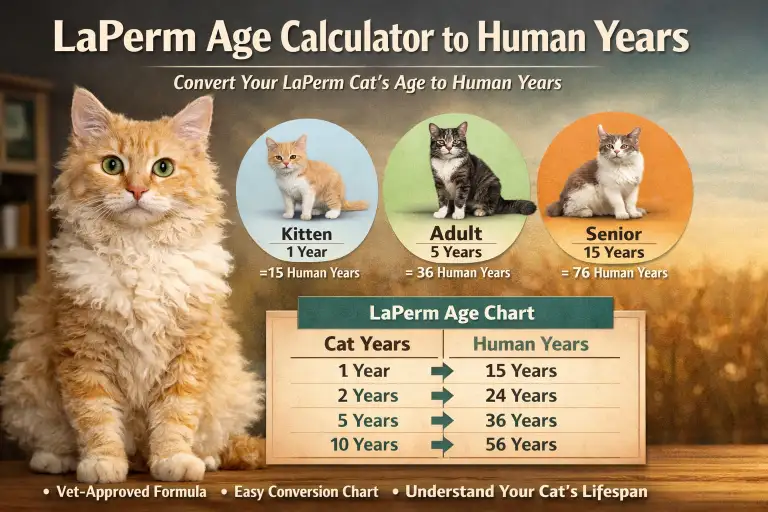
Here’s a quick instant reference to give you an idea of how LaPerm cat years translate into human years:
| LaPerm Age (Cat Years) | Human Age Equivalent |
|---|---|
| 1 year | ~15 years |
| 2 years | ~24 years |
| 5 years | ~36 years |
| 10 years | ~56 years |
| 15 years | ~76 years |
This page will guide you through the science-backed conversion model, provide a full LaPerm age chart, and help you understand what your cat’s “human age” really means in terms of development and health.
Let’s explore how LaPerm cats age compared to humans and why the early years matter most.
How LaPerm Cats Age Compared to Humans
LaPerm cats do not age the same way humans do. A cat’s first years go by much faster than ours. This is why a 1-year-old LaPerm is not like a 1-year-old child — it is more like a teenager.
Cats grow and mature quickly in the beginning, then their aging slows down as they become adults.
Here are the main reasons LaPerm cats age faster early on:
- Fast growth as kittens (learning, developing, becoming independent)
- Reaching adult size by about 1 year old
- Early maturity in the first 2 years
After the early years, cats age more steadily year by year.
To make it easy, think of it like this:
- The first year of a LaPerm’s life is a big jump
- The second year is another big step
- After that, aging becomes slower and more regular
Life stages also help owners understand their cat better:
| Life Stage | LaPerm Age Range | Similar Human Age |
|---|---|---|
| Kitten | 0–1 year | Child to Teen |
| Young Adult | 2–6 years | 20s to 40s |
| Mature Adult | 7–10 years | 40s to 50s |
| Senior | 11+ years | 60+ years |
Knowing these stages can help you understand your LaPerm’s behavior, energy level, and care needs.
LaPerm Cat Age Conversion Formula (Vet-Approved Model)
Many people grew up hearing the old idea that 1 cat year = 7 human years.
But that is not true.
Cats, including LaPerm cats, age much faster in their first two years. After that, aging becomes slower.
Veterinarians and animal experts often use this widely accepted model:
- 1st year of a cat’s life ≈ 15 human years
- 2nd year ≈ 9 more human years
- Each year after that ≈ 4 human years
This gives a much more realistic estimate.
Here is the breakdown in a simple table:
| Cat Age Year | Human Years Added |
|---|---|
| Year 1 | ~15 years |
| Year 2 | +9 years |
| After Year 2 | +4 years each year |
So for example:
- A 1-year-old LaPerm ≈ 15 human years
- A 2-year-old LaPerm ≈ 24 human years
- A 3-year-old LaPerm ≈ 28 human years
This formula helps owners understand their cat’s life stage better, but remember: it is still an estimate. Every cat is a little different.
LaPerm Age Chart (Cat Years to Human Years Table)
The easiest way to understand your LaPerm cat’s age is by using an age chart.
This table shows the most common cat ages and their human age equivalents.
Just find your LaPerm’s age on the left, then look across to see the human age estimate.
| LaPerm Age (Cat Years) | Human Age Equivalent |
|---|---|
| 1 year | 15 years |
| 2 years | 24 years |
| 3 years | 28 years |
| 4 years | 32 years |
| 5 years | 36 years |
| 6 years | 40 years |
| 7 years | 44 years |
| 8 years | 48 years |
| 9 years | 52 years |
| 10 years | 56 years |
| 11 years | 60 years |
| 12 years | 64 years |
| 13 years | 68 years |
| 14 years | 72 years |
| 15 years | 76 years |
| 16 years | 80 years |
| 17 years | 84 years |
| 18 years | 88 years |
| 19 years | 92 years |
| 20 years | 96 years |
This chart is a helpful guide for understanding whether your LaPerm is still young, fully grown, or becoming a senior cat.
Keep in mind:
- Indoor cats often live longer than outdoor cats
- Health, care, and genetics can affect aging
- This is an estimate, not an exact number
LaPerm Lifespan, Life Stages & FAQs for Owners
LaPerm cats are known for being healthy, friendly, and long-living pets.
Most LaPerm cats can live well into their senior years with good care.
Here is a simple lifespan guide:
| Category | Typical Range |
|---|---|
| Average LaPerm lifespan | 12–15 years |
| Healthy indoor lifespan | 15–18 years |
| Senior stage begins | Around 11 years |
As your LaPerm gets older, their needs may change. Senior cats may sleep more, move slower, and need more vet checkups.
Below are some common questions owners ask.
FAQs
How long do LaPerm cats live?
Most LaPerm cats live between 12 and 15 years, and many indoor LaPerms can reach 18 years or more.
When is a LaPerm cat considered old?
A LaPerm is usually considered a senior around 11 years old.
Is the cat age chart always exact?
No. The chart is an estimate. Cats age differently depending on health, lifestyle, and genetics.
Do indoor LaPerm cats live longer?
Yes. Indoor cats are safer from accidents, fights, and diseases, so they often live longer.
Why do cats age so fast in the first two years?
Cats grow and mature quickly as kittens, so their early years equal a big jump in human age.
What is the biggest cat age myth?
The biggest myth is that 1 cat year equals 7 human years. The real aging process is more complex.
Final Note for Owners
Understanding your LaPerm’s age in human years can help you give the right care at the right time. Use the calculator and chart as a helpful guide, and always talk to your veterinarian if you have questions about your cat’s health.
For a more detailed explanation of feline life stages and aging, you can also visit the American Animal Hospital Association (AAHA) cat care guidelines.

Ata Ur Rehman is the founder of Pet Age in Human Years Calculator, an educational platform that provides age conversion charts and lifespan guides for dogs, cats, birds, and other companion animals. His work focuses on helping pet owners understand how animal ages translate into human years using commonly accepted age conversion formulas and published lifespan averages.
The website compiles breed and species lifespan data from kennel clubs, breed organizations, and general animal lifespan studies to present simple and easy-to-understand guides for pet owners worldwide.
This website was created to centralize animal age conversion charts into one easy reference platform for pet owners.