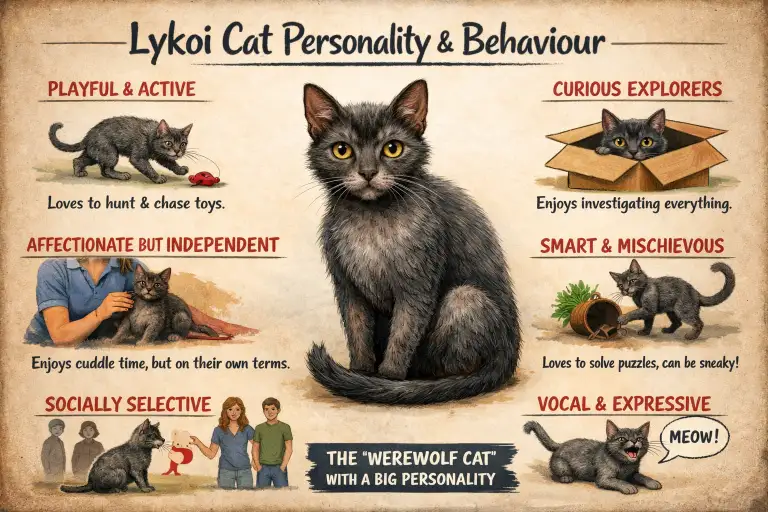
The Lykoi cat has a personality that often surprises people. Many first notice their unusual appearance, but their behavior is what truly defines them. Lykois are alert, thoughtful, and very aware of their surroundings. They are not the type of cat that rushes into every situation. Instead, they like to watch first and decide later.
Lykoi cats are often described as intelligent and observant. They pay close attention to people, sounds, and movement in the home. This can make them seem serious at times, but it does not mean they are unfriendly. They simply like to understand what is happening before joining in.
Temperament can vary a lot from one Lykoi to another. Some are playful and outgoing, while others are calm and reserved. What they usually share is emotional awareness. Lykois tend to notice changes in mood, routine, or environment more than many other cats.
It is important to understand that a Lykoi’s personality develops slowly. Trust matters a lot to this breed. Once they feel safe, many Lykois become deeply loyal and connected to their humans, even if they are not constant lap cats.
Core Lykoi Personality Traits
| Trait | What It Looks Like in Daily Life |
|---|---|
| Intelligent | Learns routines quickly, solves small problems |
| Observant | Watches quietly before acting |
| Loyal | Forms strong bonds with trusted people |
| Independent | Enjoys space but stays nearby |
| Play-focused | Engages deeply during playtime |
What Shapes Lykoi Cat Behavior
Lykoi behavior is shaped by both genetics and life experience. This breed naturally has a high level of alertness. They are wired to notice small details, which affects how they move, play, and interact with people.
Early social experiences play a big role. A Lykoi that is gently handled and exposed to normal household sounds when young is more likely to grow into a confident adult. A lack of early exposure does not make them “bad cats,” but it can make them more cautious.
The environment also matters. Lykois do best in homes with predictable routines. Sudden changes, loud noise, or frequent new visitors can make them pull back and observe instead of engaging. This is a normal response for them, not a problem behavior.
Trust is one of the strongest influences on Lykoi behavior. When they feel respected and not forced into interaction, they relax more. Over time, this leads to stronger bonds and more open behavior.
Factors That Influence Lykoi Behavior
| Factor | How It Affects Behavior |
|---|---|
| Genetics | Natural alertness and curiosity |
| Early socialization | Confidence with people and handling |
| Home environment | Comfort level and stress response |
| Routine | Predictability increases calm behavior |
| Trust with humans | Determines closeness and affection |
Social Behavior — How Lykoi Cats Interact With Humans and Pets
Lykoi cats are social, but in a thoughtful way. Many prefer to stay close to their people rather than sit directly on laps. They might follow you from room to room or sit nearby while watching what you do.
Affection in Lykois is often subtle. Slow blinks, gentle head turns, and quiet presence are common signs of bonding. Some will enjoy cuddling, but only on their terms. This does not mean they are distant; it means they value choice.
With other cats or pets, Lykois often observe before interacting. They are not usually aggressive, but they do like clear boundaries. Once comfortable, they can play well with other animals, especially if introductions are calm and gradual.
They may bond more closely with one person, especially the one who respects their signals. This can make them seem selective, but it is simply how they form trust.
Lykoi Affection Styles and Social Preferences
| Behavior | What It Means |
|---|---|
| Sitting nearby | Feels safe and connected |
| Following quietly | Social interest without touch |
| Short cuddle sessions | Enjoys affection in small doses |
| Watching people | Emotional awareness and curiosity |
| One-person bonding | Deep trust with chosen human |
Communication, Play, and Natural Instincts
Lykoi cats communicate more with body language than loud sounds. They are usually not very vocal, but when they do make noise, it often has a clear purpose, such as asking for play or attention.
Their body language can be very subtle. A still posture, focused eyes, or slow movements often mean they are thinking or observing. This is sometimes mistaken for fear or tension, but it is usually normal behavior.
Play is extremely important for Lykois. They enjoy games that involve chasing, stalking, and problem-solving. Wand toys, moving objects, and interactive play fit their natural instincts well.
Because they are intelligent, boredom can show as withdrawal rather than destruction. A Lykoi that seems “quiet” may simply need more mental engagement.
Lykoi Body Language and Communication Signals
| Signal | Likely Meaning |
|---|---|
| Still posture | Focused or observing |
| Slow blinking | Trust and comfort |
| Tail held low but relaxed | Calm awareness |
| Sudden play bursts | Mental stimulation need |
| Quiet watching | Natural alert behavior |
Commonly Misunderstood Lykoi Behaviors and FAQs
Many Lykoi behaviors are often misunderstood. Their serious expressions are sometimes mistaken for aggression, but most Lykois are gentle and controlled. Being quiet does not mean they are unhappy or unfriendly.
Another common misunderstanding is independence. Lykois can enjoy alone time, but they still form strong emotional bonds. They simply show affection in quieter ways.
As Lykois age, behavior may shift. Kittens are curious and playful, adults become more steady, and seniors may seek more comfort and routine. These changes are normal and expected.
Understanding these patterns helps owners feel calm and confident instead of worried. Observing behavior over time matters more than judging single moments.
Common Questions Answered Briefly
- Are Lykoi cats affectionate? Yes, often in subtle ways.
- Do they like to cuddle? Some do, but usually in short sessions.
- Are they aggressive? No, they are usually thoughtful and controlled.
- Do they bond with one person? Often, yes.
- Are they good family cats? Yes, in calm and respectful homes.
For more general feline behavior understanding, you can explore guidance from a veterinary behavior organization:
https://www.avsab.org/resources/position-statements

Ata Ur Rehman is the founder of Pet Age in Human Years Calculator, an educational platform that provides age conversion charts and lifespan guides for dogs, cats, birds, and other companion animals. His work focuses on helping pet owners understand how animal ages translate into human years using commonly accepted age conversion formulas and published lifespan averages.
The website compiles breed and species lifespan data from kennel clubs, breed organizations, and general animal lifespan studies to present simple and easy-to-understand guides for pet owners worldwide.
This website was created to centralize animal age conversion charts into one easy reference platform for pet owners.