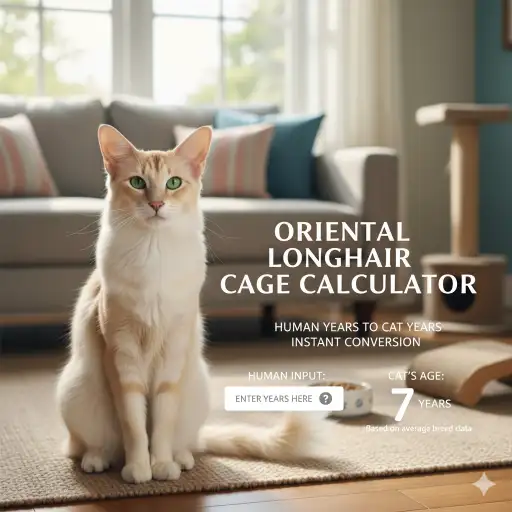
Understanding your Oriental Longhair’s age in human years is more than a curiosity. It can help you provide better care, know when to expect life stage changes, and anticipate health needs. Many cat owners are surprised to learn that cats age much faster than humans during their first few years of life. While a human child takes several years to grow into adolescence, a kitten can reach full physical maturity in just over a year. That means understanding the human-equivalent age of your cat can help you track growth, health, and behavior in a more meaningful way.
Many people still use the old idea that one cat year equals seven human years. This is a huge oversimplification and can be misleading. Cat aging is not linear. The first year of a cat’s life is the most dramatic, where a kitten experiences growth and development equivalent to a 15-year-old human. The second year adds another nine human years, and after that, each year of a cat’s life is roughly equal to four human years. This method is more accurate and based on veterinary research, reflecting real biological changes.
Oriental Longhairs are a unique breed with a generally healthy, long-lived profile. They are often indoor cats, which can allow them to live well into their late teens and occasionally over twenty years. By using an age calculator, you can see how your Oriental Longhair compares to a human in terms of physical health, mental development, and social behavior. It can also help you plan veterinary visits and preventative care.
Knowing your cat’s human-equivalent age can also help with emotional connection. Many owners wonder if a 10-year-old cat is “old” in human terms. Using a calculator gives perspective on what to expect in terms of activity, play, and potential health issues. This knowledge helps you celebrate each stage appropriately and make lifestyle adjustments for your cat’s comfort and well-being.
How Oriental Longhairs Age Compared to Humans
Cats age differently from humans, and Oriental Longhairs are no exception. The first year of life is the fastest in terms of physical growth and development. A kitten that is just 12 months old has already reached the equivalent of a 15-year-old human in terms of growth and body maturity. The second year adds about nine human years, making a two-year-old cat roughly 24 in human age. After that, each cat year equals about four human years. This pattern shows that cats reach adulthood very quickly but then age more slowly over the rest of their lives.
Life stages in cats are important to understand because they influence behavior, health, and energy levels. Kittens are playful, curious, and learn social skills. Young adults, typically ages two to four in cats, are more independent and may start showing signs of routine preferences. Adult cats, between five and ten, tend to be steady in behavior but need more consistent health care and monitoring. Seniors, usually 11 and older, can show slower movements, increased sleep, and sometimes emerging health issues.
Indoor Oriental Longhairs often live longer than outdoor cats because they are protected from accidents, predators, and certain diseases. However, even indoor cats experience aging in ways that mimic humans. Mental stimulation, physical activity, and a balanced diet all influence quality of life. Using an age calculator can provide a clearer idea of which stage your cat is in, helping you match activities, feeding schedules, and veterinary care to their specific needs.
Many owners are surprised at how quickly their kittens reach adulthood. Playful kitten behaviors such as jumping, climbing, and exploring are concentrated in the first 12 months. By the second year, Oriental Longhairs may begin to display calmer behaviors, but they still have the energy and curiosity of young adults. Understanding these stages in human terms helps you anticipate behavior changes, prevent problems, and support your cat’s health and well-being.
Oriental Longhair Age Conversion Formula & Chart
The most widely accepted method to convert cat years to human years is based on veterinary research. The first year of a cat’s life is equal to about 15 human years, the second year adds nine more, and every subsequent year is roughly four human years. This approach accounts for the rapid early growth of kittens and the slower aging of adult cats.
To make this simple for owners, the following table converts Oriental Longhair ages into human years and includes life-stage color coding for quick reference.
| Cat Age (Years) | Human Age Equivalent | Life Stage |
|---|---|---|
| 0–1 | 0–15 | Kitten |
| 1–2 | 15–24 | Young Adult |
| 2–3 | 24–28 | Young Adult |
| 3–4 | 28–32 | Adult |
| 4–5 | 32–36 | Adult |
| 5–6 | 36–40 | Adult |
| 6–7 | 40–44 | Adult |
| 7–8 | 44–48 | Adult |
| 8–9 | 48–52 | Adult |
| 9–10 | 52–56 | Adult |
| 10–11 | 56–60 | Senior |
| 11–12 | 60–64 | Senior |
| 12–13 | 64–68 | Senior |
| 13–14 | 68–72 | Senior |
| 14–15 | 72–76 | Senior |
| 15+ | 76+ | Senior |
This chart helps owners quickly identify where their Oriental Longhair falls in terms of human-equivalent age. Life stages are color-coded for clarity: kittens in light green, young adults in yellow, adults in orange, and seniors in red. Visual cues like these make the calculator much easier to use and interpret.
Using the chart alongside the calculator allows for better planning of health care, play routines, and behavioral monitoring. For instance, a six-year-old cat is an adult at 40 human years, so routine vet checkups, regular dental care, and controlled diet become important. A 12-year-old cat is a senior at 64 in human terms, so you may notice slower movements and increased rest periods, indicating it’s time for joint supplements or more gentle activity.
Using the Calculator & Understanding Life Stages
Using the Oriental Longhair age calculator is straightforward. You start by entering your cat’s age in years or months. The calculator instantly provides a human-equivalent age and highlights the life stage. This gives you context about your cat’s behavior, health, and energy levels. It is especially helpful for new owners who may be unfamiliar with the rapid early growth of kittens.
Life stages guide expectations. Kittens are energetic and curious, requiring play and social interaction. Young adults are independent but still active and need structured play. Adults maintain steady behavior, require regular veterinary care, and may develop long-term dietary preferences. Seniors often need gentle routines, comfort, and monitoring for age-related health concerns.
A secondary table can help summarize life stages alongside behavior and health considerations:
| Life Stage | Age (Years) | Behavior & Activity | Health Considerations |
|---|---|---|---|
| Kitten | 0–1 | Playful, curious, learning social skills | Vaccinations, early spay/neuter |
| Young Adult | 1–4 | Independent, energetic, routine preferences | Routine vet visits, proper nutrition |
| Adult | 5–10 | Steady behavior, balanced activity | Dental care, joint monitoring |
| Senior | 11+ | Slower, more rest, occasional stiffness | Joint supplements, frequent checkups |
This table allows owners to see at a glance what to expect at each stage. It also helps tailor feeding, play, and veterinary routines. Skimmable, visual tables make understanding age easier, especially when trying to balance multiple cats in different life stages.
Understanding life stages in human terms also helps owners plan emotionally. For example, a 15-year-old Oriental Longhair is equivalent to a 76-year-old human. Owners can prepare for age-related behavior changes, appreciate the bond during quieter years, and make adjustments to the cat’s environment to maintain comfort and safety.
Accuracy, Limitations & FAQs
While the age calculator is highly useful, it is important to understand its limitations. Age conversion provides an estimate, not a precise measurement. Individual cats may age faster or slower depending on genetics, diet, exercise, and overall health. Breed tendencies, such as those seen in Oriental Longhairs, influence longevity, but lifestyle has a significant impact.
Owners should also avoid thinking in exact numbers. A 10-year-old cat may be 56 in human years according to the formula, but their activity level and health could vary widely. Indoor cats usually live longer, but that does not guarantee they will reach the maximum estimated age. Similarly, outdoor cats may face risks that impact longevity but still follow similar biological aging trends.
Common questions owners have include:
- How do I know if my cat is a senior?
Seniors usually start at 11 years old. Watch for slower movements, more sleep, or stiffness. - Is my kitten really equivalent to a teenager?
Yes, the first year is very rapid growth, comparable to a 15-year-old human. - Can lifestyle affect human-equivalent age?
Yes, diet, exercise, and medical care all influence health and aging. - Does the calculator account for genetics?
No, it provides a general estimate, but breed traits can influence lifespan. - How often should I monitor a senior Oriental Longhair?
Every 6 months is recommended for health checkups and preventative care. - Why does the “1 cat year = 7 human years” myth persist?
It’s easy to remember but ignores the rapid early growth and slower adult aging of cats.
Understanding these limitations helps owners interpret results without anxiety and plan appropriate care for their cat’s current life stage. It emphasizes that while the calculator gives a useful perspective, individual variations matter.
For further reading on feline aging and veterinary guidance, you can visit the American Association of Feline Practitioners for more detailed advice on cat health, life stages, and longevity.

Ata Ur Rehman is the founder of Pet Age in Human Years Calculator, an educational platform that provides age conversion charts and lifespan guides for dogs, cats, birds, and other companion animals. His work focuses on helping pet owners understand how animal ages translate into human years using commonly accepted age conversion formulas and published lifespan averages.
The website compiles breed and species lifespan data from kennel clubs, breed organizations, and general animal lifespan studies to present simple and easy-to-understand guides for pet owners worldwide.
This website was created to centralize animal age conversion charts into one easy reference platform for pet owners.