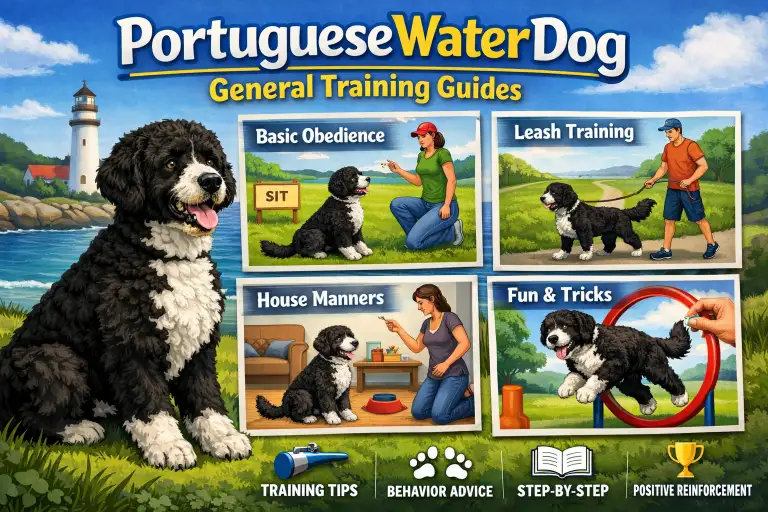
Training a Portuguese Water Dog is about channeling intelligence, energy, and natural working instincts into reliable behavior. This breed is smart, athletic, and people-oriented, which makes them highly trainable—but also easy to mismanage without structure.
Many owners assume their dog is stubborn when behaviors such as selective listening, overexcitement, or mischief appear. In reality, these behaviors often result from inconsistent training, lack of mental stimulation, or poorly timed lessons.
Why Proper Training Matters
Training is not optional for a Portuguese Water Dog. Without structure, their energy can manifest as jumping, barking, ignoring commands, or destructiveness. Proper training helps your dog:
- Stay calm indoors and in public
- Listen even when excited or distracted
- Respond safely around water, people, and other dogs
- Understand daily household expectations
Proper Training
| With Proper Training | Without Proper Training |
|---|---|
| Listens even when excited | Ignores cues when distracted |
| Calmer indoors | Restless, pacing, or barking for attention |
| Safer around people and water | Poor recall and impulse control |
| Easier to manage in public | Overwhelming in busy places |
| Mentally satisfied | Bored and destructive |
Training also protects your dog. Reliable recall, calm behavior around water, and impulse control reduce the risk of accidents and injury.
Understanding the Portuguese Water Dog Temperament and Learning Style
Portuguese Water Dogs learn best when training matches their natural behavior and intelligence. This breed was bred to work closely with humans, making them alert, observant, and quick learners.
They are highly intelligent, energetic, and sensitive. They notice tone, mood, and fairness, and they test boundaries to understand the rules. Confusing or repetitive training can lead to frustration, selective listening, or boredom.
Key traits of the breed:
- High intelligence – learns fast but gets bored easily
- High energy – needs both mental and physical activity
- Strong attachment to owners – responds best to calm, consistent guidance
- Sensitive nature – harsh corrections damage trust
- Love of water and movement – recall and impulse control are essential
| Breed Trait | What It Means for Training |
|---|---|
| Very intelligent | Learns quickly but gets bored easily |
| High energy | Needs mental work, not just exercise |
| Strong attachment | Responds best to calm, positive training |
| Sensitive nature | Harsh corrections reduce trust |
| Loves water and movement | Recall and impulse control need extra work |
Understanding these traits helps you train effectively and avoid frustration.
Step-by-Step Portuguese Water Dog Training Method
The key to successful training is simplicity, clarity, and consistency. Portuguese Water Dogs learn best with short, meaningful sessions rather than long drills. Positive reinforcement works far better than harsh corrections.
Basic training rules:
- Train every day, even for a few minutes
- Keep sessions short (5–10 minutes)
- Reward desired behaviors immediately
- End sessions on a positive note
| Dog Age | Main Training Focus |
|---|---|
| Puppy | Name response, potty training, calm handling, simple cues |
| Young dog | Leash manners, recall, impulse control, social skills |
| Adult dog | Reliability, obedience under distractions, real-life cues |
| Training Element | Recommendation |
|---|---|
| Session length | 5–10 minutes |
| Sessions per day | 2–4 short sessions |
| Best location | Start quiet, then move to busier areas |
| Rewards | Treats, praise, play, or toys |
| End session | Always end on success |
Start with basic obedience, gradually adding distractions and new environments. Training should remain fun, fair, and mentally engaging.
Common Portuguese Water Dog Training Problems and Solutions
| Training Problem | Why It Happens | What Helps |
|---|---|---|
| Jumping on people | Excitement, poor impulse control | Teach sit before greetings |
| Ignoring commands outside | Distractions are more interesting than rewards | Train slowly in new places |
| Barking for attention | Boredom or learned behavior | Reward calm behavior, add mental stimulation |
| Pulling on leash | Energy and poor leash skills | Short walks with training breaks |
| Poor recall near water | Strong natural water drive | Practice recall away from water first |
Common mistakes include repeating commands multiple times or training only when problems occur. These approaches reduce reliability. Consistency, calm guidance, and structured sessions prevent most issues.
Progress may fluctuate. Portuguese Water Dogs may seem perfect one week and distracted the next. Patience and consistent short sessions are essential.
Training Schedule, Tools, and Final Tips for Success
Portuguese Water Dogs thrive on routine and structure. Training should be part of daily life, not occasional or reactive.
Sample Daily Training Routine:
- Morning: Short obedience practice
- Walks: Leash manners and recall
- Afternoon: Puzzle toys or mental games
- Evening: Calm behavior practice
| Time of Day | Training Focus |
|---|---|
| Morning | Short obedience session |
| Walks | Leash skills and recall |
| Afternoon | Mental stimulation and problem-solving |
| Evening | Calmness and settling |
Helpful training tools:
- Soft treats your dog enjoys
- Comfortable harness or flat collar
- Standard leash for practice
- Puzzle toys for mental enrichment
- Quiet space for initial training
| Helpful Approach | What to Avoid |
|---|---|
| Clear rules | Inconsistent commands |
| Short sessions | Long, boring lessons |
| Positive rewards | Harsh corrections |
| Calm guidance | Yelling or frustration |
| Daily practice | Only training when problems arise |
Final advice: Portuguese Water Dogs require patience, structure, and involvement. Training is about communication, not control. When done right, it strengthens the bond and produces a confident, happy
For more detailed information on Portuguese Water Dog health and breed standards, you can visit the American Kennel Club page: https://www.akc.org/dog-breeds/portuguese-water-dog/.

Ata Ur Rehman is the founder of Pet Age in Human Years Calculator, an educational platform that provides age conversion charts and lifespan guides for dogs, cats, birds, and other companion animals. His work focuses on helping pet owners understand how animal ages translate into human years using commonly accepted age conversion formulas and published lifespan averages.
The website compiles breed and species lifespan data from kennel clubs, breed organizations, and general animal lifespan studies to present simple and easy-to-understand guides for pet owners worldwide.
This website was created to centralize animal age conversion charts into one easy reference platform for pet owners.