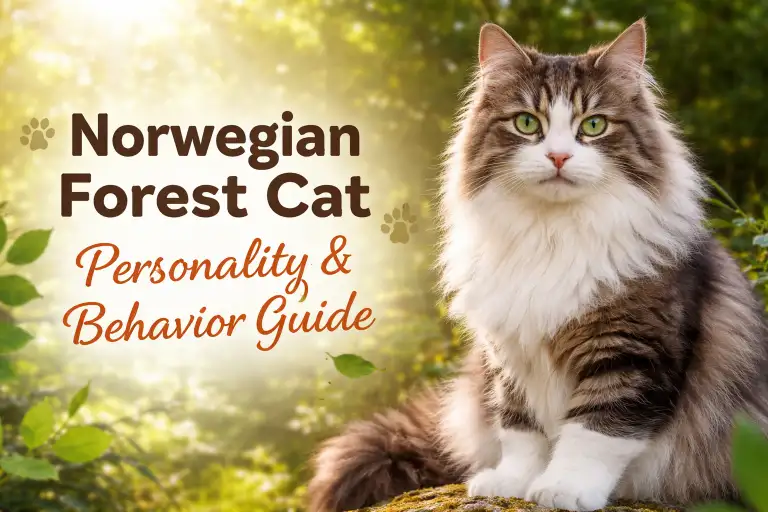
The Norwegian Forest Cat personality is often described in simple terms—independent, calm, intelligent—but those labels don’t fully capture how these cats actually experience and move through the world. A better way to understand them is as quietly social observers: cats that form strong bonds without needing constant interaction or reassurance.
Most Norwegian Forest Cats are emotionally steady rather than reactive. They tend to watch first, decide second, and act only when it feels worthwhile. This can sometimes be misread as aloofness, but in reality it reflects confidence and security. These cats don’t feel the need to demand attention to feel safe in their environment or relationships. When they choose to engage, it’s deliberate and meaningful.
Affection in this breed is usually calm and understated. Many Norwegian Forest Cats prefer being near their people rather than on them. Sitting at the edge of the couch, resting a few feet away, or quietly following from room to room are common ways they maintain connection. For owners expecting a constant lap cat, this can feel confusing at first, but over time it often becomes clear that closeness doesn’t always require physical contact.
Another defining trait is emotional independence paired with loyalty. Norwegian Forest Cats typically bond deeply with one or two people, but they don’t rely on constant interaction to reinforce that bond. They are comfortable spending time alone, yet they remain very aware of household routines and their humans’ presence. This balance makes them especially appealing to people who appreciate companionship without clinginess.
It’s also important to remember that no breed description overrides individuality. Some Norwegian Forest Cats are more outgoing, others more reserved; some enjoy brief cuddles, others prefer consistent proximity without touch. Personality is shaped not only by genetics, but by early experiences, environment, and the pace at which trust is built.
Understanding the Norwegian Forest Cat personality starts with letting go of expectations rooted in louder, more demonstrative breeds. These cats tend to connect quietly, observe deeply, and express attachment in subtle but consistent ways.
What Shapes Norwegian Forest Cat Behavior
Norwegian Forest Cat behavior is not random. It develops slowly over time and is shaped by both nature and daily life experiences. Understanding this helps explain why these cats act calm, thoughtful, and selective in how they interact.
One major influence is their natural history. Norwegian Forest Cats developed in cold, wooded environments where climbing, watching, and choosing safe resting spots mattered. Even in modern homes, this shows up as a strong preference for high places, quiet corners, and observing before acting. These behaviors are not signs of distance—they are comfort habits.
Another important factor is slow maturity. This breed takes longer than many others to fully grow, both physically and emotionally. Young Norwegian Forest Cats may seem playful but cautious, while adults often become more settled and emotionally steady. Their personality does not change suddenly; it unfolds gradually.
Environment also plays a big role. A calm home with predictable routines often brings out their relaxed and confident side. Loud, chaotic spaces may cause them to withdraw quietly rather than act out. This withdrawal is often misunderstood, but it is usually a way of feeling safe, not a sign of fear or dislike.
Human behavior matters too. Norwegian Forest Cats respond best to respectful interaction. Being allowed to approach on their own terms helps them build trust. When they feel pressured, they may simply choose distance instead of reacting strongly.
Finally, early experiences shape how social they become. Kittens that are gently handled and given time to explore often grow into adults that are curious and steady. Those experiences influence how comfortable they feel around people, other pets, and new situations later in life.
Understanding these influences makes their behavior easier to read. Instead of asking “Why is my cat like this?” it becomes clearer that their actions are thoughtful responses to their history and environment.
How Norwegian Forest Cats Communicate and Show Affection
Norwegian Forest Cats are quiet communicators. They often use body language and small actions instead of loud sounds. Because of this, many people miss the signs of affection and trust unless they know what to look for.
These cats usually communicate by watching, positioning themselves nearby, and using gentle movements. A slow blink, relaxed posture, or choosing to rest close to you are all important signals. Silence does not mean lack of feeling. For this breed, calm behavior often means they feel safe and comfortable.
Affection styles and what they mean
Many Norwegian Forest Cats are not classic lap cats. Instead, they prefer closeness without constant touch. This is one of the most misunderstood parts of their personality.
| What the cat does | What it looks like | What it usually means |
|---|---|---|
| Sits near you | Same couch, different spot | Trust and bonding |
| Follows you quietly | Moves room to room | Feeling connected |
| Short cuddle time | Leaves after a few minutes | Comfort without needing more |
| Sleeps nearby | Same room, not on you | Feeling safe with you |
These behaviors show affection in a calm and steady way. The cat is choosing to share space, which is very meaningful for this breed.
Body language and quiet signals
Norwegian Forest Cats also use small body movements to communicate their mood. These signals are easy to miss but very helpful once you notice them.
| Signal | Often misunderstood as | What it usually means |
|---|---|---|
| Still and watching | Not interested | Curious and focused |
| Slow tail movement | Annoyed | Paying attention |
| Slow blinking | Sleepy | Trust and comfort |
| Upright ears | Alert or tense | Calm awareness |
Vocal sounds are usually soft and limited. Some cats make small chirps or trills, especially when greeting familiar people. Many do not meow often, and that is normal for this breed.
Understanding these quiet signals helps owners feel more confident. A Norwegian Forest Cat may not ask for attention loudly, but they communicate clearly in their own gentle way.
Social, Play, and Territorial Behavior
Norwegian Forest Cats show their personality clearly through how they play, share space, and interact with people and other animals. Their behavior is usually calm, thoughtful, and based on comfort rather than excitement.
Social behavior at home
With humans, these cats prefer respectful space. They enjoy being part of daily life but do not need constant attention. Many will sit nearby, watch activities, or join quietly without asking to be touched. With children and visitors, they are often polite but reserved, choosing to observe first before interacting.
With other cats or pets, Norwegian Forest Cats usually avoid conflict. They tend to keep their distance and watch rather than chase or challenge. This does not mean they are weak or fearful. It simply means they prefer peaceful sharing of space.
Play style and natural instincts
Play is important, but their play style is not wild or nonstop. Norwegian Forest Cats like short bursts of activity followed by rest. They enjoy watching before jumping and often play in a slow, planned way.
Climbing is especially important. High places help them feel safe and in control. Watching from above is a natural instinct, not avoidance. Many also enjoy play that involves stalking, hiding, and pouncing, which reflects their hunting instincts.
| Behavior | What people may think | What it usually means |
|---|---|---|
| Short play sessions | Low energy | Energy used wisely |
| Watching before playing | Not interested | Planning the move |
| Prefers climbing | Avoiding people | Feeling safe and calm |
Territorial comfort behaviors
Norwegian Forest Cats care about their space, but they are not usually aggressive about it. They like having favorite spots where they can rest, watch, or feel secure. These spots may change from day to day.
Scratching, perching, and choosing certain rooms are ways they mark comfort, not control. These actions help them feel relaxed and balanced in their environment.
Understanding these behaviors makes daily life easier. Instead of pushing interaction, it helps to let the cat choose how and when to join.
Commonly Misunderstood Behaviors and Behavior Changes Over Time
Many Norwegian Forest Cat behaviors are often misunderstood, especially when people expect loud or very cuddly cats. These cats are calm by nature, and their behavior makes more sense when seen through that lens.
One common misunderstanding is thinking they are distant or cold. In reality, many Norwegian Forest Cats are emotionally secure. They do not need to stay on top of their people to feel close. Choosing to be nearby, watching quietly, or sharing the same room are strong signs of trust.
Another misunderstanding is silence. These cats are often quiet, and this is normal. A calm, silent cat is usually relaxed. Loud meowing is not the only way cats communicate, and this breed prefers subtle signals.
Some owners also worry when their cat spends time alone. For Norwegian Forest Cats, alone time is often a comfort choice, not a sign of sadness. They enjoy independence while still staying connected to their environment.
Behavior also changes naturally with age:
- Kittens are curious but careful, exploring slowly
- Young cats may test limits while still watching closely
- Adults are steady, calm, and routine-focused
- Older cats often seek more quiet time and gentle closeness
These changes are normal and happen gradually. A calmer cat is not losing personality—it is simply growing into emotional balance.
Understanding these patterns helps reduce worry. Most behaviors that seem confusing are actually signs of confidence, comfort, and maturity.
For a deeper understanding of normal cat behavior and communication, you can explore the feline behavior resources from the Cornell University College of Veterinary Medicine, which explain how cats express comfort, stress, and social bonds.

Ata Ur Rehman is the founder of Pet Age in Human Years Calculator, an educational platform that provides age conversion charts and lifespan guides for dogs, cats, birds, and other companion animals. His work focuses on helping pet owners understand how animal ages translate into human years using commonly accepted age conversion formulas and published lifespan averages.
The website compiles breed and species lifespan data from kennel clubs, breed organizations, and general animal lifespan studies to present simple and easy-to-understand guides for pet owners worldwide.
This website was created to centralize animal age conversion charts into one easy reference platform for pet owners.