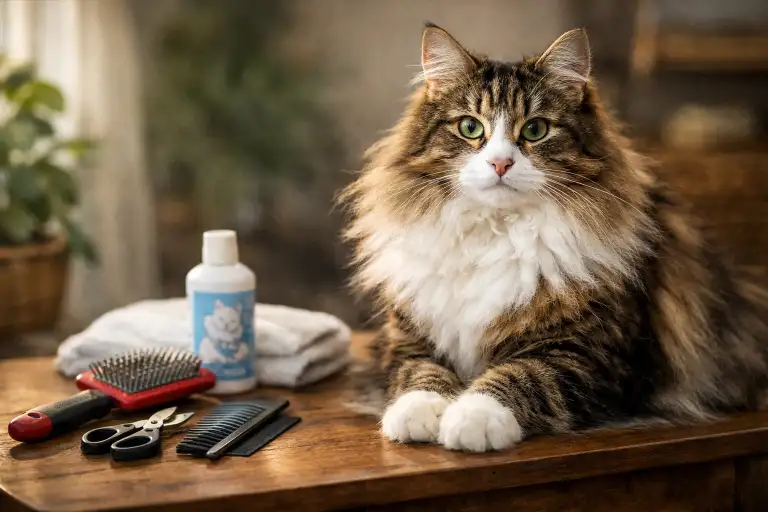
Norwegian Forest Cats may look rugged and self-sufficient, but their coat tells a different story. This breed developed in harsh Scandinavian climates, and their grooming needs are shaped by that history. Understanding why they need regular grooming is the foundation for doing it safely and effectively.
Norwegian Forest Cats have a true double coat. The long, water-resistant outer guard hairs protect against moisture and dirt, while the dense undercoat provides insulation. This combination is excellent for cold weather—but it also means loose fur doesn’t always fall out on its own. Instead, it gets trapped beneath the topcoat, where it can compact, tangle, and eventually form mats if not managed.
Many owners assume that because cats groom themselves, additional grooming isn’t necessary. With Norwegian Forest Cats, that assumption often leads to problems. Their tongues can’t reach deep enough into the undercoat to remove shed fur effectively, especially during seasonal shedding. Over time, this trapped fur increases the risk of matting, skin irritation, and discomfort.
Grooming needs also change based on lifestyle and life stage:
- Indoor cats often shed year-round due to artificial lighting and stable temperatures.
- Outdoor or semi-outdoor cats may pick up debris and experience heavier seasonal coat changes.
- Kittens usually have softer, lighter coats but still need early grooming exposure.
- Senior cats may groom themselves less thoroughly, making human grooming essential rather than optional.
Another important factor is size and build. Norwegian Forest Cats are large, muscular cats with thick neck ruffs, full bellies, and feathered legs. These areas are prone to tangles and mats and are also sensitive to rough handling. Grooming isn’t just about keeping the coat pretty—it’s about maintaining comfort, mobility, and skin health.
When done consistently and calmly, grooming becomes a form of routine care and early health monitoring. Changes in coat texture, excessive shedding, or sudden resistance to grooming can all be early signs that something isn’t right. That’s why understanding this breed’s grooming needs isn’t about perfection—it’s about awareness, prevention, and respecting the cat in front of you.
Brushing a Norwegian Forest Cat (How, Where, and How Often)
Brushing is the most important grooming task for a Norwegian Forest Cat. If you only do one thing at home, this should be it. Regular brushing keeps the coat healthy, reduces shedding, and helps prevent painful mats.
Because this breed has a thick double coat, loose fur often gets stuck under the top layer. If it stays there, it can turn into tight knots. These knots pull on the skin and can be very uncomfortable for the cat.
How often to brush
How often you brush depends a lot on the season. Norwegian Forest Cats shed heavily when the seasons change.
| Season | Brushing Frequency | What to Expect |
|---|---|---|
| Spring | 4–5 times per week | Heavy shedding, loose undercoat |
| Summer | 2–3 times per week | Lighter coat, fewer tangles |
| Fall | 3–4 times per week | Coat thickens again |
| Winter | 1–2 times per week | Full coat, less shedding |
Indoor cats may shed more evenly all year, so they may need brushing a bit more often.
Where mats usually form
Mats do not show up everywhere at once. They usually start in hidden spots where fur rubs together.
| Area | Why It Mats Easily |
|---|---|
| Behind the ears | Soft fur and constant movement |
| Under the front legs | Rubbing while walking |
| Belly | Fine fur and hard to reach |
| Neck ruff | Thick fur and moisture |
| Base of the tail | Shedding and body oils |
Always check these areas, even if the top of the coat looks fine.
How brushing should feel for your cat
Brushing should never hurt. Use slow movements and light pressure. Short sessions are better than long ones, especially for cats that are new to grooming. If your cat flicks their tail hard, flattens their ears, or tries to leave, it’s time to stop.
Important safety notes
- Do not pull on tangles or mats
- Do not cut mats with scissors
- Do not force your cat to stay still
If mats feel tight or close to the skin, home grooming is no longer safe. This is when a professional groomer or vet should step in.
Brushing done often and gently is much safer than trying to fix big problems later.
Nail Trimming, Ear, Eye, and Dental Care Basics
Brushing is the main grooming job, but it is not the only one. Nail, ear, eye, and dental care help keep your Norwegian Forest Cat comfortable and healthy. These tasks are simple when done regularly and calmly.
You do not need to do all of these every week. The goal is to check often and act early, before small issues turn into big ones.
Nail trimming
Norwegian Forest Cats are large and heavy. Long nails can catch on carpets, scratch skin, or make walking uncomfortable.
- Indoor cats still need nail trims
- Nails grow faster than most owners expect
- Overgrown nails can curl and hurt the paw
Trim only the sharp tip. If your cat pulls away, hisses, or becomes stiff, stop and try again another day. Nail trimming should never be a fight.
Ear care
Healthy ears should look clean and pale pink inside. A little wax is normal.
Check the ears when you brush your cat. Watch for:
- Strong smell
- Thick, dark wax
- Red or sore skin
Do not put anything deep inside the ear. If ears look dirty often, a vet should check them.
Eye care
Some Norwegian Forest Cats get mild eye discharge, especially seniors.
- Clear or light brown discharge is common
- Thick yellow or green discharge is not normal
- Squinting or redness needs a vet visit
Use a soft, damp cloth to wipe the area gently if needed.
Dental care
Dental problems are very common in cats, even when they eat well.
- Bad breath is not normal
- Red gums or drooling are warning signs
- Dental pain can cause grooming problems
At-home dental care helps, but vets should handle dental disease.
Quick care guide
| Grooming Task | Typical Check | Why It Matters | When to Get Help |
|---|---|---|---|
| Nail trimming | Every 2–4 weeks | Prevents pain and injury | Cat resists strongly or nails curl |
| Ear check | Weekly | Catches infections early | Bad smell or dark buildup |
| Eye check | Weekly | Prevents irritation | Thick discharge or redness |
| Dental check | Monthly | Avoids dental pain | Bad breath or swollen gums |
These small checks take very little time but make a big difference in your cat’s comfort.
Bathing Norwegian Forest Cats (When It’s Needed and When It’s Not)
Most Norwegian Forest Cats do not need regular baths. Their coat is made to protect itself, and frequent bathing can actually cause more problems.
Many owners think baths help with shedding or keep the coat clean. For this breed, that is usually not true. Bathing too often can dry the skin, break the coat, and make matting worse.
When a bath may be needed
Bathing can help in a few special cases:
- Greasy or oily fur that brushing cannot fix
- Dirt, feces, or sticky substances in the coat
- Senior cats who cannot groom themselves well
- Medical reasons suggested by a vet
In these cases, bathing should be gentle and planned, not rushed.
When bathing is not recommended
Baths should be avoided when:
- The cat is healthy and clean
- The goal is to reduce shedding
- The coat already has mats
- The cat is very stressed or fearful
Wet fur tangles easily. If mats are already present, water can tighten them and make removal harder and more painful.
Bathing guide at a glance
| Situation | Bath Needed? | Why |
|---|---|---|
| Normal shedding | No | Brushing works better |
| Light dirt on fur | No | Spot cleaning is safer |
| Greasy coat | Sometimes | May need gentle washing |
| Senior cat hygiene | Sometimes | Depends on mobility |
| Mats in the coat | No | Water makes mats worse |
Important safety reminders
- Never force a bath
- Never bathe just for routine grooming
- Never rush drying on a thick coat
If bathing feels stressful or unsafe, it is best handled by a professional groomer or vet.
Grooming Frequency, Safety, and Common Mistakes
Regular grooming works best when it is simple and calm. You do not need to do everything at once. Small, regular care keeps your Norwegian Forest Cat healthy and relaxed.
Grooming schedule overview
| Grooming Task | How Often | Notes |
|---|---|---|
| Brushing | 2–5 times per week | More often during shedding season |
| Nail trimming | Every 2–4 weeks | Trim only the sharp tip |
| Ear check | Once a week | Look, don’t dig |
| Eye check | Once a week | Wipe only if needed |
| Dental check | Once a month | Vet care if signs appear |
| Bathing | Rarely | Only when truly needed |
This schedule is a guide. Some cats may need more or less care.
Safety and stress signs to watch for
Always watch your cat’s body language during grooming. Stop if you see:
- Ears pulled back or flat
- Fast tail swishing
- Growling or sudden biting
- Trying hard to escape
Stopping early builds trust. Forcing grooming breaks it.
Common grooming mistakes owners make
- Waiting too long between brushing sessions
- Brushing only the top of the coat
- Cutting mats with scissors
- Bathing to control shedding
- Continuing when the cat is stressed
These mistakes often lead to pain, fear, or injury.
When to use a professional groomer or vet
Home grooming has limits. Get professional help if:
- Mats are tight or close to the skin
- Your cat becomes aggressive during grooming
- Your cat is old, sick, or in pain
- Grooming feels unsafe for you or the cat
Professional help is not a failure. It is part of good care.
Grooming should make your cat feel better, not worse. When done gently and often, it becomes a normal and safe routine.
For more veterinarian-approved guidance on basic cat care and grooming safety, you can visit the American Veterinary Medical Association (AVMA) cat owner resources.

Ata Ur Rehman is the founder of Pet Age in Human Years Calculator, an educational platform that provides age conversion charts and lifespan guides for dogs, cats, birds, and other companion animals. His work focuses on helping pet owners understand how animal ages translate into human years using commonly accepted age conversion formulas and published lifespan averages.
The website compiles breed and species lifespan data from kennel clubs, breed organizations, and general animal lifespan studies to present simple and easy-to-understand guides for pet owners worldwide.
This website was created to centralize animal age conversion charts into one easy reference platform for pet owners.