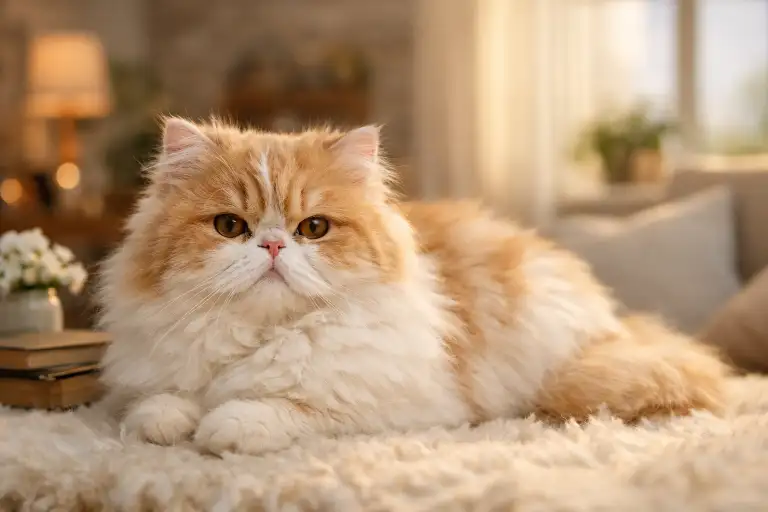
The Persian cat personality is often described as calm, gentle, and quiet—but those words alone don’t fully capture what it’s like to live with one. Persians are emotionally steady cats who tend to experience the world at a slower, more deliberate pace. They are not dramatic, demanding, or constantly seeking stimulation, and that subtlety is exactly why their personalities are so often misunderstood.
Rather than being highly expressive, Persians communicate through presence. A Persian who chooses to rest near you, follow you from room to room, or settle into the same space each day is showing attachment in a low-key, intentional way. Their affection is consistent rather than intense, and they tend to prefer familiarity over novelty.
Many Persians are selective with their social energy. They usually enjoy human companionship but on their own terms, favoring gentle interaction and predictable routines. This makes them well suited to quieter households, though individual personality still matters—some Persians are more outgoing, while others are deeply reserved.
It’s also important to understand that a calm personality does not mean a lack of awareness or emotion. Persians are observant cats. They notice changes in their environment, pick up on household moods, and often choose to watch rather than participate. This reflective nature is a core part of their temperament, not a sign of disinterest.
At their best, Persians are steady companions—content to share space, offer quiet affection, and bring a sense of calm to the home. Appreciating their personality starts with recognizing that not all cats express connection through constant movement or vocalization. With Persians, stillness itself is often the message.
What Shapes Persian Cat Behavior
Persian cat behavior is shaped by a mix of natural temperament and daily environment. These cats are born with a calm and gentle nature, but how they behave day to day depends a lot on what their life looks like at home.
One of the biggest influences is routine. Persians feel safest when their world is predictable. Regular feeding times, quiet rest areas, and familiar people help them stay relaxed. Sudden changes, loud noises, or busy spaces can make them pull back, not because they are weak, but because they prefer peace.
The home environment matters more for Persians than for many other cats. They usually do best indoors, where they can control their space and avoid stress. A calm home helps them stay confident. A noisy or crowded home may cause them to hide more or stay very still, which is often mistaken as being “lazy” or “sad.”
Early life experiences also play a role. Persians that were gently handled as kittens often grow into adults who are more comfortable around people. Those with less early contact may be more reserved. Both are normal. Personality differences are expected, even within the same breed.
It’s also important to understand that Persians are very sensitive to energy. They notice when people are rushed, upset, or tense. In those moments, many Persians choose to step back and observe rather than engage. This is part of their thoughtful nature, not a behavior problem.
Overall, Persian cats behave best when they feel safe, calm, and respected. Their behavior is not about control or dominance. It is about comfort, trust, and stability.
How Persian Cats Communicate and Show Affection
Persian cats are quiet communicators. They do not use loud meows or big movements to get attention. Instead, they rely on small actions and calm behavior to express how they feel. This is normal for this breed and often missed by new owners.
Many Persians show affection by simply being nearby. Sitting next to you, resting in the same room, or choosing the same spot every day are all signs of trust. They may not always climb into your lap, but their presence is meaningful.
Body language is very important with Persians. Their signals are soft and easy to overlook. Watching how they sit, look, and move can tell you a lot about their comfort level.
Here are some common ways Persian cats communicate:
| Persian Cat Behavior | What It Usually Means |
|---|---|
| Slow blinking | Feeling safe and relaxed |
| Sitting close without touching | Affection with personal space |
| Quiet or no meowing | Content and emotionally calm |
| Turning head away gently | Needs a break, not upset |
| Following you quietly | Attachment and interest |
Persians may also show love through routine. A cat that greets you at the same time each day, sleeps in a favorite shared space, or waits calmly nearby is showing a strong bond in a peaceful way.
Because they are not very vocal, silence is often a good sign with Persians. It usually means they are comfortable and settled, not lonely or unhappy.
Understanding these small signals helps build trust and prevents confusion. Persian cats do communicate—they just do it quietly.
Social, Play, and Daily Behavior Patterns
Persian cats have a calm and gentle way of living. Their daily behavior is slow, steady, and predictable. They enjoy peaceful routines and usually do not like sudden changes in their day.
When it comes to people, Persians enjoy company but do not demand attention. They often bond closely with one or two people in the home. They like soft voices, slow movements, and gentle touch. Too much handling or rough play can make them pull away.
With other pets, Persian cats usually prefer calm companions. They can live well with other cats or quiet animals, but they may avoid pets that are very active or noisy. Persians often choose to share space rather than play together.
Play time for Persians is short and gentle. They enjoy simple toys and slow movements. A few minutes of play is often enough. After that, they like to rest and watch their surroundings.
Here is a simple look at common daily behavior patterns in Persian cats:
| Behavior Area | What Is Normal for Persians |
|---|---|
| Social style | Calm and selective |
| Play style | Short and gentle play |
| Activity level | Low to medium |
| Time spent resting | High |
| Interaction with pets | Peaceful co-living |
Persian cats enjoy watching the world more than chasing it. Sitting by a window, resting on a favorite cushion, or lying near their people are all signs of comfort.
This calm lifestyle does not mean they are bored. It means they feel safe.
Commonly Misunderstood Persian Behaviors
Many Persian cat behaviors are often misunderstood, especially by people who expect cats to be active, loud, or playful all the time. Persians behave differently, and that difference is normal.
One common mistake is thinking Persians are lazy. In truth, they save their energy and move only when they feel the need. Resting often means they feel safe and relaxed, not bored.
Another misunderstanding is quiet behavior. Persian cats do not meow much. Silence usually means they are comfortable. Loud meowing is not their main way of communicating.
Hiding or staying in one spot is also misunderstood. Persians often choose calm spaces to rest and feel secure. This is a comfort choice, not fear.
Here is a simple table to help explain these behaviors:
| Often Thought to Mean | What It Usually Means |
|---|---|
| Lazy | Calm and energy-saving |
| Unfriendly | Quiet and selective |
| Bored | Content and relaxed |
| Hiding | Feeling safe and settled |
| Too quiet | Emotionally calm |
Persian cats also move slowly and gently. This does not mean they are weak or sad. It is simply part of their peaceful nature.
Understanding these behaviors helps owners worry less and enjoy their cat more. Persian cats show happiness in quiet ways, and once you learn those signs, their behavior makes much more sense.
For a broader understanding of how cat behavior works across different personalities and environments, you can also explore this helpful guide from the ASPCA.

Ata Ur Rehman is the founder of Pet Age in Human Years Calculator, an educational platform that provides age conversion charts and lifespan guides for dogs, cats, birds, and other companion animals. His work focuses on helping pet owners understand how animal ages translate into human years using commonly accepted age conversion formulas and published lifespan averages.
The website compiles breed and species lifespan data from kennel clubs, breed organizations, and general animal lifespan studies to present simple and easy-to-understand guides for pet owners worldwide.
This website was created to centralize animal age conversion charts into one easy reference platform for pet owners.