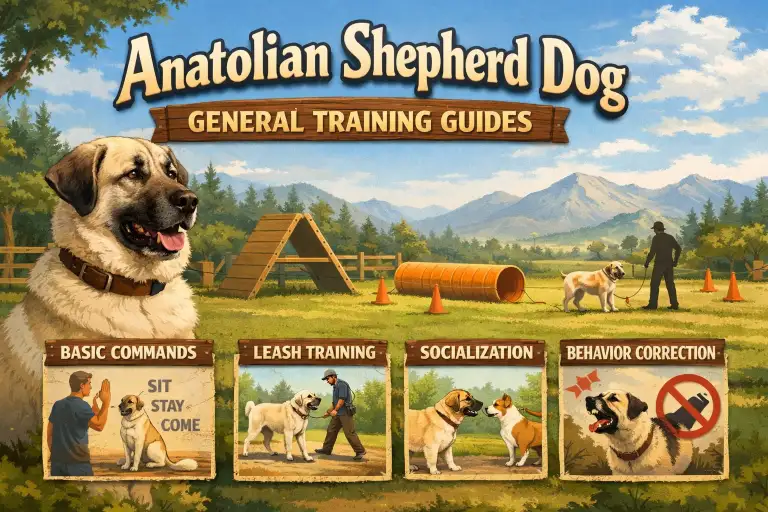
Training an Anatolian Shepherd is not about teaching blind obedience — it’s about building cooperation with a highly intelligent, independent livestock guardian dog. This breed was developed to make decisions on its own, often far away from human direction, and that history shapes how Anatolian Shepherds learn, respond, and behave in modern homes.
Many owners struggle because they approach Anatolian Shepherd training like they would a Labrador, German Shepherd, or other obedience-driven breeds. That mismatch leads to frustration, ignored commands, leash resistance, and sometimes serious behavior issues as the dog matures. This guide is designed to prevent those problems by setting realistic expectations from the start.
Whether you’re raising an Anatolian Shepherd puppy, working with an adolescent who seems “stubborn,” or managing an adult guardian dog in a family or rural setting, the goal of this article is simple: help you understand how to train this breed in a way that aligns with its instincts, psychology, and real-world behavior.
Before diving into training methods, it’s critical to assess whether your lifestyle, experience level, and environment are a good fit for this breed. Many training failures are not caused by the dog — they stem from unmet expectations and improper management.
Is the Anatolian Shepherd the Right Dog for You?
| Factor | What to Expect |
|---|---|
| Trainability | Learns quickly but chooses when to comply |
| Independence level | Very high; decision-making is self-directed |
| Best owner type | Confident, patient, consistent, experienced |
| First-time owner difficulty | High without professional guidance |
| Response to force-based training | Poor; often causes shutdown or defiance |
| Maturity timeline | Mental maturity often takes 2–3 years |
This table isn’t meant to discourage ownership — it’s meant to protect both dogs and owners. Anatolian Shepherds thrive when their training respects their independence while providing clear structure, boundaries, and purpose.
Why Anatolian Shepherd Training Is Different and Essential
Anatolian Shepherds were not bred to wait for instructions. They were bred to protect, decide, and act on their own. This is why training this breed feels very different from training most pet dogs.
If training is delayed, inconsistent, or too harsh, problems can grow fast. An untrained Anatolian Shepherd is not just “hard to handle” — it can become unsafe around strangers, overly protective of property, and impossible to recall once it decides something is a threat.
Training is essential for three main reasons:
- Safety: This is a large, powerful dog with strong guarding instincts
- Control: Without training, the dog controls the situation — not the owner
- Trust: Proper training builds cooperation, not fear or force
Many owners fail because they use training styles meant for obedience breeds. Anatolian Shepherds do not respond well to pressure, yelling, or repeated commands. Instead of trying harder, they often shut down or ignore you completely.
The table below shows why standard training advice often fails with this breed.
| Training Area | Typical Obedience Dogs | Anatolian Shepherd |
|---|---|---|
| Reason for obeying | Wants to please the owner | Obeys only if it makes sense |
| Response to repeated commands | Improves with repetition | Starts ignoring commands |
| Reaction to harsh correction | Tries harder or becomes fearful | Becomes resistant or defensive |
| Guarding instinct | Low to moderate | Very strong and natural |
| Recall reliability | Often high | Situational and limited |
| Training focus | Commands and tricks | Boundaries and decision control |
Because of these differences, training must start early and focus on structure, clear rules, and trust, not constant obedience drills. Waiting until the dog is “older” often means training a 120-pound adult with deeply set habits.
This does not mean Anatolian Shepherds cannot be trained. It means they must be trained correctly, with respect for how their brain works and why they behave the way they do.
Understanding Anatolian Shepherd Behavior and Learning Style
To train an Anatolian Shepherd well, you must first understand how this dog thinks. Many training problems happen because owners expect this breed to act like a typical pet dog. Anatolian Shepherds do not think that way.
This breed was developed to guard livestock without human help. That means the dog is used to making decisions alone. When something feels unsafe, the dog reacts first and thinks later. This is not bad behavior — it is natural behavior for this breed.
Here are the most important behavior traits that affect training:
- Independent thinking: The dog decides if a command is worth following
- Strong guarding instinct: The dog is always watching for danger
- Slow mental maturity: Adult behavior may not settle until 2–3 years of age
- Low tolerance for pressure: Yelling or force often makes things worse
- Selective obedience: The dog may obey at home but ignore you outside
Because of this, Anatolian Shepherds learn best when training feels fair, calm, and useful. They do not respond well to repeated commands, anger, or dominance-based methods. Training must focus on teaching the dog how to make better choices, not how to blindly obey.
The table below connects common Anatolian Shepherd behaviors with what they mean for training.
| Behavior Trait | What Owners Often Think | What It Really Means for Training |
|---|---|---|
| Ignores commands | The dog is stubborn | The dog does not see value in the command |
| Barks at strangers | The dog is aggressive | The dog is doing its guarding job |
| Pulls on leash | The dog is untrained | The dog is scanning and controlling space |
| Slow to mature | The dog is difficult | The brain is still developing |
| Resists punishment | The dog is dominant | The dog shuts down or loses trust |
Understanding this behavior helps owners stop blaming the dog and start adjusting the training plan. When training matches the dog’s natural instincts, progress becomes faster and safer.
How to Train an Anatolian Shepherd Dog Step by Step
Training an Anatolian Shepherd works best when it is simple, calm, and consistent. Long lessons, repeated commands, or force will not help. This breed learns through daily structure, not drill-style obedience.
The goal is not perfect obedience. The goal is a dog that listens, respects boundaries, and makes safer choices.
Here are the core training rules that matter most:
- Train in short sessions
- Be clear and calm, not loud
- Give rules that stay the same every day
- Reward good choices right away
- Stop training before the dog gets bored
Anatolian Shepherds learn better from routine than from tricks. Training should be part of daily life, not something that only happens during “practice time.”
The table below shows a simple daily training structure for puppies and adult dogs.
| Training Area | Puppy (2–12 months) | Adult Dog |
|---|---|---|
| Session length | 3–5 minutes | 5–10 minutes |
| Sessions per day | 3–5 short sessions | 2–3 short sessions |
| Main focus | Social rules, calm behavior | Boundaries, control, reliability |
| Recall training | On leash or long line | Long line or fenced areas |
| Mental work | Simple games, food rewards | Decision-based rewards |
| Physical exercise | Light, age-safe activity | Controlled walks, job-based work |
Training focus also changes based on age and environment. A puppy in a home setting needs different training than an adult dog guarding land or livestock.
| Age or Environment | Training Priority |
|---|---|
| Young puppy | Handling, calm behavior, safe social exposure |
| Teen dog (6–18 months) | Boundary testing, leash manners, impulse control |
| Adult family dog | Visitor control, recall limits, calm leadership |
| Rural or livestock setting | Territory rules, over-guarding control |
| Busy household | Ignoring chaos, staying calm indoors |
One very important rule: never repeat commands. Say it once. If the dog does not respond, guide or reset the situation instead of repeating words. Repeating commands teaches the dog that listening is optional.
Progress with this breed is slow but steady. Most owners see early improvement in calm behavior within weeks, but full reliability often takes many months or even years. This is normal for Anatolian Shepherds.
Common Training Problems and When to Get Professional Help
Many Anatolian Shepherd owners feel worried when training does not go as planned. This is normal. Most problems come from misunderstanding the breed, not from bad dogs or bad owners.
Anatolian Shepherds test limits, ignore commands at times, and react strongly to what they think is danger. These behaviors can often be improved with better structure, patience, and the right training plan.
The table below lists common training problems and what usually helps.
| Training Problem | Why It Happens | What Helps Most |
|---|---|---|
| Dog ignores commands | Dog decides the command is not useful | Fewer commands, clear rules, better rewards |
| Poor recall | Strong independence and guarding focus | Long-line training, fenced practice areas |
| Pulling on leash | Dog wants to control space | Calm leash work, slower walks, direction changes |
| Barking at strangers | Natural guarding instinct | Controlled exposure, clear visitor rules |
| Over-protective behavior | Dog feels fully responsible for safety | Owner leadership, boundary training |
| Training feels slow | Late maturity of the breed | Patience and consistent routine |
Some behaviors improve with time and proper training. Others can become serious if ignored. Knowing when to get help is part of being a responsible owner.
The table below shows clear warning signs that mean professional help is needed.
| Red Flag Behavior | Why It Matters | Who to Contact |
|---|---|---|
| Biting or snapping | Risk to people and animals | Professional trainer or vet behaviorist |
| Severe aggression toward strangers | Can escalate quickly | Certified behavior specialist |
| Guarding food, people, or land intensely | Can become dangerous | Experienced working-dog trainer |
| Fear reactions that worsen | Fear can turn into aggression | Veterinary behaviorist |
| No improvement after months of training | Plan may be wrong | Qualified trainer for reassessment |
Getting help is not a failure. Anatolian Shepherds are complex dogs, and many owners need expert guidance to stay safe and successful.
For official breed standards, history, and responsible ownership guidance, you can also refer to the Anatolian Shepherd Dog Club of America, which provides detailed, breed-specific information from experienced breeders and experts:
https://www.asdca.org/

Ata Ur Rehman is the founder of Pet Age in Human Years Calculator, an educational platform that provides age conversion charts and lifespan guides for dogs, cats, birds, and other companion animals. His work focuses on helping pet owners understand how animal ages translate into human years using commonly accepted age conversion formulas and published lifespan averages.
The website compiles breed and species lifespan data from kennel clubs, breed organizations, and general animal lifespan studies to present simple and easy-to-understand guides for pet owners worldwide.
This website was created to centralize animal age conversion charts into one easy reference platform for pet owners.