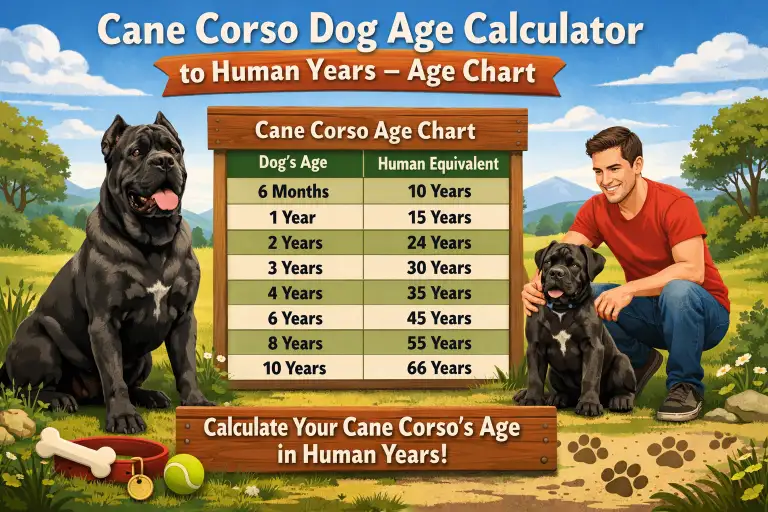
If you’ve ever wondered how old your Cane Corso really is in human terms, you’re not alone. Large and giant breeds like the Cane Corso age very differently from smaller dogs, which is why simple rules like “one dog year equals seven human years” don’t work here.
A Cane Corso age calculator is designed to give a more realistic estimate by accounting for the breed’s size, rapid early growth, and shorter average lifespan. Cane Corsos mature quickly in their first two years, then age more gradually through adulthood before entering their senior years earlier than most small and medium dogs.
For example, a one-year-old Cane Corso is already comparable to a human in their early 30s, while a five-year-old Cane Corso is closer to a middle-aged adult than a young person. This early acceleration is normal for giant breeds and is one reason accurate age conversion matters for health planning.
Use the Cane Corso age calculator on this page by selecting your dog’s age in years. The result gives an estimated human-age range rather than a single fixed number, reflecting how real biological aging works. Factors such as genetics, body condition, exercise level, and overall health can shift where your individual dog falls within that range.
Understanding your Cane Corso’s age in human years helps you make better decisions about training expectations, nutrition, exercise intensity, and preventive veterinary care—especially as your dog moves from adulthood into the senior stage.
Cane Corso Age Chart: Dog Years to Human Years (Giant Breed)
Many owners prefer a chart instead of a calculator because it is quick and easy to scan. This Cane Corso age chart shows how dog years roughly convert to human years for a giant breed. These numbers are estimates, not exact ages, but they give a much clearer picture than the old 7-year rule.
Cane Corsos age very fast in their first two years. After that, aging slows down, but they still reach senior status earlier than smaller dogs.
Below is a simple and easy-to-read age chart made specifically for Cane Corsos.
Cane Corso Dog Age to Human Age Chart
| Cane Corso Age (Years) | Human Age Equivalent | What This Means |
|---|---|---|
| 1 year | 30–35 years | Fully grown body, still maturing mentally |
| 2 years | 38–42 years | Young adult stage |
| 3 years | 42–46 years | Adult dog |
| 4 years | 46–50 years | Peak strength years |
| 5 years | 50–55 years | Mature adult |
| 6 years | 55–60 years | Early senior stage |
| 7 years | 60–65 years | Senior |
| 8 years | 65–70 years | Older senior |
| 9–10 years | 70–80+ years | Geriatric stage |
This chart helps explain why a 6- or 7-year-old Cane Corso may already show signs of aging, such as slower movement, joint stiffness, or less energy. For a giant breed, this is normal and expected.
Remember, two Cane Corsos of the same age can still age differently. Diet, weight, exercise, and vet care all play a role in how fast or slow a dog ages.
Why Cane Corso Dog Years Are Not Equal to 7 Human Years
You may have heard that one dog year equals seven human years. This idea is easy to remember, but it is not accurate, especially for large dogs like the Cane Corso.
Dogs do not age at the same speed as humans. Cane Corsos grow very fast in their first year, much faster than a human child. A one-year-old Cane Corso is already fully grown in body size, while a one-year-old human is still a baby. This fast early growth is the main reason the 7-year rule does not work.
Large and giant breeds also age differently from small dogs. Smaller dogs usually live longer and age more slowly later in life. Cane Corsos, on the other hand, age faster early and reach their senior years sooner.
Scientists now know that dog aging is not a straight line. Studies on canine aging show that dogs age quickly at first, then more slowly as adults. This curved aging pattern explains why simple math rules give wrong results.
The table below shows the difference between common myths and real facts about dog aging.
Dog Years vs Human Years – Myth vs Reality
| Common Myth | What Actually Happens |
|---|---|
| 1 dog year = 7 human years | Dog aging is not equal or linear |
| All dogs age the same | Size and breed change aging speed |
| A 7-year-old dog is middle-aged | A 7-year-old Cane Corso is usually a senior |
| Big dogs live as long as small dogs | Giant breeds usually have shorter lifespans |
Understanding this helps owners make better choices. If you think your Cane Corso is “still young” at six or seven years old, you may delay senior care that your dog actually needs.
Knowing the truth about dog aging helps you plan vet visits, adjust exercise, and change diet at the right time.
Cane Corso Life Stages: Puppy, Adult, and Senior Aging Explained
Cane Corsos move through life stages faster than many other dogs. Knowing these stages helps you understand what your dog needs at each age and why behavior and health can change over time.
Cane Corso puppies grow very quickly during their first year. Their bodies get big fast, but their bones and joints are still developing. This is why careful feeding and controlled exercise are important early on. Even though a puppy may look strong, their body is not ready for hard work yet.
By about two to three years old, most Cane Corsos are considered adults. This is when they reach full size and strength. Many owners see this as the “best years” because the dog is confident, powerful, and more settled in behavior. Even during this stage, aging is still happening on the inside.
Cane Corsos often enter their senior years earlier than people expect. For many dogs of this breed, senior age can begin around six or seven years old. Energy levels may drop, and small changes like stiffness after rest or slower movement can appear.
The table below shows the typical life stages of a Cane Corso and what owners usually notice.
Cane Corso Life Stages and What to Expect
| Life Stage | Typical Age Range | Common Changes |
|---|---|---|
| Puppy | 0–12 months | Fast growth, clumsy movement |
| Adolescent | 1–2 years | Strong body, immature mind |
| Adult | 3–5 years | Peak strength and stamina |
| Senior | 6–8+ years | Slower movement, joint stiffness |
Not every Cane Corso will age at the same speed. Some dogs stay active longer, while others show aging signs earlier. Genetics, weight, exercise, and vet care all play a role.
Helping Your Cane Corso Age Healthily and Live Longer
While you cannot stop aging, you can help your Cane Corso stay comfortable and healthy for as long as possible. Good daily care makes a big difference, especially for large and giant breeds.
Keeping your Cane Corso at a healthy weight is one of the most important things you can do. Extra weight puts stress on joints and the heart and can shorten lifespan. Feeding the right amount and avoiding too many treats helps protect your dog as they age.
Exercise is still important, even for older Cane Corsos. Long, hard workouts may not be suitable anymore, but regular walks, light play, and mental activities help keep muscles strong and minds active. Short and steady exercise is better than intense activity.
Regular vet visits become more important as your Cane Corso gets older. Blood tests, joint checks, and heart screenings can catch problems early, when they are easier to manage. Early care often means better quality of life.
The table below shows simple ways to support your Cane Corso at each life stage.
How to Support a Cane Corso at Each Age
| Life Stage | Main Focus | Simple Care Tips |
|---|---|---|
| Puppy | Healthy growth | Controlled feeding, gentle exercise |
| Adult | Body maintenance | Weight control, regular activity |
| Senior | Comfort and health | Joint support, vet checkups |
Small changes at home also help senior dogs. Soft bedding, non-slip floors, and easy access to food and water can make daily life much more comfortable.
For a deeper look at the science behind canine aging and lifespan differences, you can review this peer-reviewed research on dog epigenetic aging published by the National Institutes of Health: https://www.ncbi.nlm.nih.gov/pmc/articles/PMC6348472/

Ata Ur Rehman is the founder of Pet Age in Human Years Calculator, an educational platform that provides age conversion charts and lifespan guides for dogs, cats, birds, and other companion animals. His work focuses on helping pet owners understand how animal ages translate into human years using commonly accepted age conversion formulas and published lifespan averages.
The website compiles breed and species lifespan data from kennel clubs, breed organizations, and general animal lifespan studies to present simple and easy-to-understand guides for pet owners worldwide.
This website was created to centralize animal age conversion charts into one easy reference platform for pet owners.