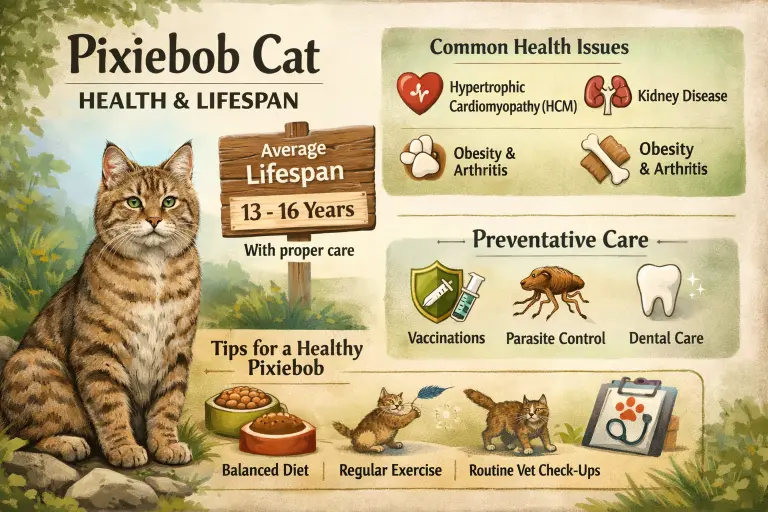
Pixiebob cats are often described as sturdy, calm, and well-balanced companions, and many owners naturally wonder how long they can expect to share life with one. On average, Pixiebob cats tend to live about 12 to 15 years, which is similar to many well-cared-for domestic cats. Some may live longer, while others may live a shorter time. These numbers are only averages, not promises or limits.
A cat’s lifespan is influenced by many small, everyday factors rather than one single thing. Where a Pixiebob lives, what it eats, how much stress it experiences, and how often it receives routine veterinary care all play a role. Two Pixiebobs from the same litter can end up with very different lifespans simply because their lives unfold differently.
Indoor living is often linked with a longer lifespan for most cats, including Pixiebobs. Cats who live indoors are generally less exposed to traffic, predators, harsh weather, and contagious diseases. That does not mean outdoor cats cannot live long lives, but it does mean they often face more risks that can shorten lifespan over time.
It is also important for owners to remember that lifespan numbers are not a measure of love or effort. A cat can be deeply loved and still face health challenges later in life. Thinking of lifespan as a flexible range rather than a fixed number helps owners focus on daily quality of life instead of worrying about the future.
Before moving into health topics, the table below gives a simple overview of how lifestyle can influence lifespan expectations.
| Living Environment | Typical Lifespan Range | General Context for Owners |
|---|---|---|
| Indoor-only | 13–16 years | Lower exposure to risks and injuries |
| Indoor with supervised outdoor time | 12–15 years | Depends on safety and environment |
| Outdoor or free-roaming | 8–12 years | Higher exposure to accidents and illness |
Are Pixiebob Cats Healthy?
Pixiebob cats are often thought of as a relatively healthy breed overall. Many owners report that their cats stay active, alert, and stable well into adulthood. However, the word “healthy” can mean different things depending on how it is used. It does not mean that Pixiebobs are immune to illness or guaranteed a problem-free life.
Like all cats, Pixiebobs can experience health issues at different stages of life. Some concerns are linked to genetics, while others are related to age, lifestyle, or general feline biology. Being a recognized breed does not automatically make a cat more fragile, but it also does not remove normal health risks that all cats share.
One helpful way to think about health is as a moving picture rather than a fixed label. A Pixiebob kitten may appear very healthy but still need careful monitoring as it grows. An adult Pixiebob may seem strong and calm but could develop subtle changes that deserve attention. Health is shaped over time through routine care, observation, and environment.
It is also worth noting that reputable breeding practices matter. Responsible breeders aim to reduce inherited issues by making thoughtful breeding choices, but even well-bred cats can develop common feline conditions later in life. This is normal and not a failure on the part of the owner or the cat.
Common Pixiebob Health Issues to Be Aware Of
This section is about awareness, not prediction. Many Pixiebob cats never experience serious health problems, but understanding common feline health themes helps owners notice changes earlier and respond calmly. Some health considerations discussed in relation to Pixiebobs are also common in cats of many breeds.
Certain inherited or structural traits may be mentioned in breed discussions, but these are usually described as possibilities rather than frequent outcomes. In everyday life, Pixiebob cats are more likely to face the same issues that affect many adult and senior cats, especially if those issues are related to weight, dental care, or aging.
Chronic conditions develop slowly and may show mild signs at first, while acute issues tend to appear suddenly. Owners are not expected to tell the difference, but noticing patterns such as gradual behavior changes or repeated discomfort can be helpful information for a veterinarian.
The table below summarizes common health considerations at a very high level, without diagnosing or ranking severity.
| Health Area | What This Means in Simple Terms | Owner Awareness Level |
|---|---|---|
| Dental health | Teeth and gums can change with age | Very common in many cats |
| Weight and body condition | Extra weight can stress joints and organs | Common and manageable |
| Urinary health | Litter box habits may change over time | Seen across many breeds |
| Kidney function | Changes often appear in older cats | Age-related concern |
| Digestive sensitivity | Some cats react to diet or stress | Individual variation |
It is important not to read this table as a list of expected problems. Instead, it works as a map of areas owners and veterinarians often keep an eye on over a cat’s lifetime.
How to Support a Healthy, Long Life for a Pixiebob
Supporting a Pixiebob’s health is mostly about steady habits, not dramatic actions. Small, consistent choices tend to matter more than occasional big changes. Many cats thrive when their routines are predictable and their environment feels safe and calm.
Regular veterinary visits play a central role in preventive care. These visits allow professionals to notice subtle changes that owners may not see at home. Early awareness can make a big difference in how health changes are managed over time, even when no treatment is needed right away.
Daily life also matters. A balanced diet suited to the cat’s age, access to fresh water, gentle play, and a clean litter box all support overall wellness. Mental health is part of physical health too. Cats who feel secure and engaged often show clearer behavior signals when something feels off.
As Pixiebobs grow older, their needs may shift. Activity levels can change, sleep patterns may increase, and preferences for warmth or quiet may become stronger. Adjusting the home environment to match these changes can improve comfort and quality of life.
The table below highlights simple preventive habits that support longevity without becoming overwhelming.
| Preventive Habit | Why It Matters | How Often to Think About It |
|---|---|---|
| Routine vet checkups | Tracks health changes early | Yearly or as advised |
| Weight monitoring | Helps protect joints and organs | Ongoing |
| Dental awareness | Supports eating and comfort | Ongoing |
| Clean living space | Reduces stress and illness | Daily |
| Gentle play and movement | Maintains mobility and mental health | Daily or weekly |
Signs Pixiebob Owners Should Not Ignore
All cats communicate discomfort in quiet ways, and Pixiebobs are no different. Owners do not need medical knowledge to notice when something feels off. Paying attention to changes, rather than isolated moments, is often the most helpful approach.
Behavior changes are especially important. A friendly cat who suddenly hides, a calm cat who becomes irritable, or a playful cat who loses interest in movement may be signaling discomfort. These changes do not point to a specific problem, but they do suggest that a professional opinion is needed.
Physical signs also matter. Changes in appetite, drinking, grooming, or litter box use are common reasons owners decide to consult a veterinarian. These signs are not emergencies in every case, but they are worth taking seriously, especially if they last more than a short time.
Owners sometimes worry about “overreacting,” but seeking guidance early is generally seen as responsible care. It is not about panic, but about partnership with a veterinary professional who can help interpret what is normal and what needs attention.Pixiebob cats, like all cats, benefit most from calm observation, routine care, and a stable home. While no guide can predict an individual cat’s future health, understanding lifespan ranges and general health themes helps owners feel more prepared and confident.For additional educational resources on feline health and aging, you may find this helpful:
https://catfriendly.com

Ata Ur Rehman is the founder of Pet Age in Human Years Calculator, an educational platform that provides age conversion charts and lifespan guides for dogs, cats, birds, and other companion animals. His work focuses on helping pet owners understand how animal ages translate into human years using commonly accepted age conversion formulas and published lifespan averages.
The website compiles breed and species lifespan data from kennel clubs, breed organizations, and general animal lifespan studies to present simple and easy-to-understand guides for pet owners worldwide.
This website was created to centralize animal age conversion charts into one easy reference platform for pet owners.